




























Views
Downloads


Complete DNA Error Analysis Worksheet | Grades 8–12 Science

Paste this activity's link or code into your existing LMS (Google Classroom, Canvas, Teams, Schoology, Moodle, etc.).
Students can open and work on the activity right away, with no student login required.
You'll still be able to track student progress and results from your teacher account.
This DNA structure error analysis worksheet challenges students in Grades 8–12 to identify, correct, and justify common misconceptions about double helix architecture, nucleotide components, and complementary base pairing. By evaluating peer claims against structural diagrams and empirical Chargaff data, learners deepen conceptual understanding and build rigorous scientific argumentation skills.
At a Glance
- Grade: Grades 8–12 · Subject: Science
- Standard: Analyze models and empirical data to explain DNA structure and base pairing
- Skill Focus: DNA structure error analysis and claim justification
- Format: 3 pages · 19 problems · Answer key included · PDF
- Best For: Mid-unit formative assessment or review
- Time: 35–45 minutes
What's Inside
This 3-page printable science resource contains 19 targeted analytical tasks across three parts. Students work with structural diagrams of the double helix and an isolated nucleotide alongside a quantitative Chargaff base percentage table. Tasks combine multi-select error diagnosis with constructed responses where students correct false claims. A complete 3-page answer key provides thorough model justifications to streamline grading.
Skill Progression
- Guided practice (Tasks 1–4): Students label the double helix model and verify basic hydrogen bonding rules.
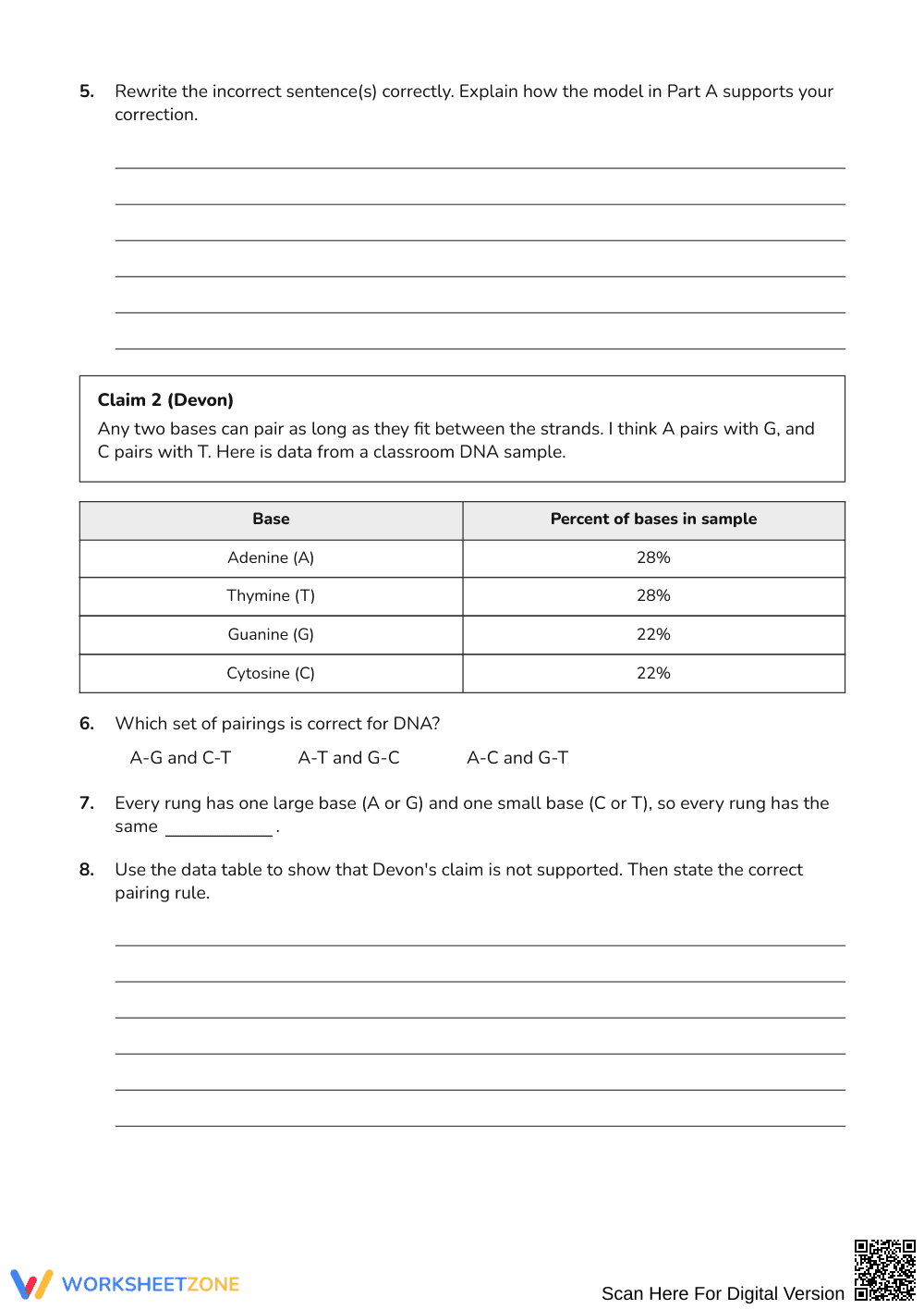
- Supported practice (Tasks 5–13): Students evaluate peer claims on antiparallel backbones and base pairing, using Chargaff data to disprove errors.
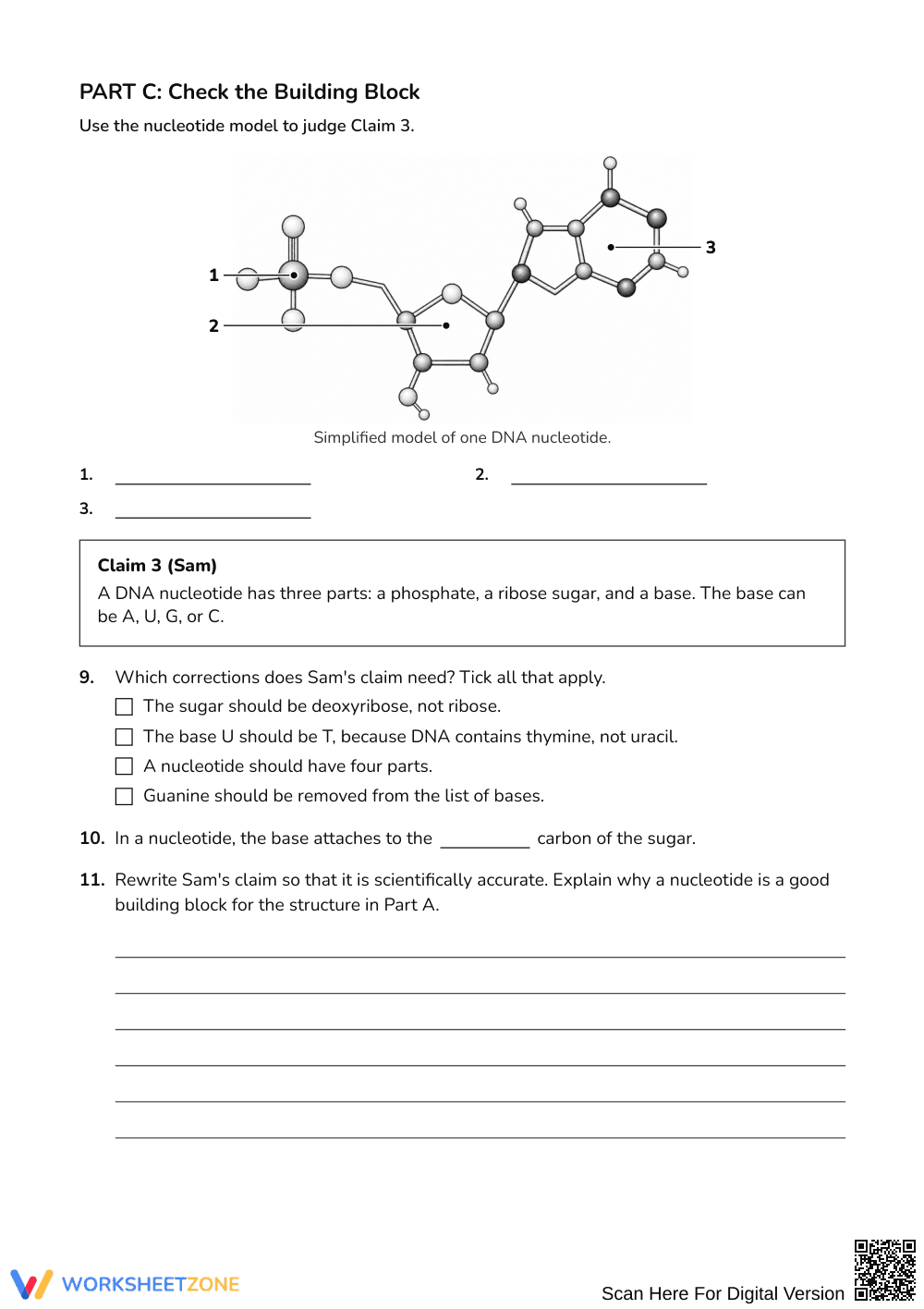
- Independent practice (Tasks 14–19): Students critique nucleotide components, correct sugar and base errors, and explain macromolecule assembly.
This structure follows a gradual-release model, moving learners from diagram identification to evidence-based claim evaluation.
Standards Alignment
This resource aligns with high school life science standards requiring students to construct explanations based on evidence for how DNA structure determines hereditary function. Supporting standards include analyzing data to validate complementary base pairing rules. Both standard codes can be copied directly into lesson plans, IEP goals, or district curriculum mapping tools.
How to Use It
Deploy this worksheet after direct instruction on molecular genetics. Use Parts A and B as a collaborative partner activity; observe whether students use Devon's data table to refute base pairing errors rather than relying solely on memory. Assign Part C as an independent exit check. Expect completion to take 35 to 45 minutes.
Who It's For
This activity suits Grades 8–12 biology students and life science classes needing rigorous concept verification. Sentence frames assist multilingual learners during written justifications, while data tables offer extension for advanced students. Pair this worksheet directly with a double helix physical modeling lab or an introductory nucleic acids lesson.
This Grades 8–12 DNA structure worksheet targets misconception analysis, error correction, and scientific argumentation across 19 scaffolded tasks. According to Fisher & Frey (2014), evaluating and correcting non-examples directly deepens student mastery within the gradual release of responsibility framework, transforming passive diagram memorization into active inquiry. Rather than simply repeating definitions, students critically interrogate peer claims regarding antiparallel backbones, base pairing rules, and nucleotide chemistry using diagrammatic models and quantitative Chargaff data. The resource includes a complete three-page answer key that guides educators through student reasoning patterns and common biological misunderstandings. Structured across three progressive stages, this print-ready worksheet equips secondary science students to synthesize structural evidence, refute invalid scientific claims, and construct precise justifications of nucleic acid architecture. It functions effectively as an evidence-based formative assessment, collaborative review lesson, or targeted intervention tool for general and advanced biology classrooms.


