


























Views
Downloads

Complete Dividing Mixed Numbers Worksheet | Grade 6 Math
Paste this activity's link or code into your existing LMS (Google Classroom, Canvas, Teams, Schoology, Moodle, etc.).
Students can open and work on the activity right away, with no student login required.
You'll still be able to track student progress and results from your teacher account.
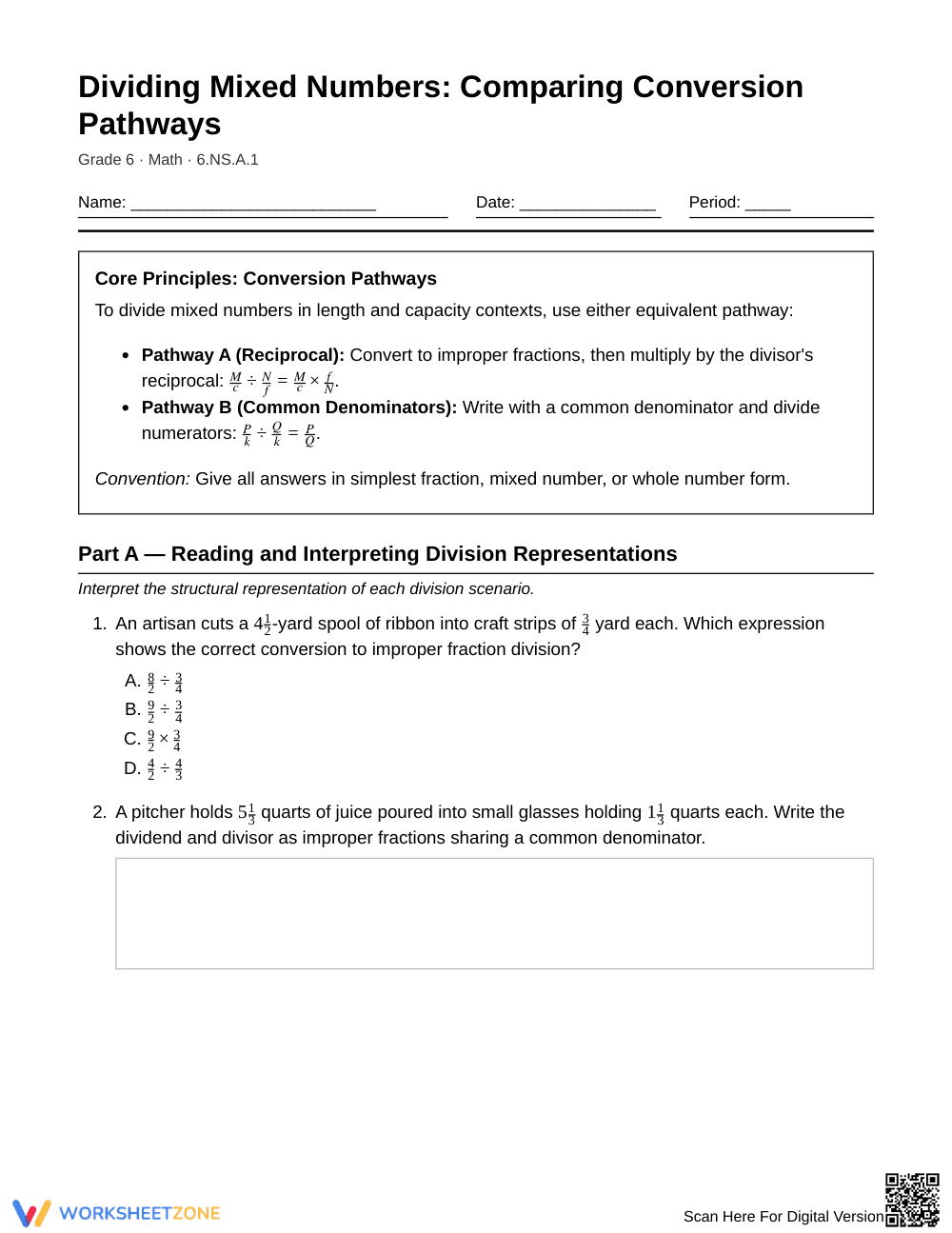
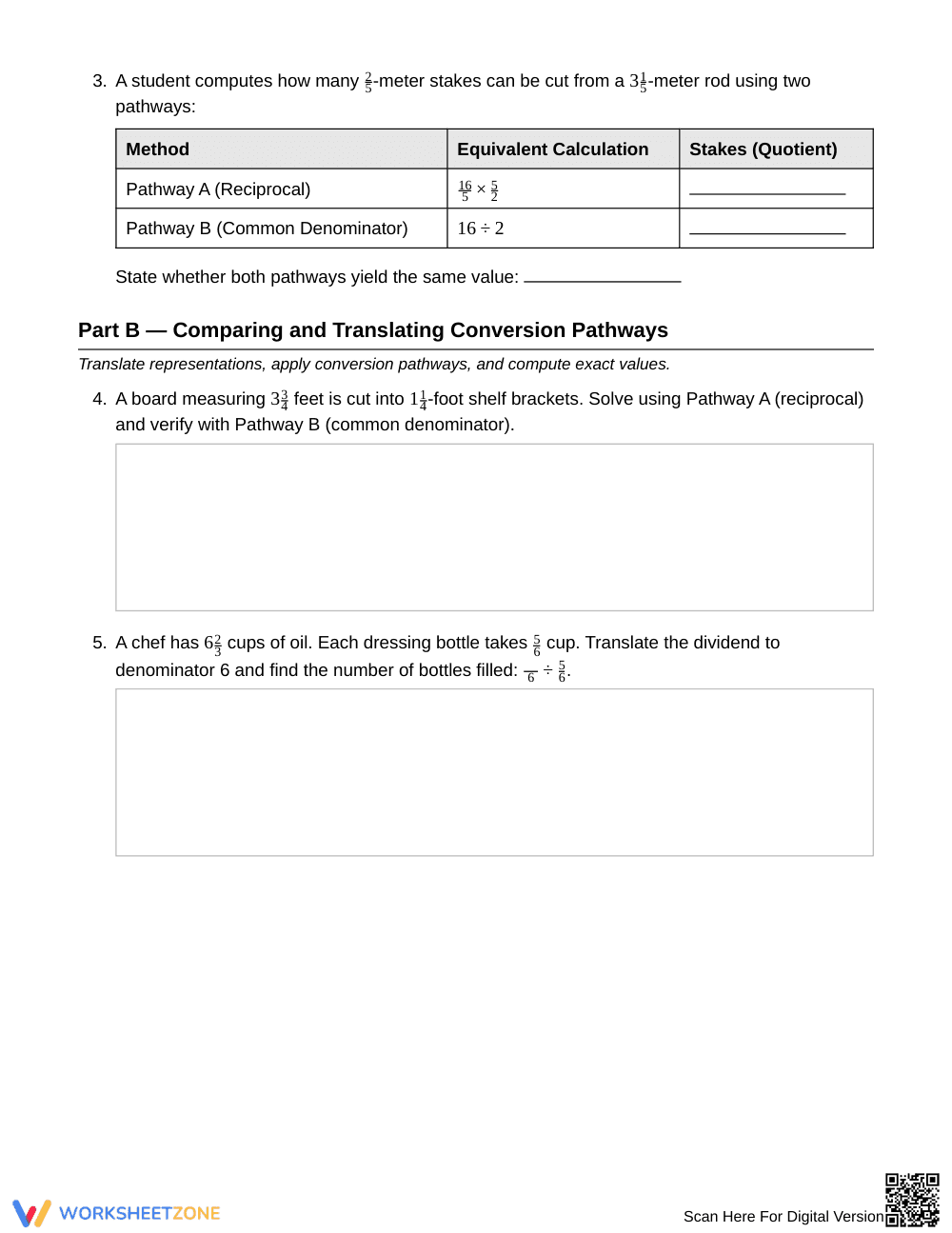
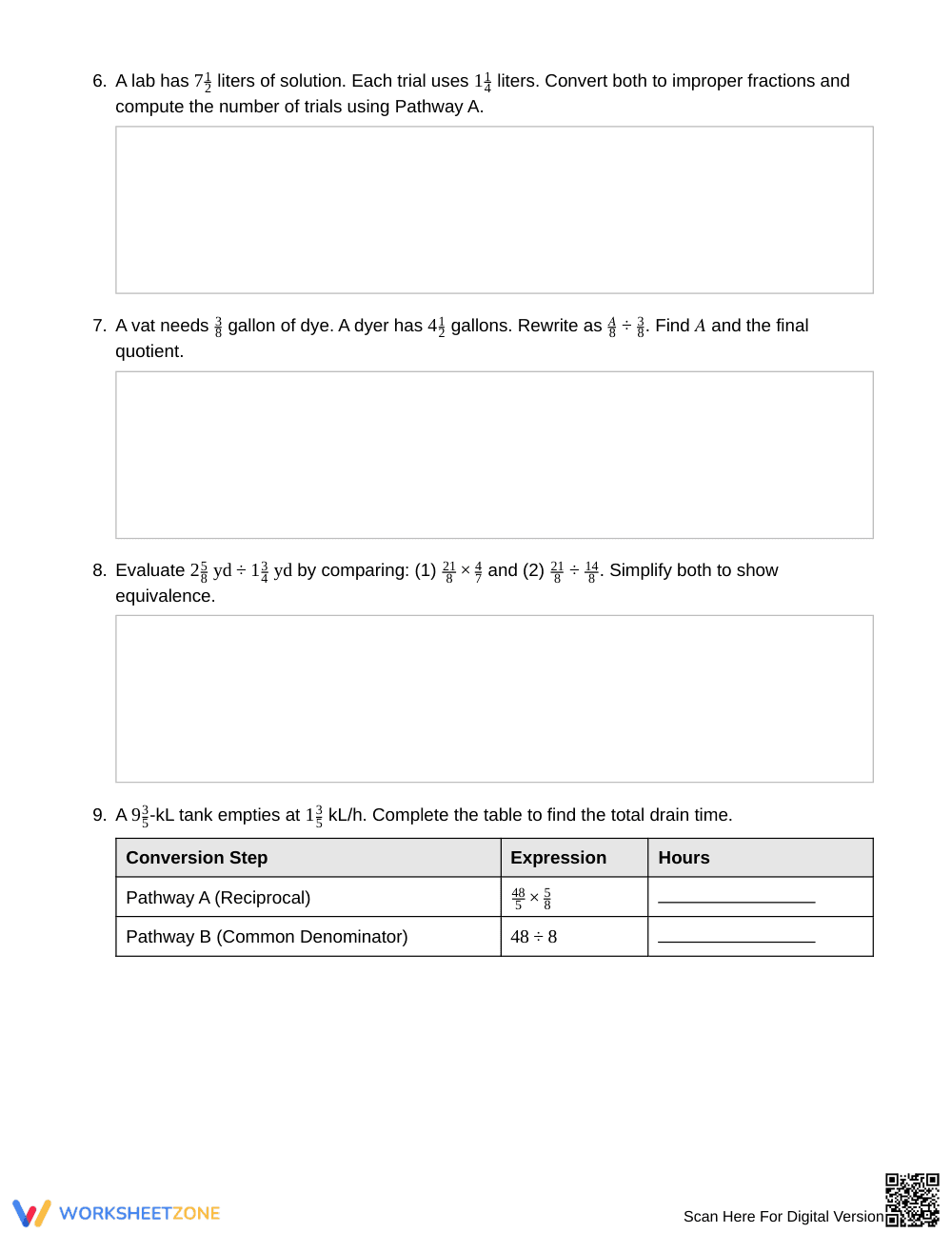
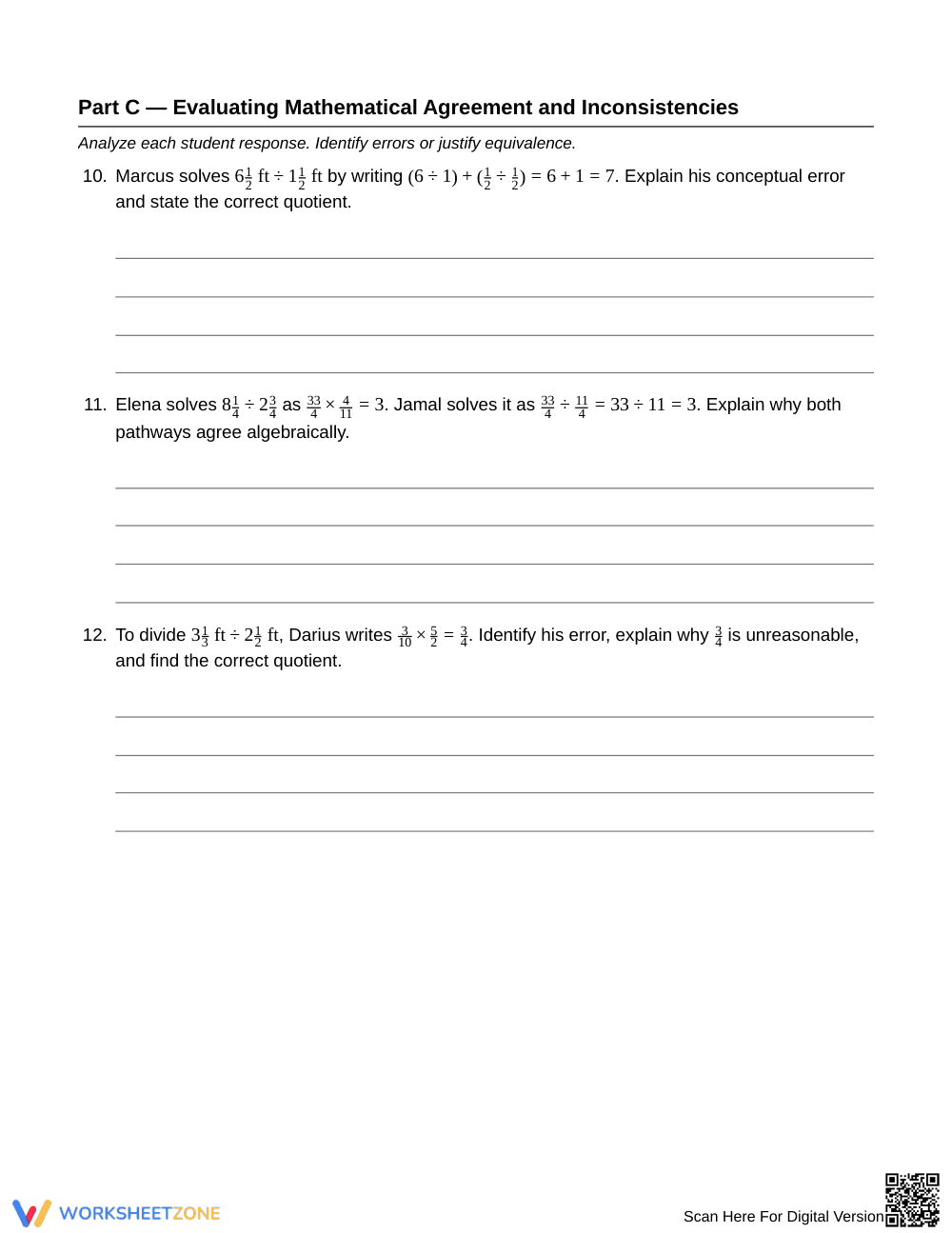
This Grade 6 math worksheet builds conceptual understanding and procedural fluency in dividing mixed numbers by comparing conversion pathways. Students solve contextual problems using reciprocal multiplication and common denominator division, developing algebraic reasoning and error analysis skills across 12 structured mathematical tasks.
At a Glance
- Grade: 6 · Subject: Math
- Standard:
6.NS.A.1— Compute quotients of fractions and solve mixed number division problems- Skill Focus: Compare Conversion Pathways
- Format: 4 pages · 12 problems · Answer key included · PDF
- Best For: Guided practice and conceptual error analysis
- Time: 35–45 minutes
What's Inside
The 4-page worksheet includes a Core Principles rule box defining reciprocal and common denominator pathways. Across three sections, students complete 12 problems featuring multiple-choice conceptual models, comparative calculation tables, contextual measurement tasks, and student error critique items. A 2-page answer key provides complete step-by-step solutions.
Skill Progression
- Guided practice (Part A, 3 problems): Students interpret division representations, identify fraction conversions, and complete comparison tables using visual and structural prompts.
- Supported practice (Part B, 6 problems): Learners solve measurement word problems using reciprocal multiplication and verify equivalence via common denominators.
- Independent practice (Part C, 3 problems): Students analyze authentic student work, identify conceptual errors, and construct algebraic justifications for equivalence.
This sequence follows a gradual-release model, moving from structured visual interpretation to independent error diagnosis.
Standards Alignment
This worksheet aligns directly with `6.NS.A.1`, requiring students to compute quotients of fractions and solve mixed number division word problems. It also supports `6.EE.A.3` through equivalence verification. Both standard codes can be copied directly into lesson plans, IEP goals, or district curriculum mapping tools.
How to Use It
Use this resource after introducing fraction division algorithms for partner practice or small-group intervention. Alternatively, assign Part C as a mid-unit formative assessment check. Watch for students incorrectly dividing whole parts separately from fractional parts. Expect completion in 35 to 45 minutes.
Who It's For
This activity is designed for Grade 6 math students and tier-2 intervention groups needing conceptual reinforcement. The dual-pathway layout supports visual learners and English language learners. Pair this worksheet with an anchor chart on fraction division models.
Aligned to Common Core standard `6.NS.A.1`, this Grade 6 mathematics resource builds mastery in dividing mixed numbers by actively comparing conversion pathways. Students transition from converting mixed numbers into improper fractions to evaluating mathematical equivalence through reciprocal multiplication and common denominator division. According to research synthesized by Fisher & Frey (2014), engaging students in structured comparative analysis and deliberate error detection deepens conceptual understanding and strengthens algorithmic flexibility far more effectively than isolated procedural drills. The inclusion of real-world measurement scenarios—such as cutting ribbon, pouring liquids, and draining tanks—anchors abstract fractional operations in authentic physical contexts. By systematically critiquing authentic student misconceptions alongside procedural practice, learners develop metacognitive monitoring habits and robust algebraic reasoning. This 4-page worksheet with 12 targeted tasks delivers evidence-based practice suitable for core instruction, collaborative problem-solving, and targeted intervention.


