


























Views
Downloads



Complete Dividing Fractions Worksheet | Grade 6 Math
Paste this activity's link or code into your existing LMS (Google Classroom, Canvas, Teams, Schoology, Moodle, etc.).
Students can open and work on the activity right away, with no student login required.
You'll still be able to track student progress and results from your teacher account.
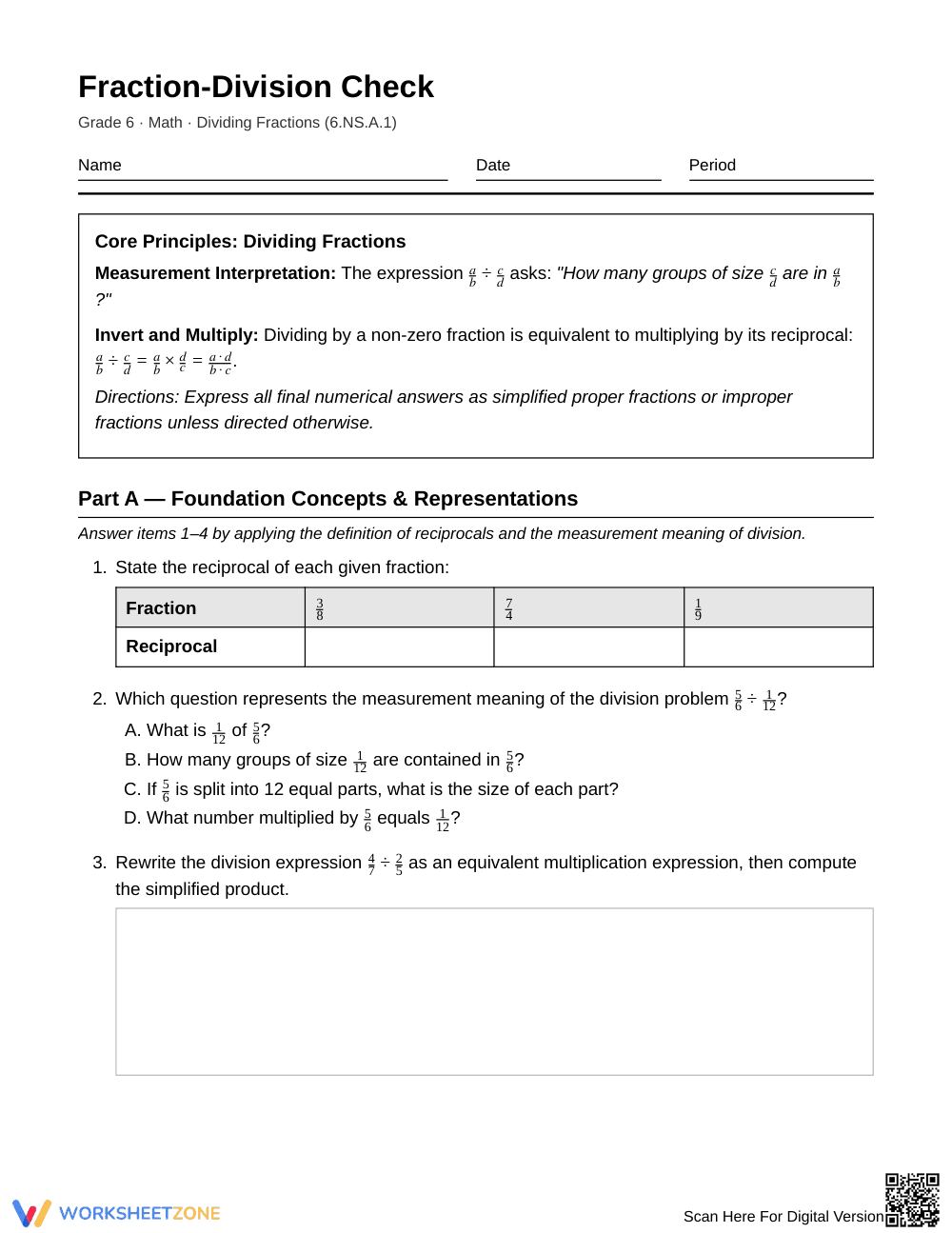
This dividing fractions worksheet develops conceptual understanding and procedural fluency for Grade 6 students. Learners examine measurement division models, apply reciprocals, and solve multi-step real-world problems, moving systematically from foundational visual concepts to algebraic reasoning and error analysis.
At a Glance
- Grade: 6 · Subject: Math
- Standard:
6.NS.A.1— Compute quotients of fractions and solve division word problems- Skill Focus: Dividing Fractions
- Format: 5 pages · 16 problems · Answer key included · PDF
- Best For: Practice, intervention, and review
- Time: 40–50 minutes
What's Inside
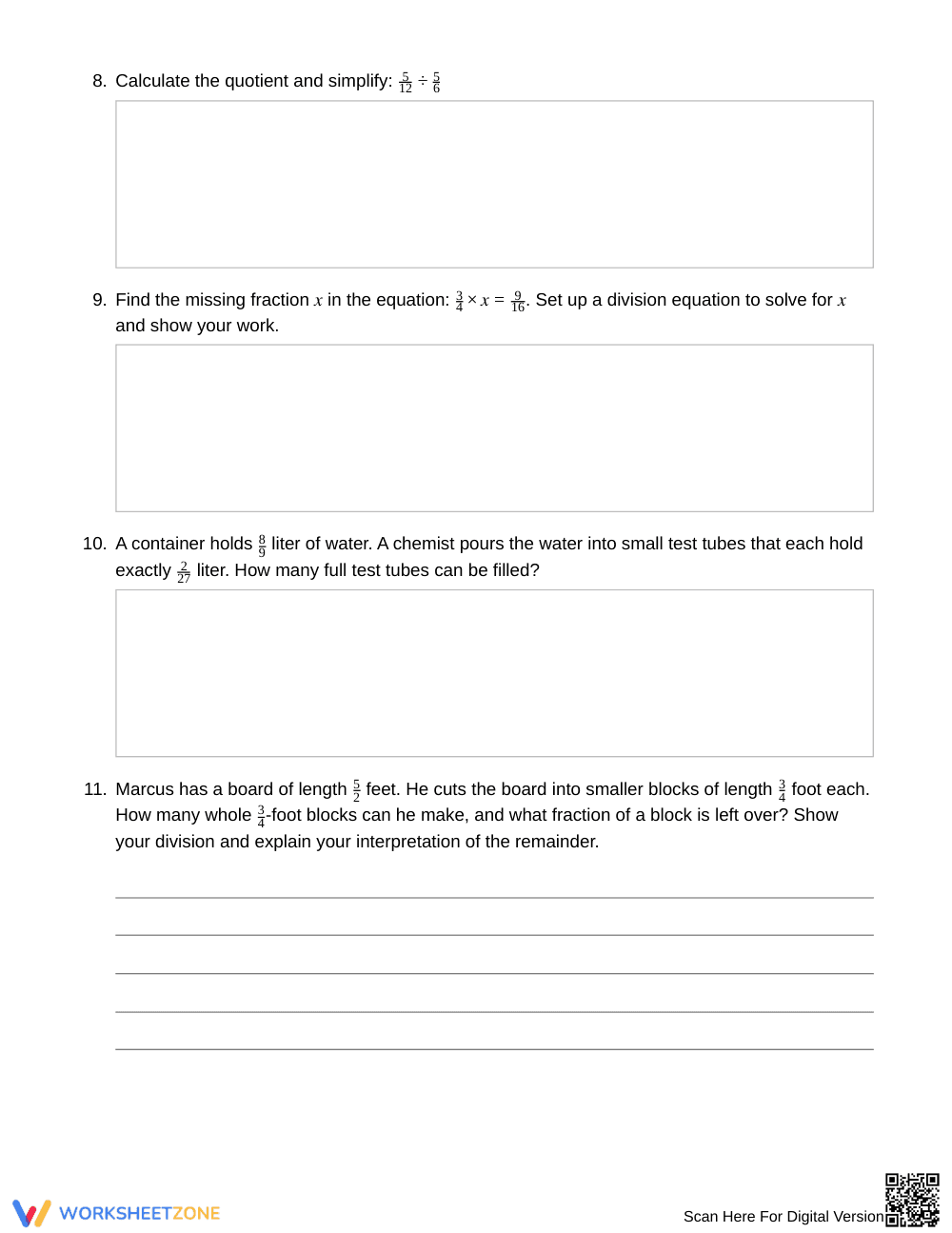
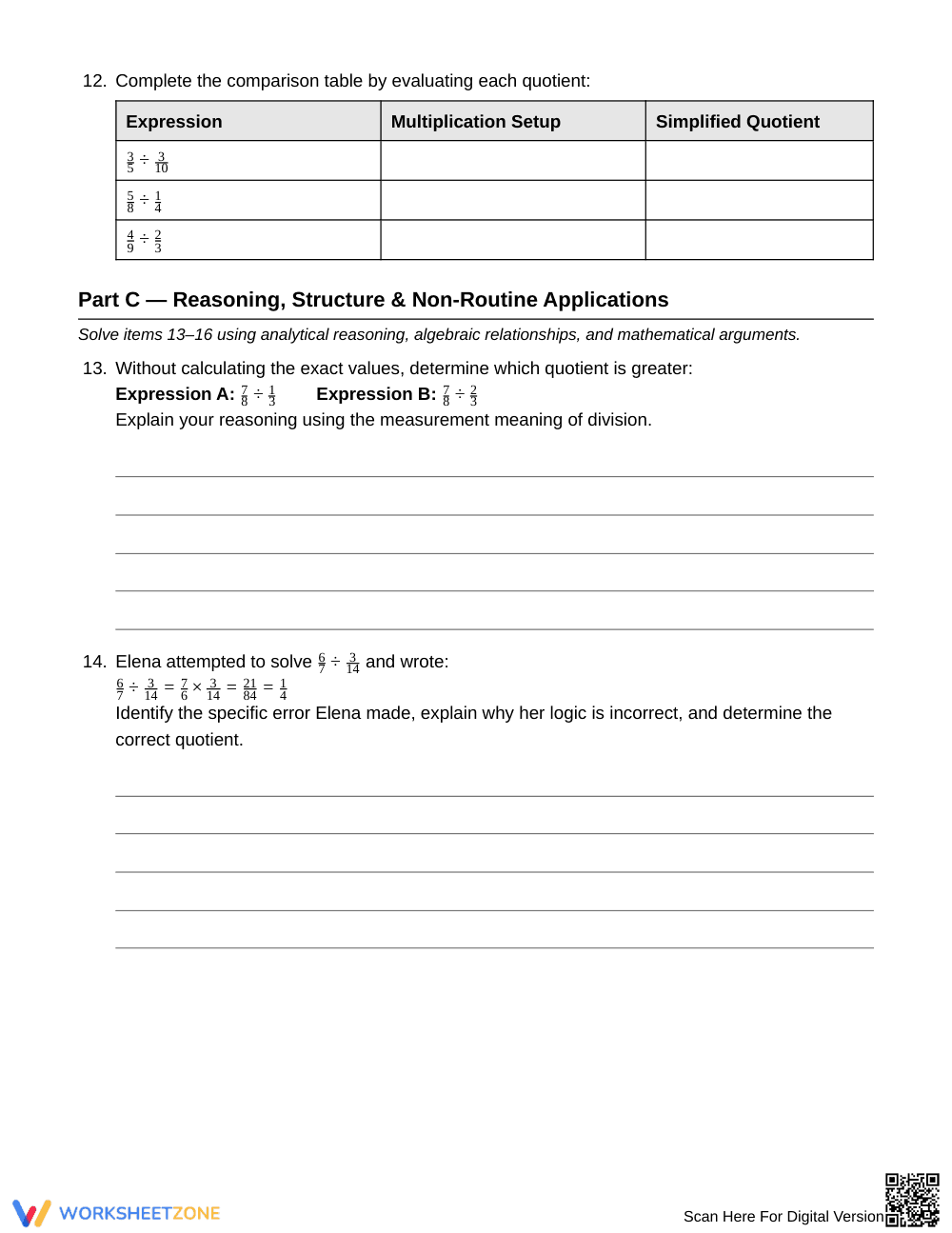
This 5-page worksheet provides 16 multi-part tasks organized into three progressive sections with a core principles reference box. Activities include reciprocal tables, conceptual multiple-choice items, equation solving, word problems with remainders, and quotient comparisons. A full 3-page answer key provides complete step-by-step solutions.
Skill Progression
- Guided Practice (Part A, Items 1–4): Reciprocal identification and measurement division models with direct reference cues.
- Supported Practice (Part B, Items 5–12): Standard division computation, missing-factor equations, and word problems with remainders.
- Independent Practice (Part C, Items 13–16): Advanced comparative reasoning, error analysis, variable generalizations, and multi-step area applications.
This structure follows a gradual-release model, fostering procedural confidence before demanding abstract generalization.
Standards Alignment
Aligned directly to `6.NS.A.1`: Interpret and compute quotients of fractions, and solve word problems involving fraction division. Supporting standard `6.EE.B.7` connects division to one-step algebraic equations. Both standard codes can be copied directly into lesson plans, IEP goals, or district curriculum mapping tools.
How to Use It
Assign after direct instruction on the invert-and-multiply algorithm to reinforce conceptual understanding. In small intervention groups, prompt students to explain the measurement meaning of remainders in Part B. As a formative assessment, check whether students invert the correct term in Part C's error analysis. Expected completion takes 40–50 minutes.
Who It's For
Ideal for Grade 6 general math classrooms, Tier 2 math intervention, or Grade 5 enrichment. For learners needing support, pair with a fraction bar anchor chart or manipulatives. Advanced students can explore the algebraic variable relationships in Part C.
Mastering fraction division under standard 6.NS.A.1 requires students to connect procedural algorithms with conceptual measurement models. According to Fisher & Frey (2014), structured gradual-release instructional frameworks substantially improve student retention of rational number operations by scaffolding basic definitions into complex analytical reasoning. This 16-task resource supports that progression by guiding Grade 6 students from reciprocal identification and conceptual interpretations to advanced error analysis and algebraic generalizations. By situating division expressions within applied measurement contexts, such as cutting ribbons or dividing container capacities, learners develop robust mental schemas alongside computational accuracy. Research confirms that middle school students who understand the underlying structural mechanics of fractional division demonstrate greater problem-solving flexibility than those relying solely on rote calculation. This comprehensive worksheet delivers an evidence-based resource for standards-aligned core instruction, targeted math intervention, and ongoing progress monitoring.


