




























Views
Downloads



Complete Diffusion & Transport Worksheet | Grade 7 Science

Paste this activity's link or code into your existing LMS (Google Classroom, Canvas, Teams, Schoology, Moodle, etc.).
Students can open and work on the activity right away, with no student login required.
You'll still be able to track student progress and results from your teacher account.
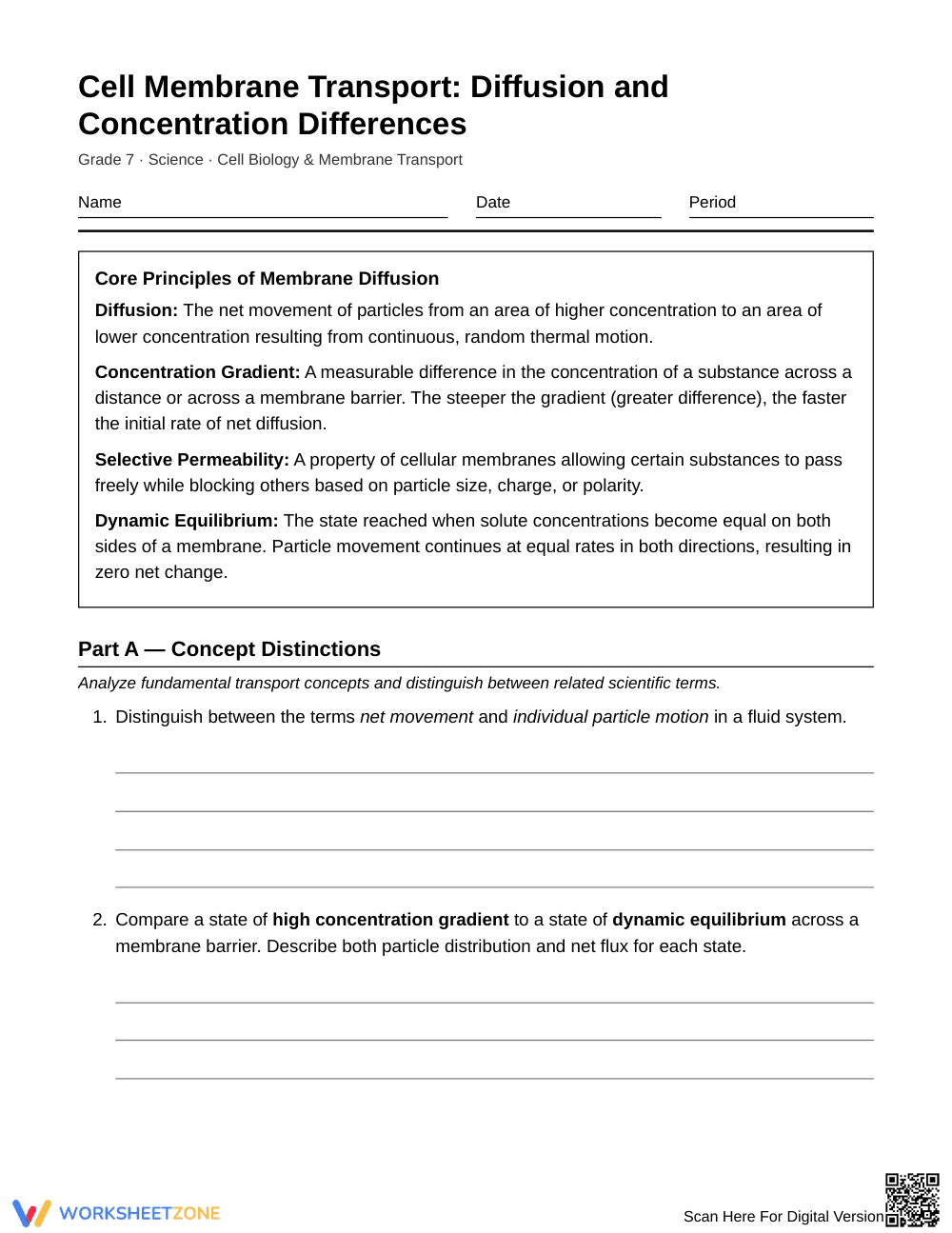
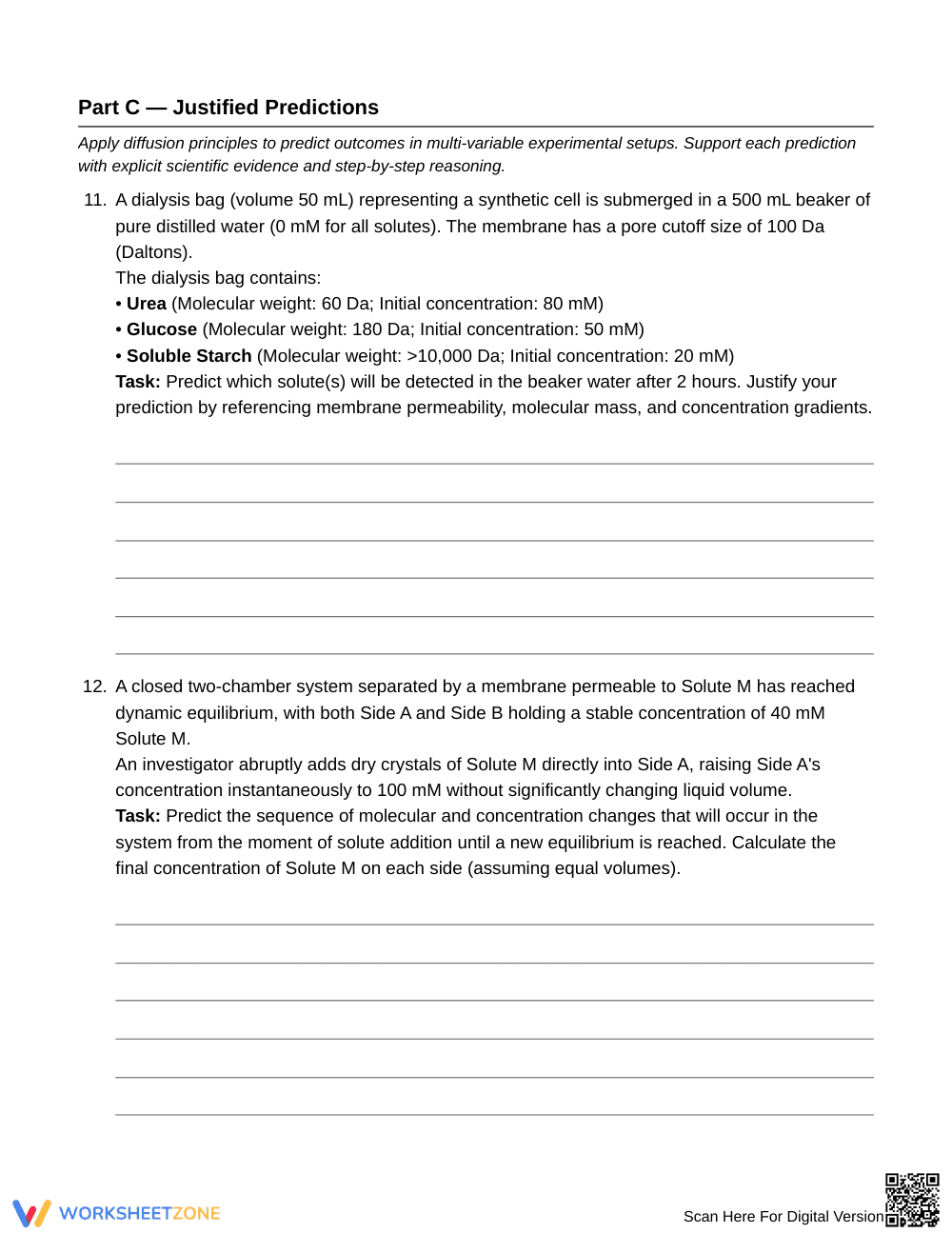
This comprehensive science worksheet guides middle school students through the cellular mechanics of passive transport, molecular kinetic motion, and concentration gradients. Learners evaluate synthetic membrane setups, analyze rate data across varying temperatures, and calculate equilibrium solute distributions to build a rigorous conceptual understanding of membrane transport across fluid systems.
At a Glance
- Grade: 7 · Subject: Science
- Standard: Middle School Life Science — Model the movement of matter across semipermeable cellular membrane barriers
- Skill Focus: Diffusion and Concentration Differences
- Format: 5 pages · 12 problems · Answer key included · PDF
- Best For: Guided practice or post-lab analysis
- Time: 40–55 minutes
What's Inside
The resource features 5 instructional pages organized into three structured sections containing 12 rigorous analytical tasks. It begins with a core principles reference box defining dynamic equilibrium, selective permeability, and concentration gradients, followed by multi-step data interpretation tables, U-tube apparatus scenarios, dialysis bag molecular cutoffs, and a 3-page complete explanatory answer key.
Skill Progression
- Guided Practice (Part A, Tasks 1–4): Builds foundational precision by prompting students to distinguish net movement from random molecular motion, compare gradient states, and differentiate passive diffusion from active cellular transport.
- Supported Practice (Part B, Tasks 5–10): Applies kinetic molecular theory and gradient calculations to synthetic models, U-tube scenarios, temperature-rate tables, and common scientific misconceptions.
- Independent Practice (Part C, Tasks 11–12): Demands justified multi-step predictions regarding Dalton molecular weight cutoffs in dialysis systems and equilibrium re-establishment following solute additions.
This sequence supports the I Do, We Do, You Do instructional framework by moving from foundational vocabulary analysis to complex multi-variable prediction.
Standards Alignment
This worksheet aligns with middle school life science standards focusing on cellular structure and transport functions. Students develop and use models to describe how substances move across selectively permeable membranes down concentration gradients to maintain homeostasis without cellular energy input. Both standard codes can be copied directly into lesson plans, IEP goals, or district curriculum mapping tools.
How to Use It
Assign this worksheet immediately after direct instruction on passive transport or as an analytical follow-up to a dialysis tubing laboratory. During work time, formatively check student responses to Task 10 to ensure learners recognize that molecular motion continues dynamically after reaching equilibrium rather than halting. Expected completion time is 40 to 55 minutes.
Who It's For
This activity is designed for Grade 7 life science students, introductory biology classes, and academic intervention groups requiring structured scaffolding around kinetic theory. It pairs naturally with hands-on diffusion demonstrations, cellular membrane anchor charts, and microscopy investigations of plasmolysis.
According to Fisher & Frey (2014), structured scaffolds within gradual-release practice frameworks significantly increase conceptual retention when students translate abstract biological mechanisms into quantitative models. By isolating variables such as pore size, temperature, and solute concentration differences across 12 targeted tasks, this worksheet ensures learners bridge the gap between macroscopic observations and sub-microscopic molecular behavior. Providing targeted data interpretation alongside concrete physical scenarios encourages middle school learners to evaluate kinetic states critically rather than relying on rote memorization. As students progress from basic directional flow predictions to complex equilibrium calculations, they develop durable analytical reasoning skills that transfer directly to advanced life science investigations. This structured instructional progression ultimately equips middle school learners to analyze transport phenomena systematically, verify dynamic equilibrium states, justify multi-variable experimental outcomes, and correct persistent kinetic misconceptions with explanatory precision.


