




























Views
Downloads


Complete Diction & Audience Worksheet | Grade 10 English II

Paste this activity's link or code into your existing LMS (Google Classroom, Canvas, Teams, Schoology, Moodle, etc.).
Students can open and work on the activity right away, with no student login required.
You'll still be able to track student progress and results from your teacher account.
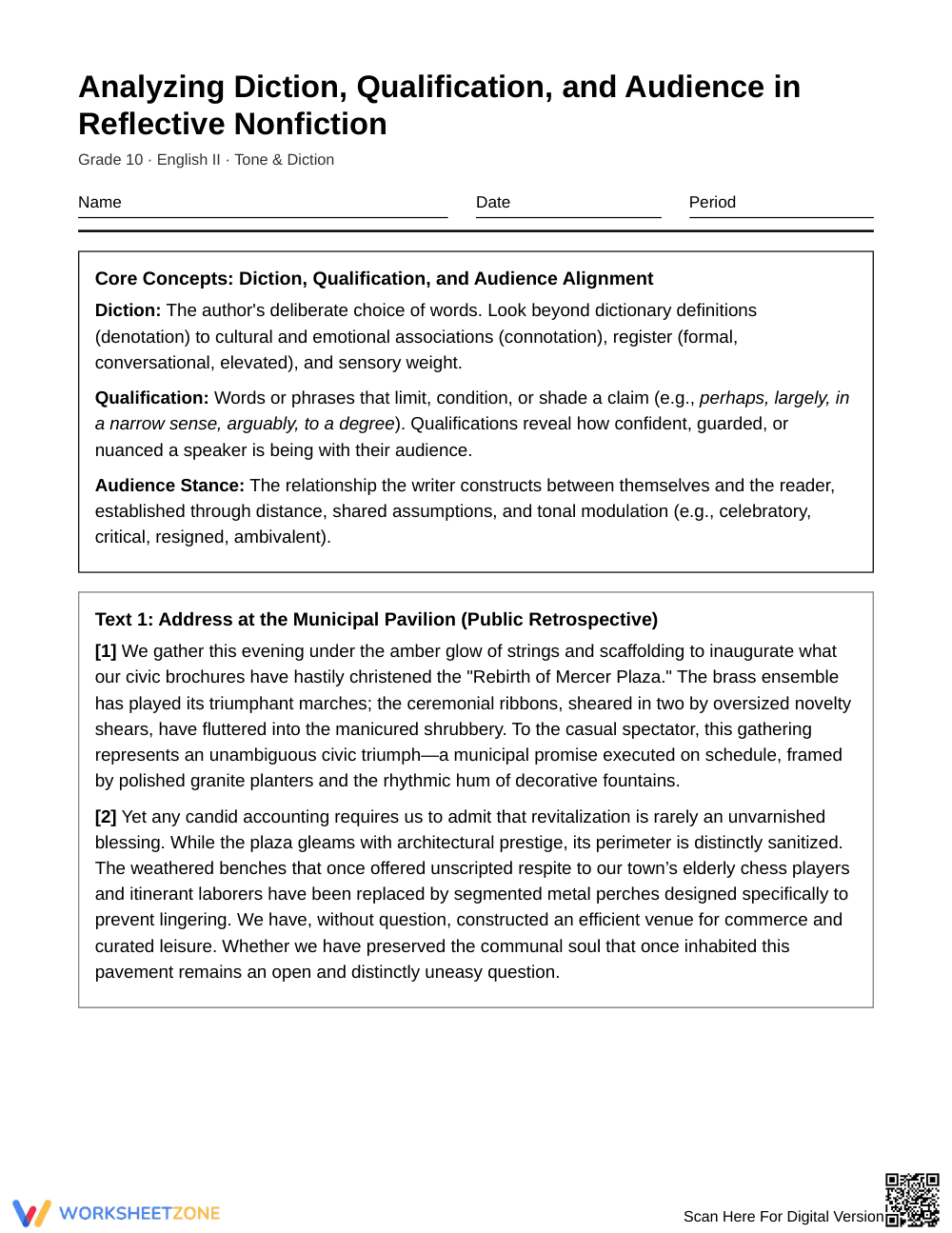
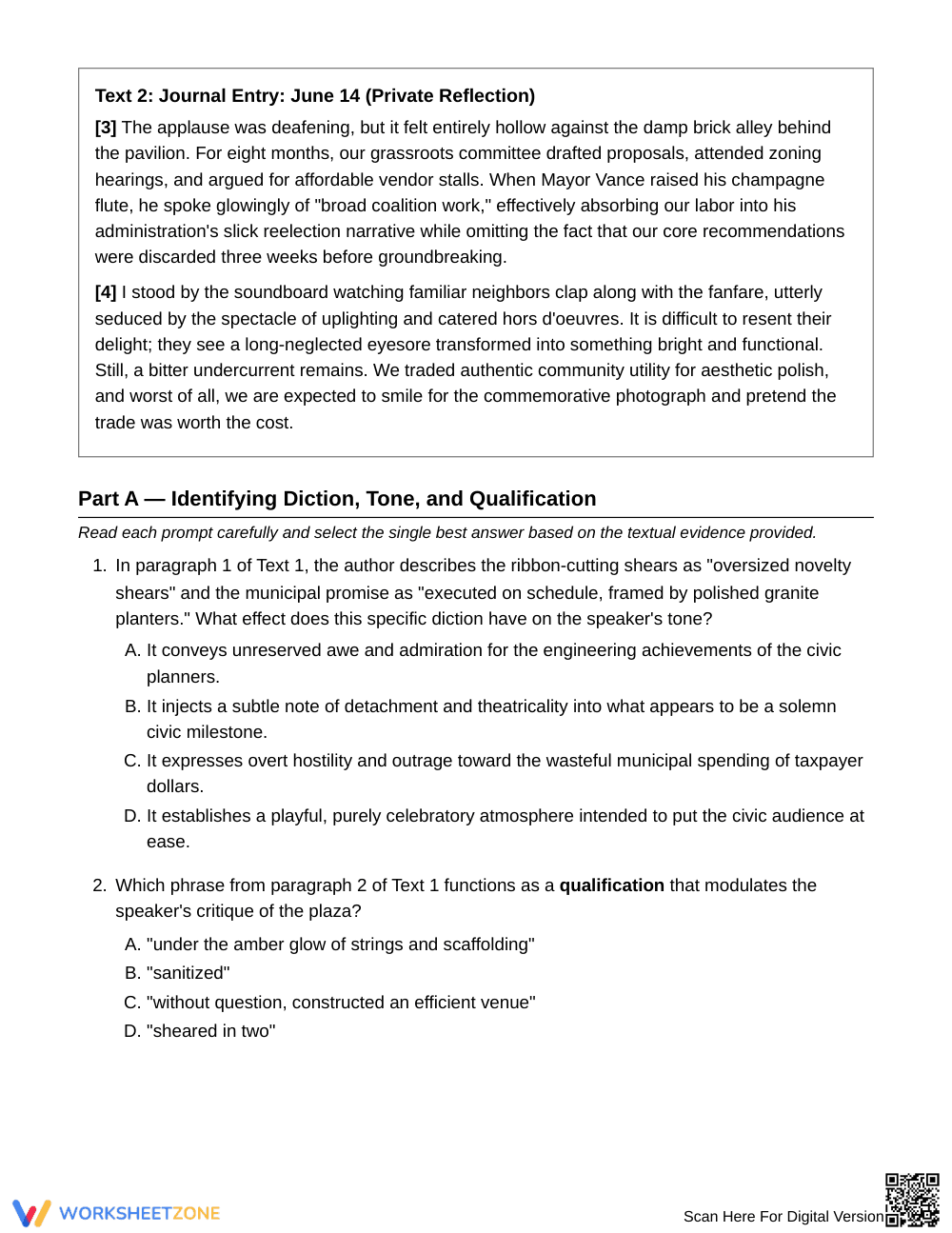
This high school English worksheet equips students to evaluate how word choice, qualification, and authorial stance interact in complex non-fiction texts. Working with paired speeches and private reflections, learners examine how nuanced phrasing reveals rhetorical intent, enabling them to deconstruct rhetorical tone and produce sophisticated literary commentary.
At a Glance
- Grade: 10 · Subject: English II
- Standard:
RI.9-10.4— Analyze the impact of specific word choices on meaning and tone- Skill Focus: Connect Diction, Qualification, and Audience
- Format: 6 pages · 12 problems · Answer key included · PDF
- Best For: Close reading and rhetorical analysis
- Time: 45–60 minutes
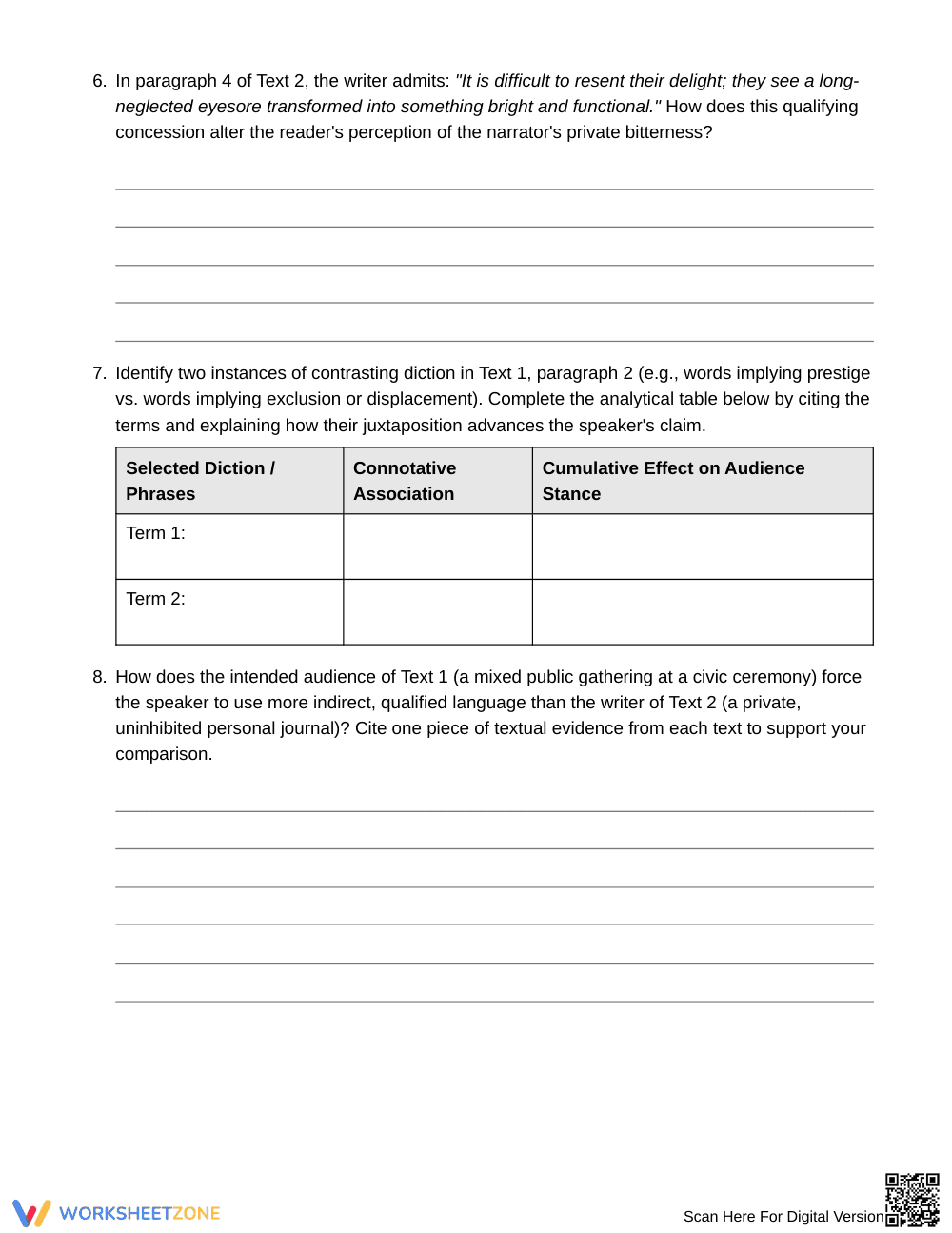
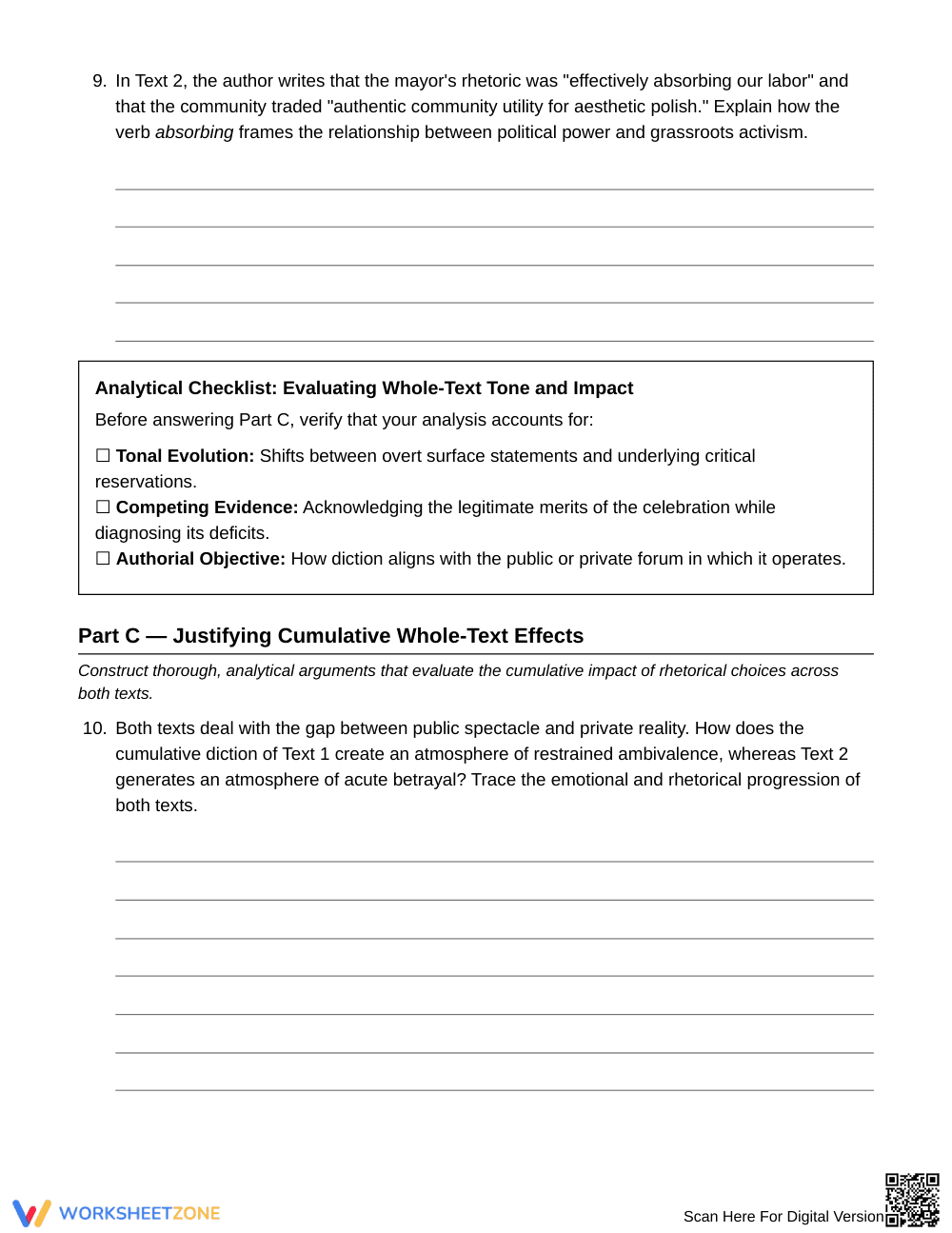
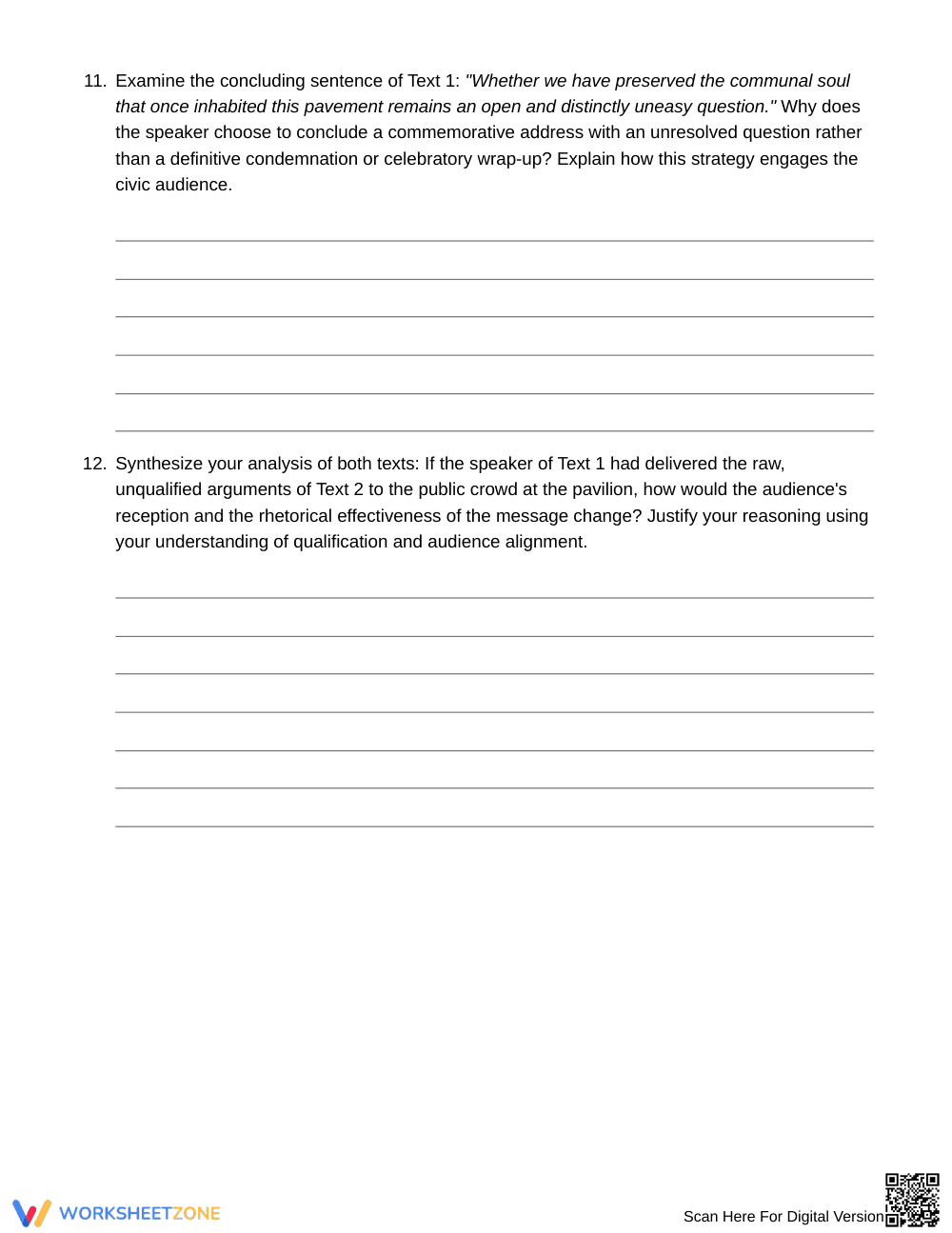
This 6-page printable packet features two contrasting companion texts about municipal redevelopment, an explicit core-concept review box, and 12 text-dependent tasks. Activities range from multiple-choice analysis to a tabular diction organizer and analytical synthesis prompts. A comprehensive 3-page answer key provides complete model responses and rationale.
Skill Progression
- Guided practice (Problems 1–3): Multiple-choice items prompt students to identify tone, recognize specific qualifying phrases, and interpret subtle connotations in context.
- Supported practice (Problems 4–9): Structured short-answer prompts and a graphic organizer require students to contrast paired vocabulary choices, trace qualifying concessions, and examine audience constraints.
- Independent practice (Problems 10–12): Extended response prompts task students with synthesizing rhetorical shifts, justifying conclusion strategies, and predicting audience reception.
This scaffolded architecture reinforces the gradual release of responsibility model, ensuring students master foundational textual identification before executing complex synthesis.
Standards Alignment
The central tasks align directly with RI.9-10.4: determine the meaning of words and phrases as they are used in a text, including figurative, connotative, and technical meanings, and analyze the cumulative impact of specific word choices on meaning and tone. As a supporting standard, RI.9-10.6 addresses determining an author's point of view or purpose in an informational text. Both standard codes can be copied directly into lesson plans, IEP goals, or district curriculum mapping tools.
How to Use It
Deploy this packet during mid-unit instruction on rhetoric or as an assessment following lessons on diction and concession. During independent work, conduct quick formative check-ins at Part B to verify whether students accurately distinguish between denotation and connotation in the graphic organizer. The entire resource takes 45 to 60 minutes to complete.
Who It's For
Designed for Grade 10 English II students, this packet supports on-level readers while offering accessible terminology boxes for developing writers. It pairs naturally with non-fiction speeches, persuasive essay units, or an anchor chart detailing the rhetoric of concessions.
Mastering standard RI.9-10.4 requires secondary students to investigate how authors manipulate diction and qualification to address particular audiences. According to Fisher & Frey (2014), intentional scaffolding that transitions from text-dependent identification to structured evaluation significantly deepens reading comprehension in secondary English language arts classrooms. This worksheet establishes that developmental pathway across 12 targeted prompts, ensuring students progress from locating connotative keywords to evaluating complex authorial intentions across competing texts. By contrasting a celebratory civic speech with a candid personal journal, learners observe directly how social setting and rhetorical purpose shape syntactic qualifiers and vocabulary register. The included analytical checklist and graphic organizer support metacognitive monitoring, which Fisher & Frey (2014) highlight as essential for sustained analytical independence. As a result, tenth-grade learners build transferable analytical frameworks that translate into sophisticated rhetorical writing, critical media evaluation, and authentic mastery of high school literacy standards.


