


























Views
Downloads




Complete Dialogue & Plot Conflict Worksheet | Grade 8 ELA
Paste this activity's link or code into your existing LMS (Google Classroom, Canvas, Teams, Schoology, Moodle, etc.).
Students can open and work on the activity right away, with no student login required.
You'll still be able to track student progress and results from your teacher account.
Mastering narrative mechanics requires students to evaluate how spoken interactions and plot events propel story action. This Grade 8 ELA worksheet guides learners through an original two-scene theatrical drama to analyze how dialogue triggers decisions, reveals motives, and ignites new conflicts under rigorous literary standards.
At a Glance
- Grade: 8 · Subject: ELA
- Standard:
RL.8.3— Analyze how dialogue or incidents propel action, reveal character, or provoke decisions- Skill Focus: Character and Plot: Link Dialogue, Response, and New Conflict
- Format: 5 pages · 12 problems · Answer key included · PDF
- Best For: Literary analysis and close-reading practice
- Time: 40–50 minutes
What's Inside
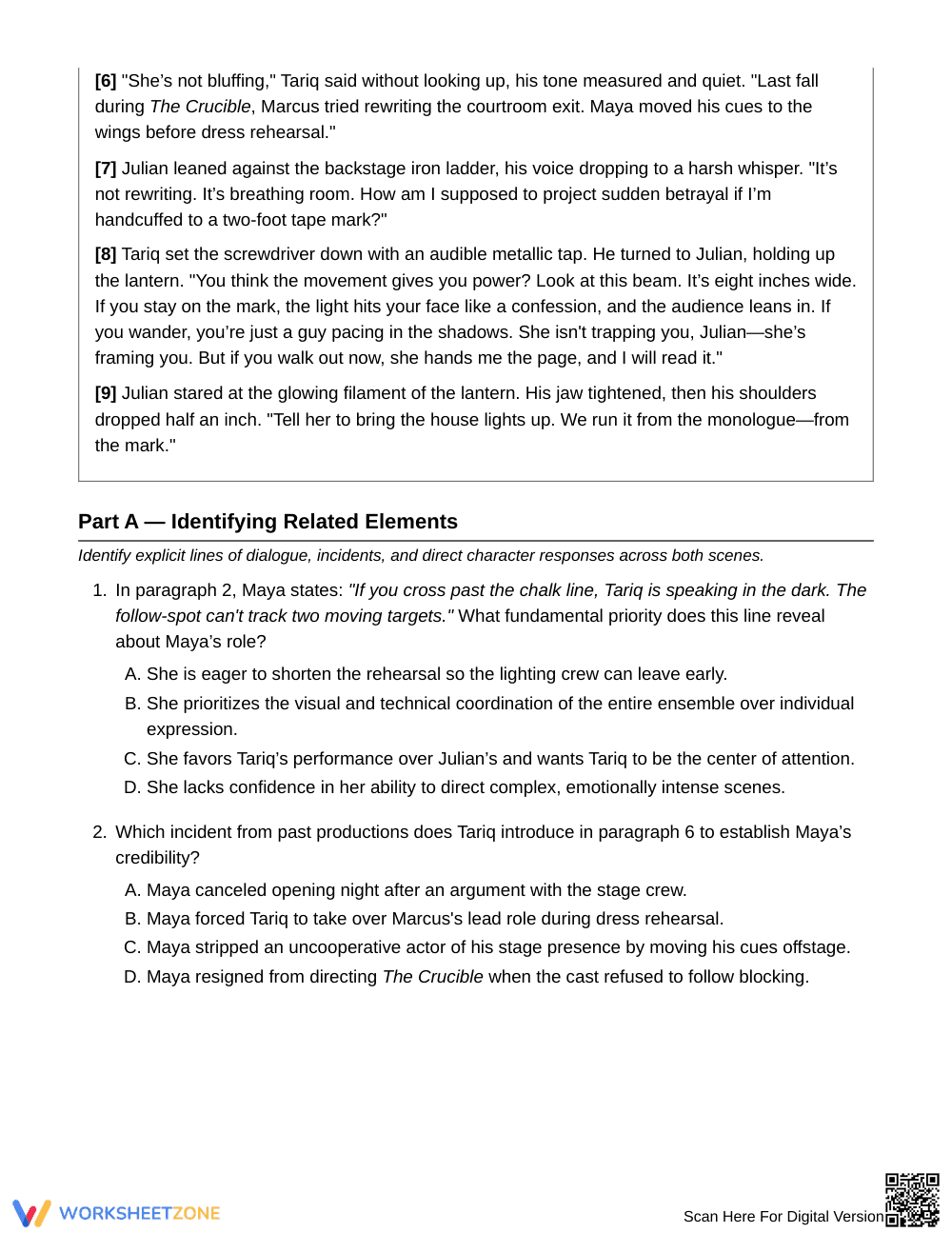
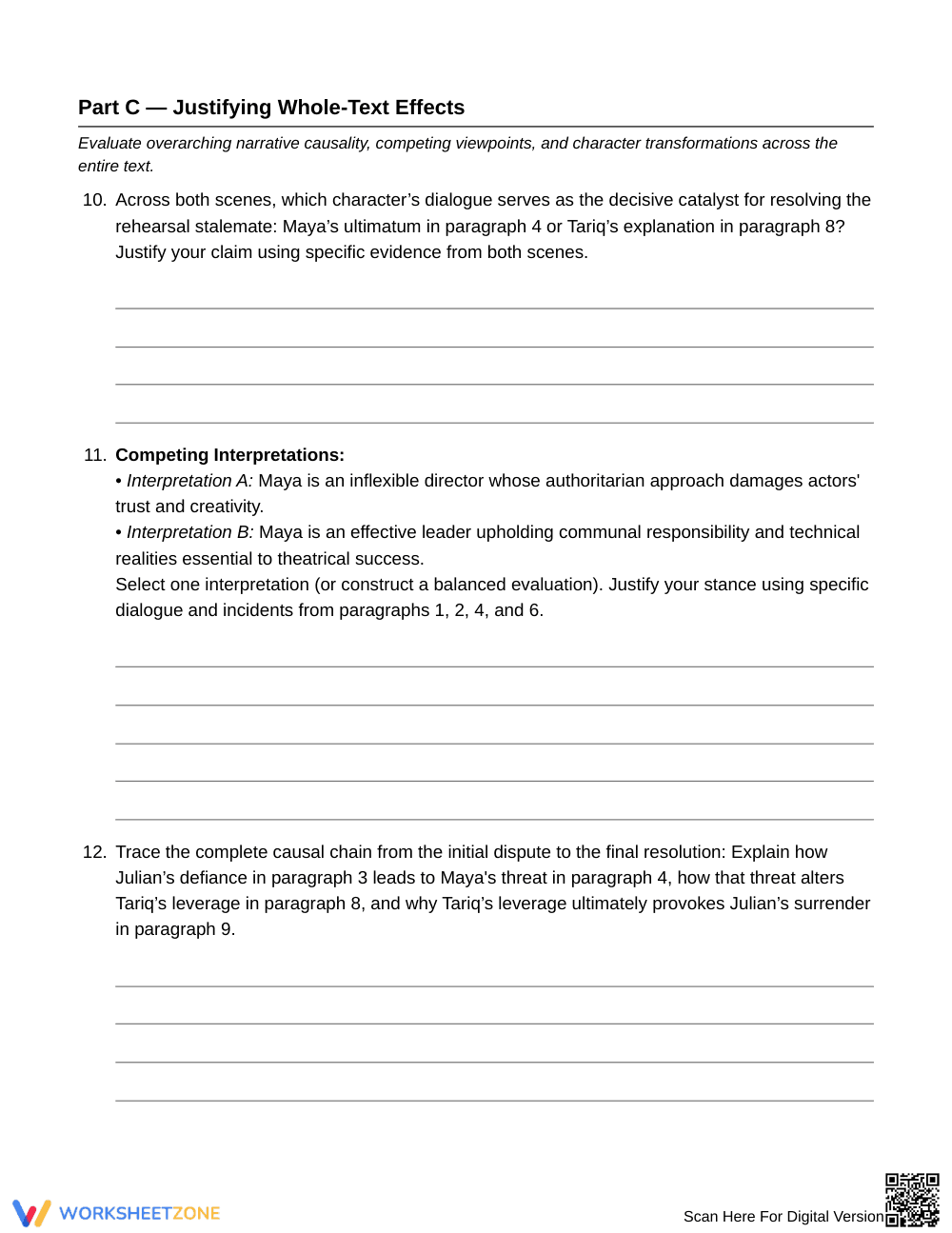
This 5-page resource includes an original two-scene script and 12 targeted text-dependent tasks. It features an RL.8.3 analytical framework rule box defining trigger, function, and consequence chains, selected-response questions targeting key evidence, open-ended causal analysis prompts, and a comprehensive 3-page answer key with exemplar responses.
Skill Progression
- Guided Practice (Part A · 3 Tasks): Students identify explicit lines of dialogue and foundational character actions using structured multiple-choice and short-answer prompts.
- Supported Practice (Part B · 6 Tasks): Learners connect spoken lines to emotional responses and secondary conflicts through analytical causal questions.
- Independent Practice (Part C · 3 Tasks): Students evaluate whole-text causality, defend competing literary interpretations, and trace multi-step plot chains.
This sequence follows a gradual-release model, moving eighth graders from basic evidence retrieval to complex thematic synthesis.
Standards Alignment
This resource aligns with primary standard RL.8.3: "Analyze how particular lines of dialogue or incidents in a story or drama propel the action, reveal aspects of a character, or provoke a decision." It also reinforces supporting standard RL.8.1 by requiring students to cite thorough textual evidence. Both standard codes can be copied directly into lesson plans, IEP goals, or district curriculum mapping tools.
How to Use It
Use this worksheet following direct instruction on dramatic structure to reinforce close reading during core practice, or assign it as a formative assessment. During work time, observe whether students identify Tariq's dual role as both peer ally and competitor to gauge analytical depth. Expected completion time is 40 to 50 minutes.
Who It's For
Designed for Grade 8 ELA classrooms, this resource supports general education students, honors learners, and striving readers needing structured narrative frameworks. Pair this worksheet with a direct instruction lesson on character motivation or an anchor chart on narrative causality to deepen comprehension.
Under standard RL.8.3, middle school readers must systematically evaluate how spoken dialogue and narrative incidents function as causal gears that propel plot action, expose character values, and provoke decisive choices. Rather than treating character interactions as isolated stylistic dialogue, rigorous eighth-grade literary standards require students to trace how an initial dispute directly alters character leverage and ignites subsequent narrative conflicts. According to research on purposeful instructional design by Fisher & Frey (2014), structured close reading paired with intentional text-dependent questioning establishes the cognitive scaffolding necessary for students to analyze complex character interactions, evaluate competing textual interpretations, and justify whole-text narrative effects. By progressing from explicit identification of dramatic ultimatums to nuanced evaluations of subtext and motivation, this instructional resource builds lasting analytical competency across diverse Grade 8 middle school ELA classrooms.


