




























Views
Downloads


Complete Body Systems Word Search | Grades 7–8 Science

Paste this activity's link or code into your existing LMS (Google Classroom, Canvas, Teams, Schoology, Moodle, etc.).
Students can open and work on the activity right away, with no student login required.
You'll still be able to track student progress and results from your teacher account.
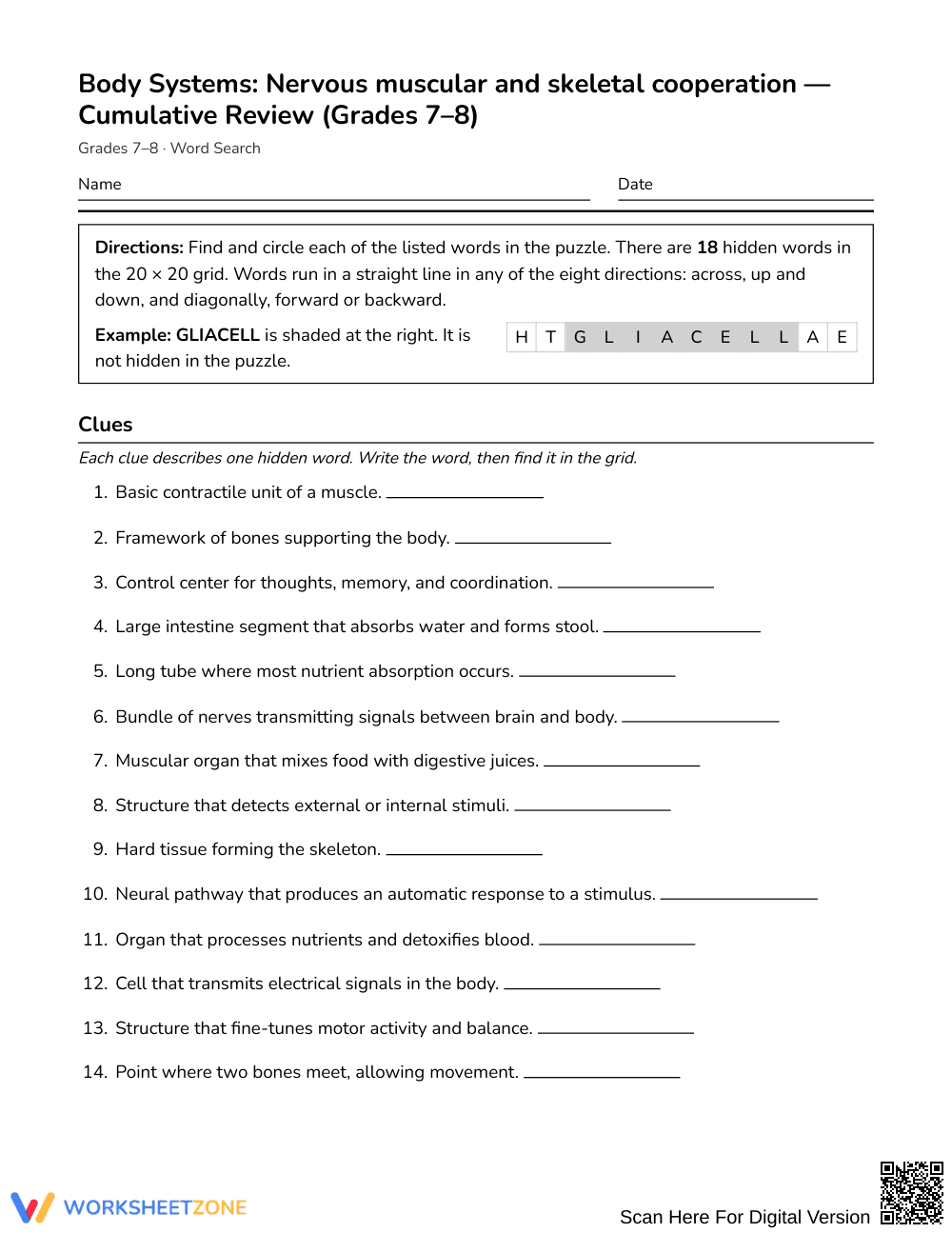
This Grades 7–8 science word search reinforces foundational anatomy terms by challenging students to locate 18 key vocabulary words linked to nervous, muscular, and skeletal coordination. Learners read descriptive clues for each organ, tissue, and cell type before hunting for terms across the puzzle, solidifying physiological definitions through active visual search and context-based recall.
At a Glance
- Grade: Grades 7–8 · Subject: Science
- Standard: Not standards-assessed — vocabulary enrichment for middle school life science body systems
- Skill Focus: Nervous, muscular, and skeletal system cooperation and tissue interactions
- Format: 3 student pages · 18 hidden vocabulary words · Full answer key included · Printable PDF
- Best For: Independent vocabulary review, sub plans, and fast-finisher work
- Time: 20–30 minutes
This 3-page printable science resource contains an 18-word puzzle alongside a complete 3-page solution key. A comprehensive clue section pairs every target term—such as reflex arc, motor neuron, tendon, and joint—with an accurate biological definition. Students scan a shuffled list of terminology and use the provided conceptual definitions to verify meanings before finding each word in the letter grid.
The activity is built upon a dense 20 x 20 letter grid designed to provide an engaging cognitive challenge for middle school students. Words run in all 8 compass directions: North, Northeast, East, Southeast, South, Southwest, West, and Northwest, including forward and backward diagonals. A shuffled word bank prevents rote scanning, requiring students to inspect letter patterns across horizontal, vertical, and diagonal orientations while referencing the anatomical clues provided below the grid.
This activity serves strictly as vocabulary enrichment and is not aligned to a formal state or national content standard. Instead, it provides focused supplementary practice that reinforces specialized anatomical and physiological terminology encountered during human body units.
This puzzle functions effectively as a mid-unit checkpoint after direct instruction on sensory-motor integration or as a constructive review activity for early finishers. Teachers can observe whether students first identify terms using the physiological clues or rely strictly on letter hunting, offering a fast formative check of vocabulary recognition. Most middle school classes complete the search in 20 to 30 minutes.
This resource is designed for Grades 7–8 life science students reviewing organ systems and body organization. It supports varied learning styles by combining visual scanning with descriptive textual definitions, making it accessible for general education classrooms, co-taught settings, and review stations. Pair this activity with a human body system diagram or an organ system anchor chart to bridge vocabulary acquisition with visual anatomical models.
Contextual vocabulary exposure directly strengthens domain-specific reading comprehension in secondary science education. According to Fisher & Frey (2014), intentional word exposure coupled with explicit definitions allows adolescent learners to build stable lexical representations of technical academic vocabulary. Rather than memorizing isolated flashcards without meaning, middle school students benefit when specialized science terminology is integrated across varied visual and analytical tasks that reinforce orthographic patterns and conceptual definitions simultaneously. Working through interconnected terms like motor neuron, reflex arc, and sensory receptor in an 18-word search puzzle enables students to build sustained familiarity with complex multi-syllabic terminology. When systematically paired with structured conceptual clues, visual word puzzles support orthographic mapping and retrieval fluency, ensuring that emerging readers and grade-level science students alike gain confidence decoding, spelling, and defining sophisticated biological structures during cumulative unit reviews.


