




























Views
Downloads


Complete Argument Revision Worksheet | Grade 6 ELA

Paste this activity's link or code into your existing LMS (Google Classroom, Canvas, Teams, Schoology, Moodle, etc.).
Students can open and work on the activity right away, with no student login required.
You'll still be able to track student progress and results from your teacher account.
This Grade 6 argument revision worksheet guides middle school writers through repairing poorly constructed claims, circular logic, and exaggerated evidence. By transforming an unpolished student essay with factual data from an included source sheet, students build the analytical stamina needed to produce defensible, policy-driven persuasive writing.
At a Glance
- Grade: 6 · Subject: ELA
- Standard:
W.6.5— Strengthen writing through focused revision, editing, and restructuring flawed arguments- Skill Focus: Revise a Weak Argument Draft
- Format: 5 pages · 10 problems · Answer key included · PDF
- Best For: Argument draft revision and guided writing
- Time: 40–50 minutes
What's Inside
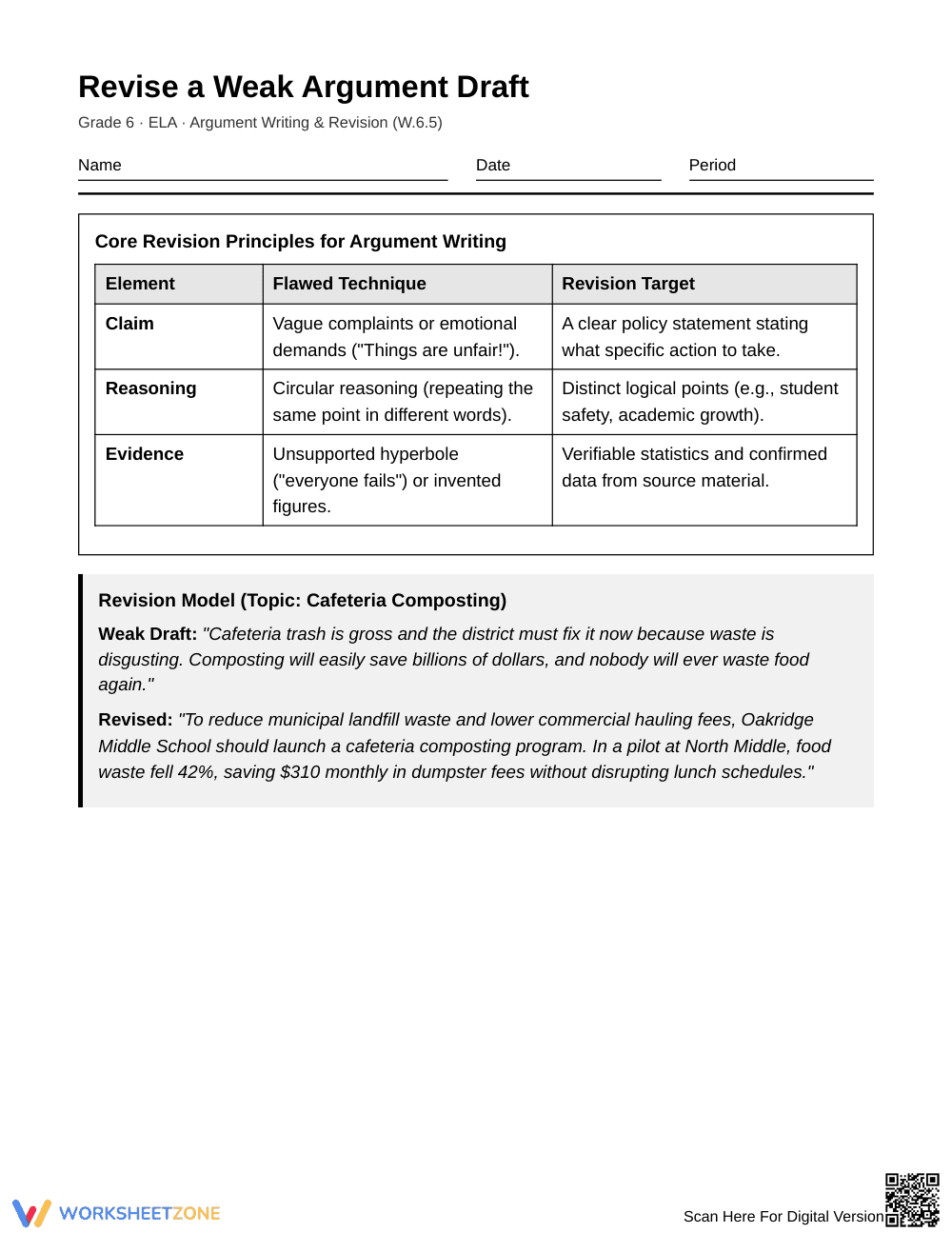
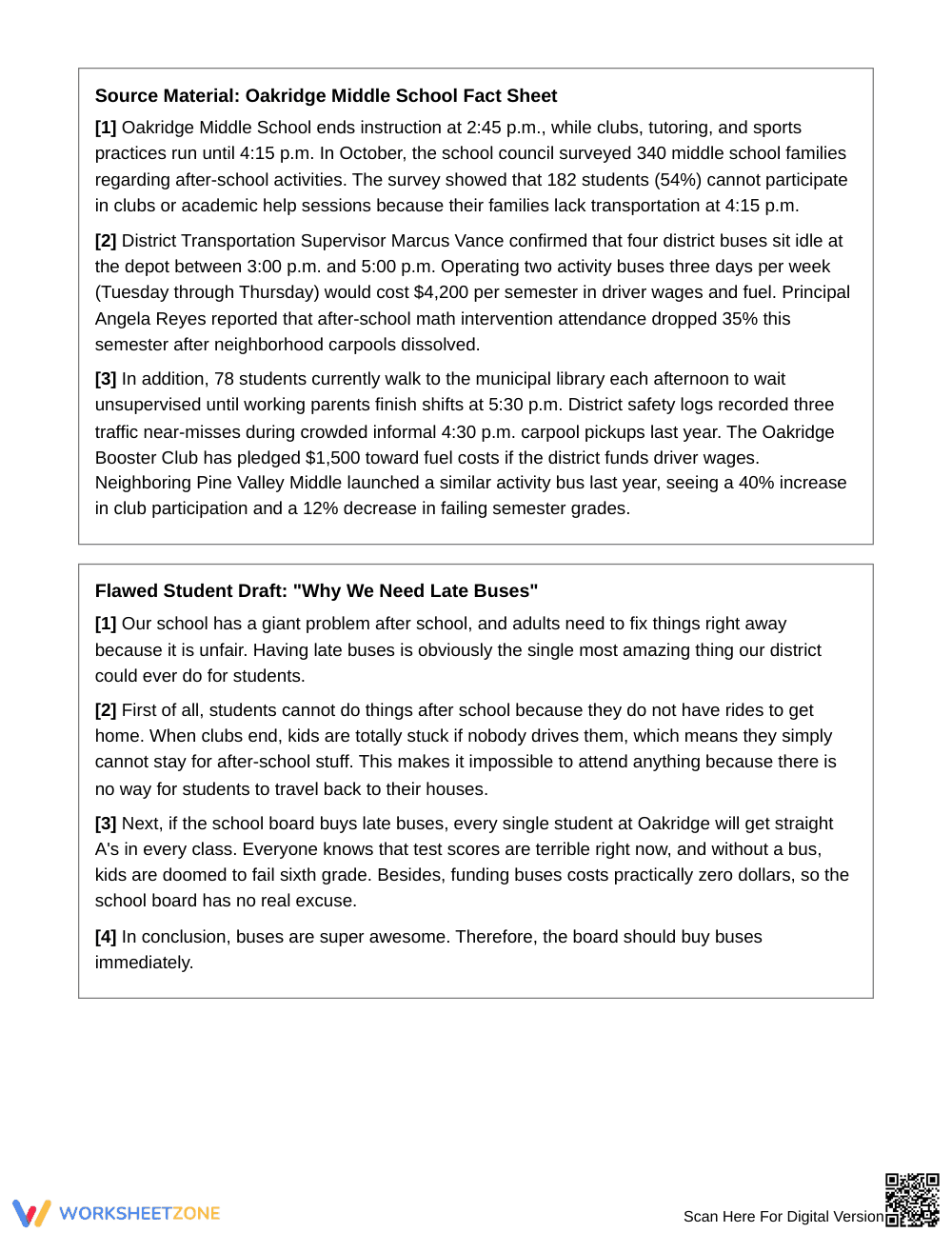
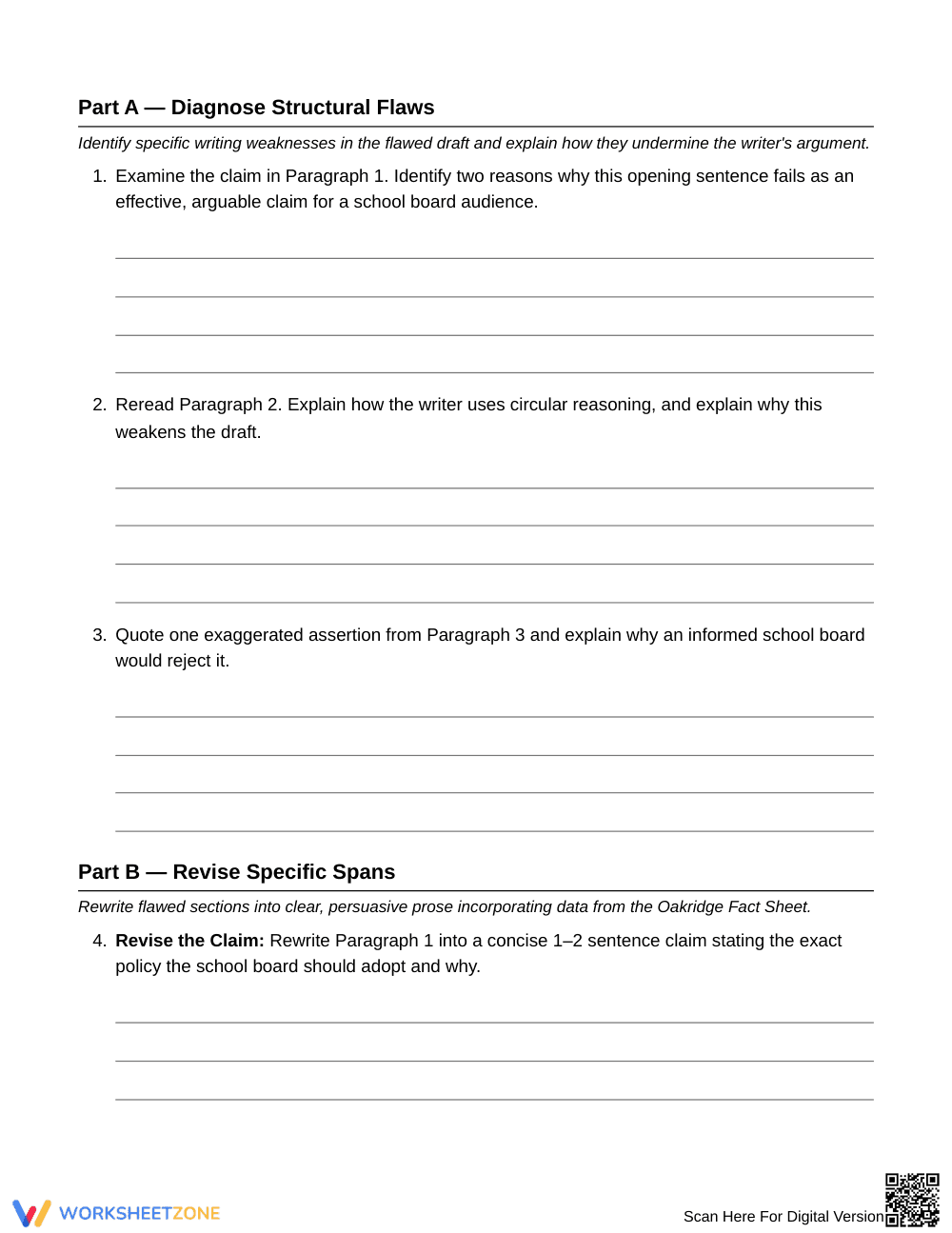
This 5-page instructional resource contains a Core Revision Principles chart, a worked before-and-after composting model, a three-paragraph factual source sheet, a flawed 4-paragraph draft, and 10 targeted tasks across three structural parts. A detailed 3-page answer key provides complete model responses for every analysis and revision prompt.
Skill Progression
- Guided practice (Tasks 1–3): Students diagnose three structural flaws in the sample draft, isolating vague claims, circular reasoning, and hyperbolic assertions with explicit prompt cues.
- Supported practice (Tasks 4–8): Students rewrite five specific draft spans using data points, budget figures, and safety facts drawn directly from the provided source sheet.
- Independent practice (Tasks 9–10): Students critique the original closing and independently draft a cohesive, 3- to 4-sentence concluding paragraph featuring a call to action.
This sequence mirrors the gradual-release model, shifting students from diagnostic identification to fully synthesized, evidence-backed composition.
Standards Alignment
Primary alignment is to Common Core standard `W.6.5`: "With some guidance and support from peers and adults, develop and strengthen writing as needed by planning, revising, editing, rewriting, or trying a new approach." The activity also reinforces `W.6.1.B` by requiring relevant facts and data to support claims. Both standard codes can be copied directly into lesson plans, IEP goals, or district curriculum mapping tools.
How to Use It
Deploy this worksheet after direct instruction on logical fallacies or during an argument revision workshop. For a formative assessment checkpoint, circulate during Part A to observe whether students can articulate why circular reasoning fails before they attempt rewriting in Part B. Most sixth graders complete all 10 tasks in 40 to 50 minutes.
Who It's For
This resource supports general education sixth graders, striving writers who rely on emotional appeals, and English language learners needing concrete data-incorporation models. Pair this activity with an argument anchor chart or a teacher-led mentor text study.
According to Fisher & Frey (2014), purposeful writing instruction relies on a structured gradual-release framework where learners progress from diagnosing concrete models to independent composition. Standard W.6.5 charges sixth-grade students with developing and strengthening writing through iterative revision, yet young writers frequently struggle to distinguish subjective complaints from verifiable reasoning without direct intervention. This worksheet operationalizes revision by isolating distinct flaws, including circular logic and unsupported hyperbole, and challenging students to replace emotional rhetoric with verified factual data from an authentic informational scenario. By practicing targeted reconstruction of claims, evidence spans, and concluding statements across 10 structured tasks, learners cultivate the evaluative judgment necessary to self-correct their own persuasive drafts. Grounded in intentional modeling and cognitive accountability, this guided approach ensures middle school writers transition successfully from initial affective responses to reasoned, standards-aligned argumentative discourse.


