


























Views
Downloads


Complete Additive Ratio Reasoning Worksheet | Grade 6 Math
Paste this activity's link or code into your existing LMS (Google Classroom, Canvas, Teams, Schoology, Moodle, etc.).
Students can open and work on the activity right away, with no student login required.
You'll still be able to track student progress and results from your teacher account.
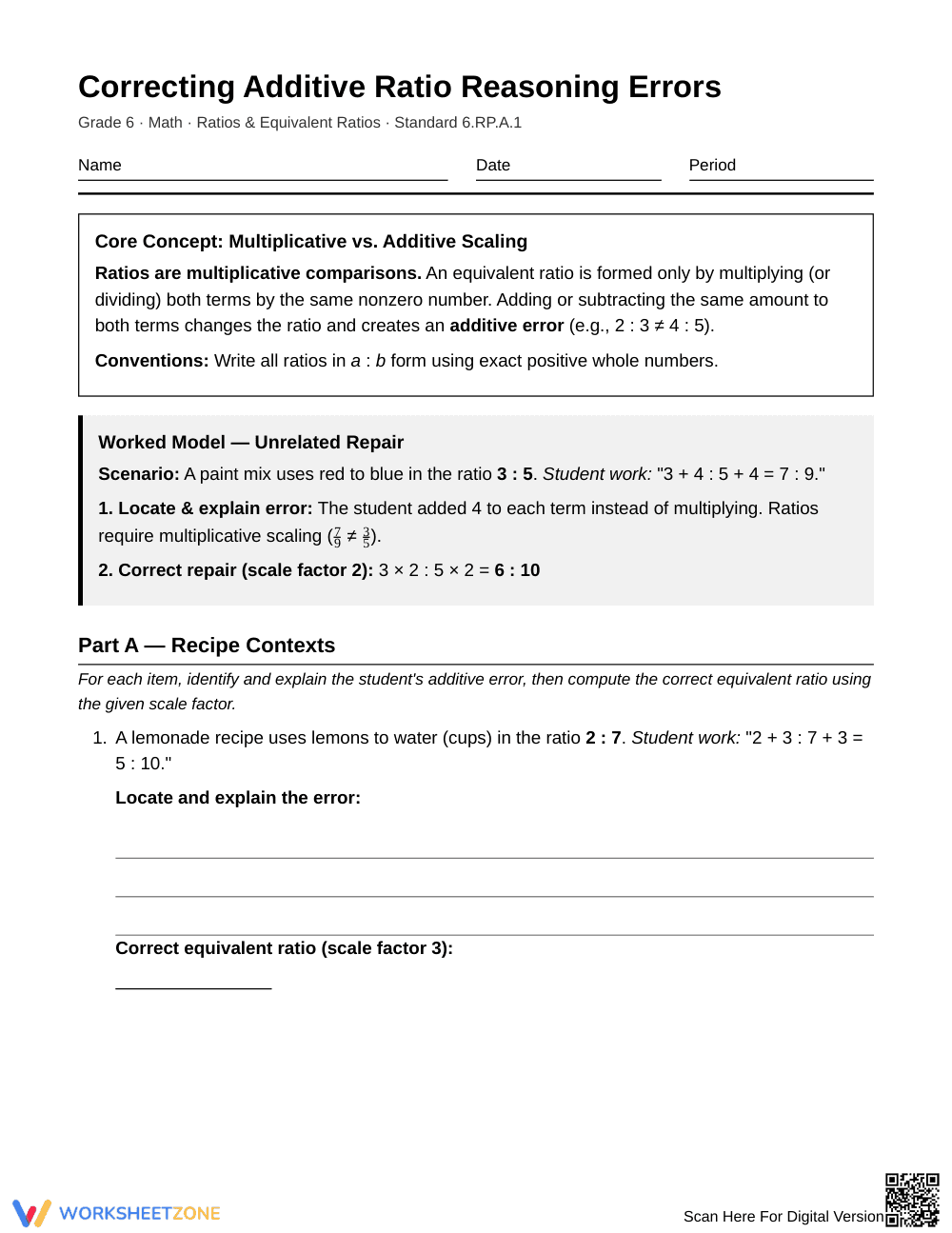
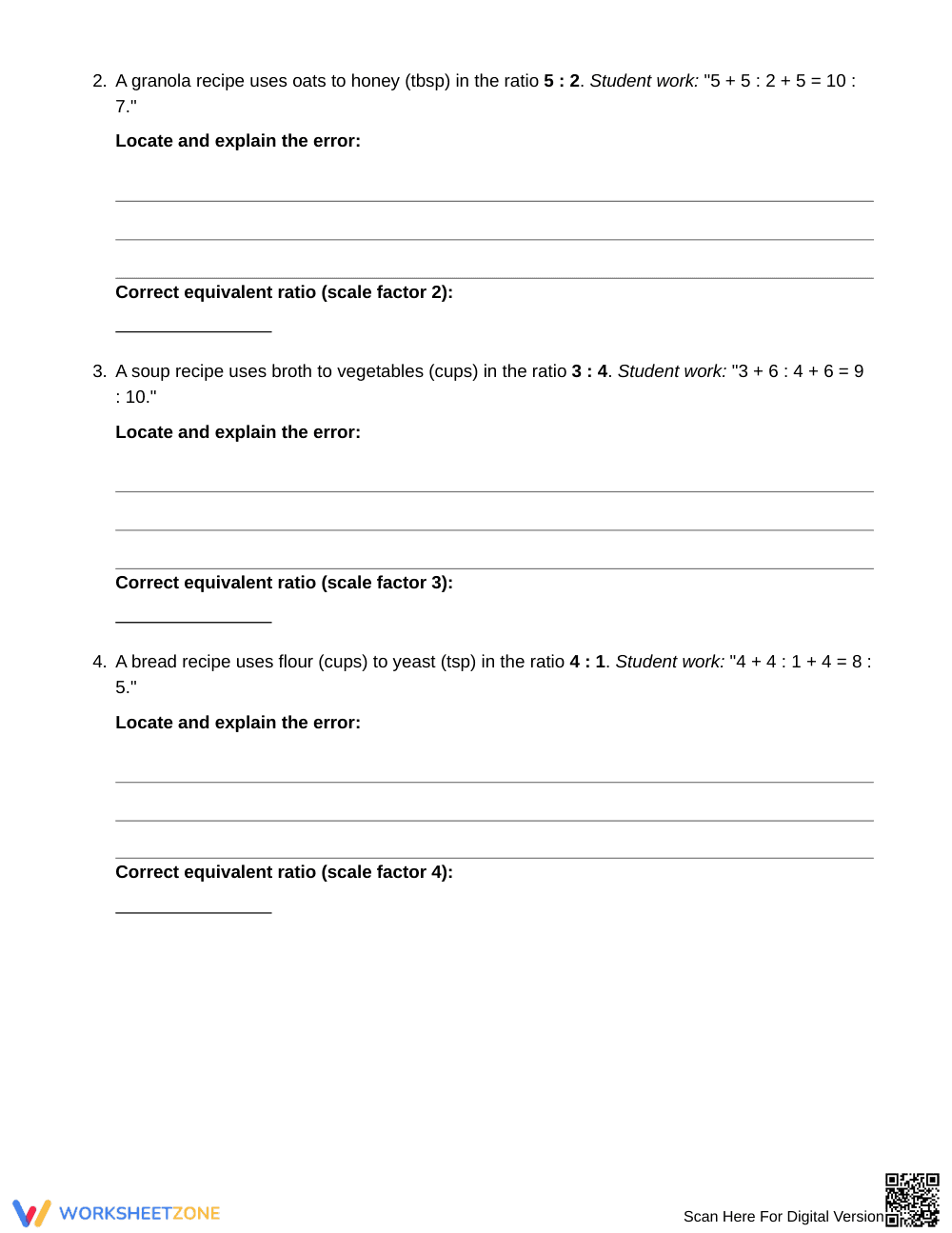
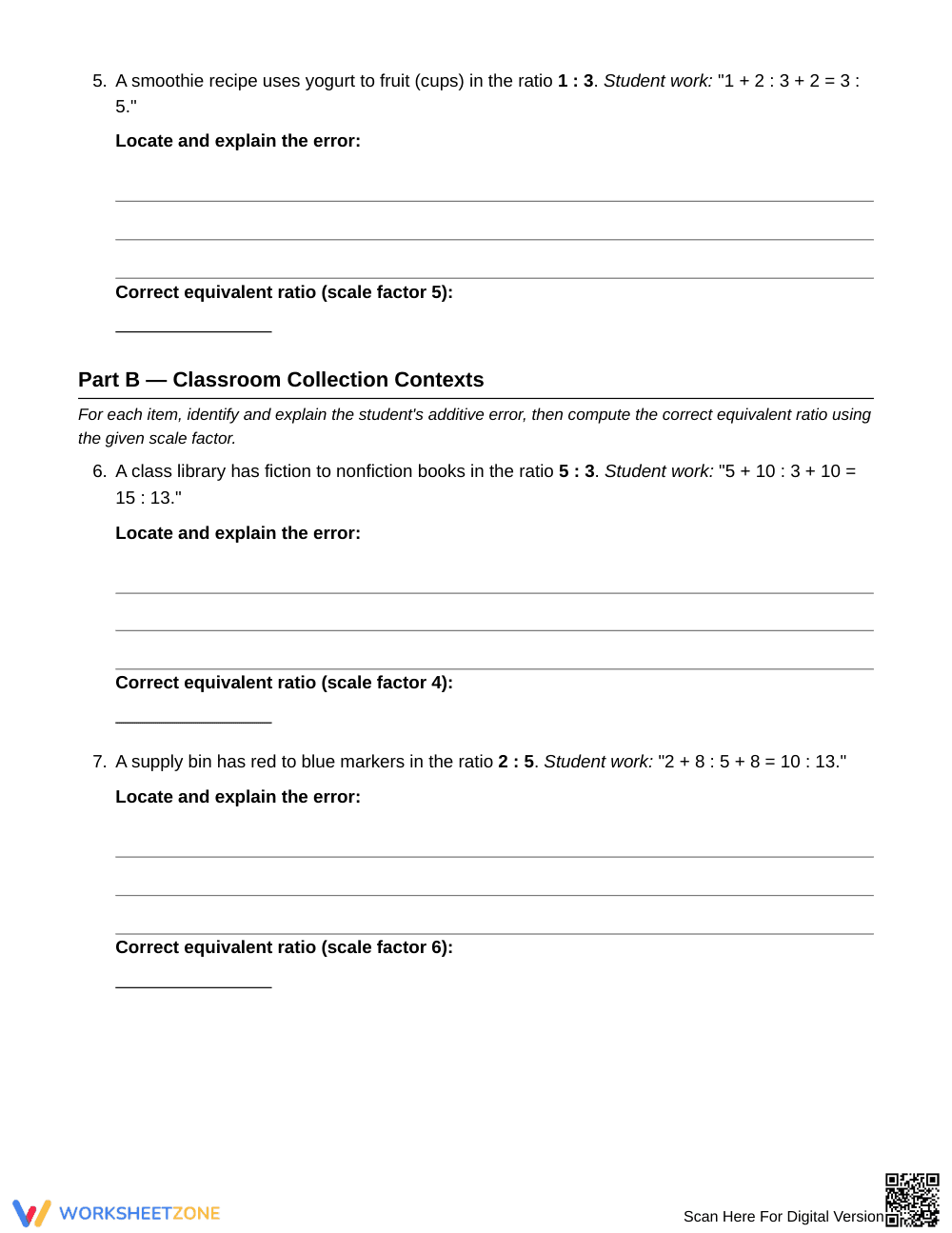
This Grade 6 ratio worksheet targets additive misconceptions in proportional relationships. Students analyze flawed student work, explain why adding terms violates ratio equivalence, and compute true equivalent ratios using multiplicative scale factors across 10 structured problems. By correcting these common errors, learners build foundational reasoning required for middle school mathematics.
At a Glance
- Grade: 6 · Subject: Math
- Standard:
6.RP.A.1— Understand ratio concepts and use ratio language to describe relationships between quantities- Skill Focus: Correct Additive Ratio Reasoning
- Format: 4 pages · 10 problems · 2-page answer key included · Printable PDF
- Best For: Misconception intervention and guided error correction
- Time: 25–35 minutes of classroom practice
What's Inside
This 4-page resource includes a core concept box defining multiplicative scaling alongside a complete worked model demonstrating error identification and repair. Students complete 10 problems across two sections: recipe mixtures in Part A and classroom collections in Part B. A 2-page answer key provides written error diagnoses and correct ratio computations.
Skill Progression
- Guided practice: The rule box and worked model demonstrate how to identify additive errors and compute correct multiplicative repairs.
- Supported practice: Part A provides 5 recipe problems where students diagnose given student mistakes and apply specified scale factors.
- Independent practice: Part B features 5 classroom scenarios requiring independent error explanations and accurate ratio calculations.
This sequence follows a gradual-release model, moving from guided error analysis to independent proportional problem-solving.
Standards Alignment
This worksheet aligns to `6.RP.A.1`: Understand ratio concepts and use ratio language to describe relationships between quantities. The tasks also support `6.RP.A.3` by strengthening equivalent ratio reasoning. Both standard codes can be copied directly into lesson plans, IEP goals, or district curriculum mapping tools.
How to Use It
Use Part A during direct instruction for paired practice following your lesson on ratio scaling. Have partners discuss why addition alters the relationship before writing their repairs. Assign Part B after direct instruction for independent evaluation or homework. While circulating, observe whether students identify additive thinking or confuse operations; misconceptions signal a need for tape diagrams. Students finish within 25 to 35 minutes.
Who It's For
This resource serves Grade 6 students learning ratios and Grade 7 students needing remediation. Provide sentence starters for multilingual learners to assist with written explanations. Pair this worksheet with an anchor chart comparing additive tape diagrams with multiplicative ratio tables.
Addressing additive misconceptions under standard 6.RP.A.1 is essential for establishing genuine proportional understanding. In ratio reasoning, middle school students frequently apply prior additive schema to multiplicative situations, treating ratios as absolute quantities rather than relative relationships. According to Fisher & Frey (2014), explicit error analysis accelerates student metacognition by requiring learners to deconstruct flawed logic before executing procedural corrections. By prompting sixth graders to isolate specific additive mistakes across recipe mixtures and classroom collections, this resource reinforces that equivalent ratios require constant multiplicative scaling. Students who systematically justify why addition fails to preserve equivalency demonstrate higher retention and greater adaptability when advancing to unit rates, proportional graphs, and scale drawings. Grounding error analysis in deliberate contrastive cases transforms a common diagnostic obstacle into an enduring conceptual breakthrough, ensuring that learners achieve mathematical fluency aligned with state and national standards.


