


























Views
Downloads
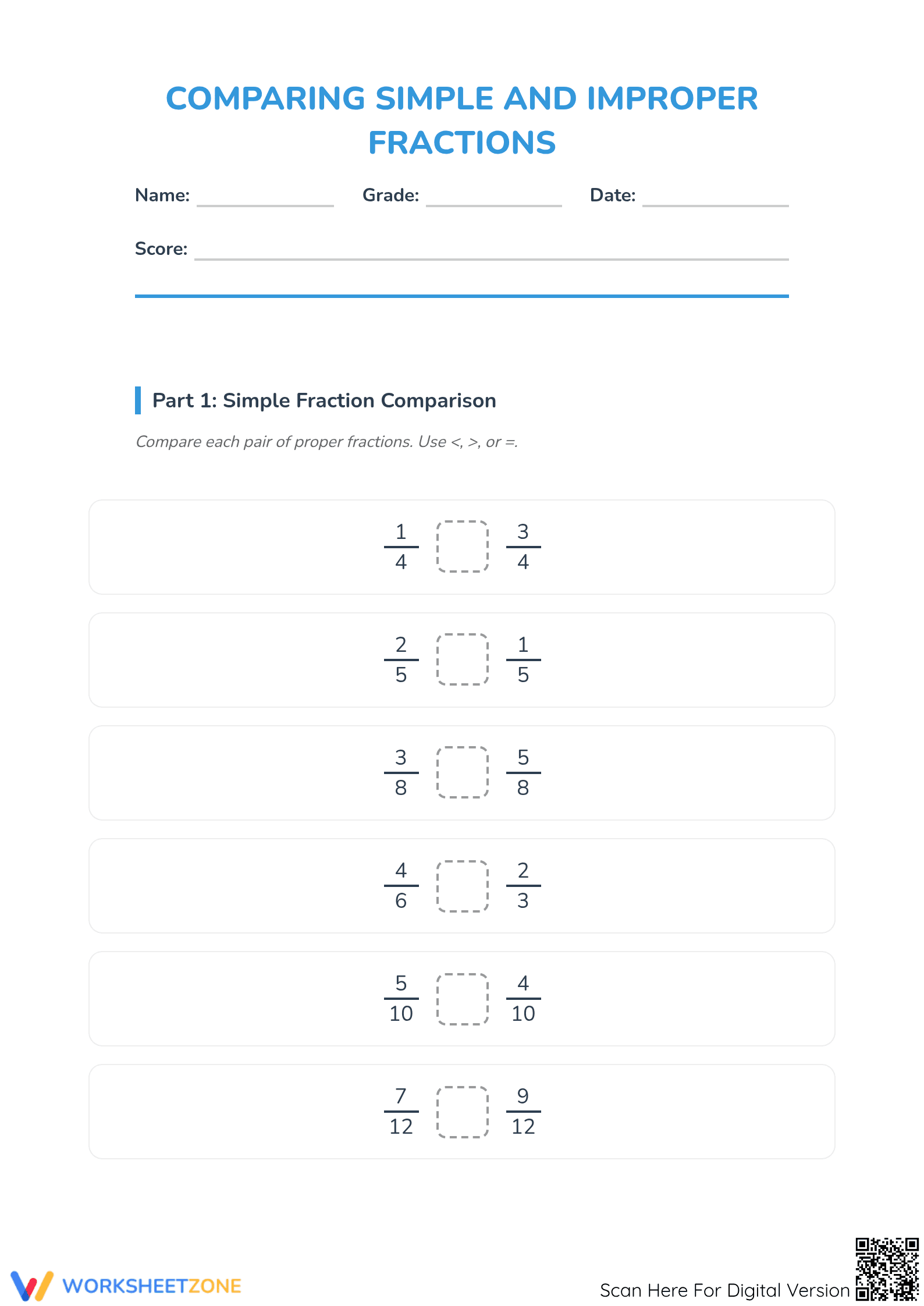
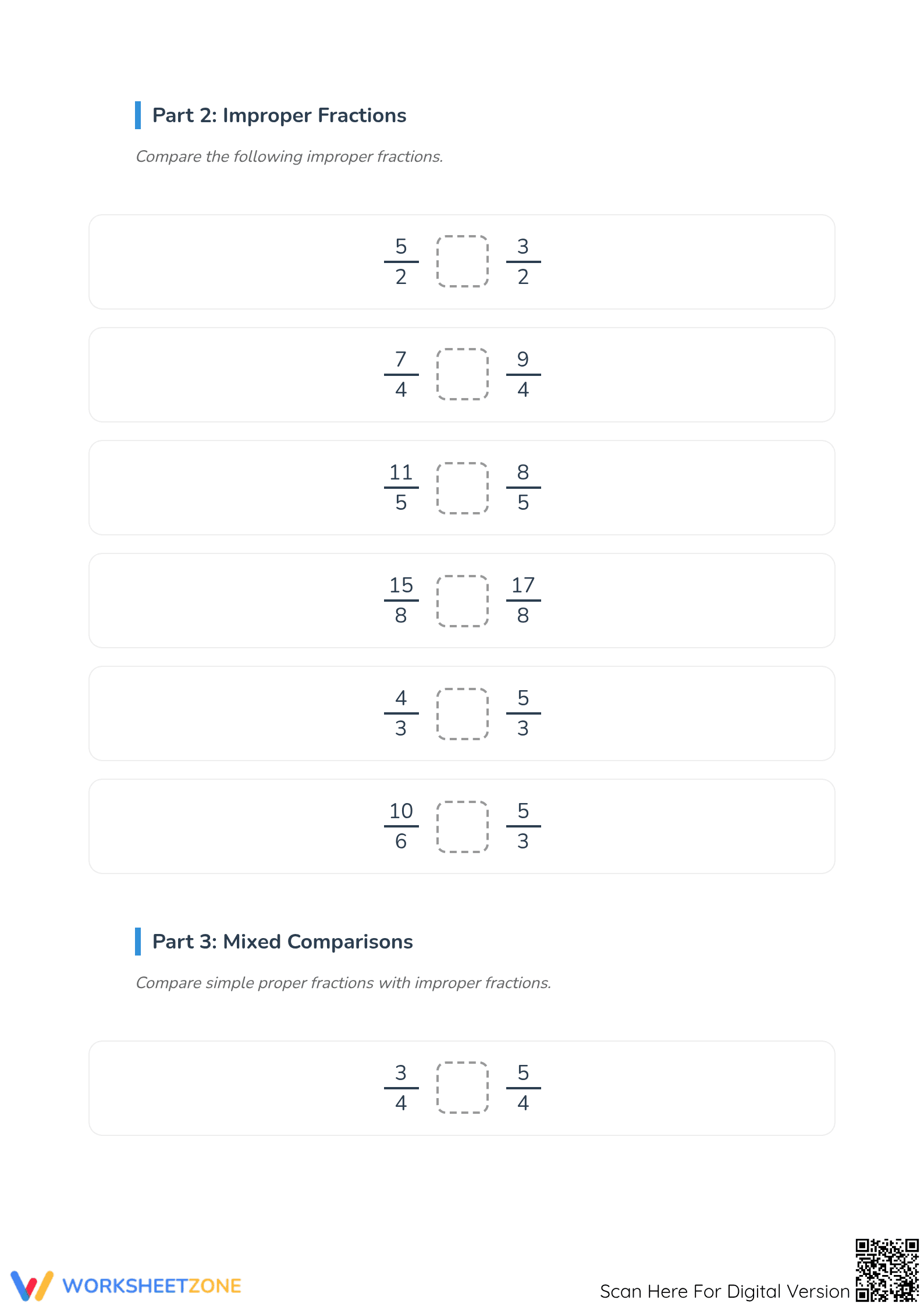

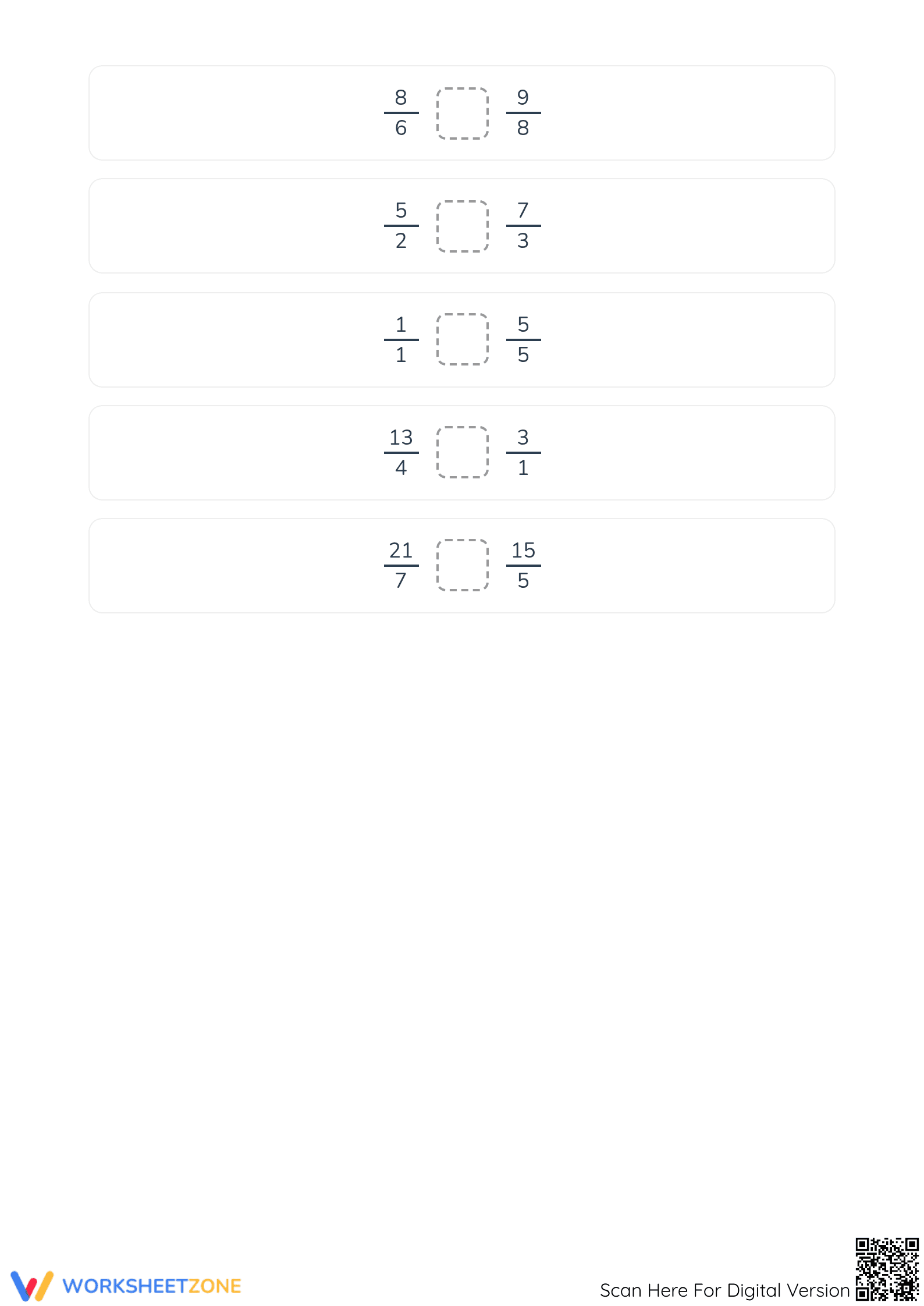

Essential Comparing Simple and Improper Fractions Worksheet
Paste this activity's link or code into your existing LMS (Google Classroom, Canvas, Teams, Schoology, Moodle, etc.).
Students can open and work on the activity right away, with no student login required.
You'll still be able to track student progress and results from your teacher account.
Students will master the relational value of fractions by comparing proper and improper sets using this systematic practice resource. This worksheet provides a rigorous approach to identifying which value is greater through logical reasoning and common denominator application. Learners move from simple like-denominator comparisons to complex improper fraction pairs, ensuring a deep understanding of fractional magnitude and value.
At a Glance
- Grade: 4–6 · Subject: Math (Fractions)
- Standard:
4.NF.A.2— Compare two fractions with different numerators and different denominators using symbols- Skill Focus: Comparing Proper and Improper Fractions
- Format: 4 pages · 25 problems · Answer key included · PDF
- Best For: Independent practice or formative assessment
- Time: 20–35 minutes
This comprehensive four-page PDF includes 25 structured comparison problems divided into four distinct sections. The layout features large, clear fraction notation with dedicated comparison boxes for the insertion of greater than, less than, or equal symbols. A complete four-page answer key is provided to facilitate rapid grading or student self-correction, making it ideal for classroom or home use.
Skill Progression
- Guided Practice: 6 problems focused on simple fractions with like denominators to establish the basic comparison logic and build student confidence.
- Supported Practice: 11 problems introducing improper fractions and mixed comparisons where numerators exceed denominators, requiring more complex visualization.
- Independent Practice: 8 challenge problems requiring students to compare fractions with unlike denominators and varying magnitudes using abstract mathematical reasoning.
The sequence follows a gradual-release model, ensuring students transition smoothly from intuitive visual comparisons to abstract numerical evaluations.
Standards Alignment
The primary focus is `4.NF.A.2`, which requires students to compare two fractions with different numerators and denominators. This resource also supports `5.NF.A.1` by reinforcing the foundational skill of finding common denominators for comparison. Both standard codes can be copied directly into lesson plans, IEP goals, or district curriculum mapping tools to ensure instructional compliance.
How to Use It
Deploy this worksheet during the independent practice phase of a lesson on fraction relationships to gauge student accuracy. It serves as an excellent formative assessment tool; teachers should observe if students are using cross-multiplication or finding common denominators for the challenge section. The expected completion time is approximately 30 minutes for most upper elementary students.
Who It's For
This resource is designed for upper elementary and middle school students who need targeted practice with non-traditional fraction forms. It is particularly effective for students transitioning from concrete models to abstract fraction operations. It can be naturally paired with an anchor chart on fraction types or a direct instruction lesson on improper values.
Standard 4.NF.A.2 emphasizes that comparing fractions requires a robust understanding of the relationship between parts and wholes, especially when dealing with improper values where the numerator exceeds the denominator. According to Fisher & Frey (2014), the implementation of progressive scaffolds—moving from like to unlike denominators—is critical for ensuring students do not merely memorize procedures but develop a true sense of numerical magnitude. This worksheet aligns with the gradual release of responsibility framework by providing structured practice opportunities within the four-part layout. Recent NAEP data highlights that fraction proficiency is a leading indicator for success in middle school algebra, making the mastery of comparison logic a non-negotiable prerequisite for higher-order mathematics. This comprehensive practice set ensures students can accurately evaluate fraction values across diverse formats, including proper, improper, and mixed-denominator sets, facilitating a smooth transition to fraction arithmetic and ratio-based problem solving.


