


























Views
Downloads
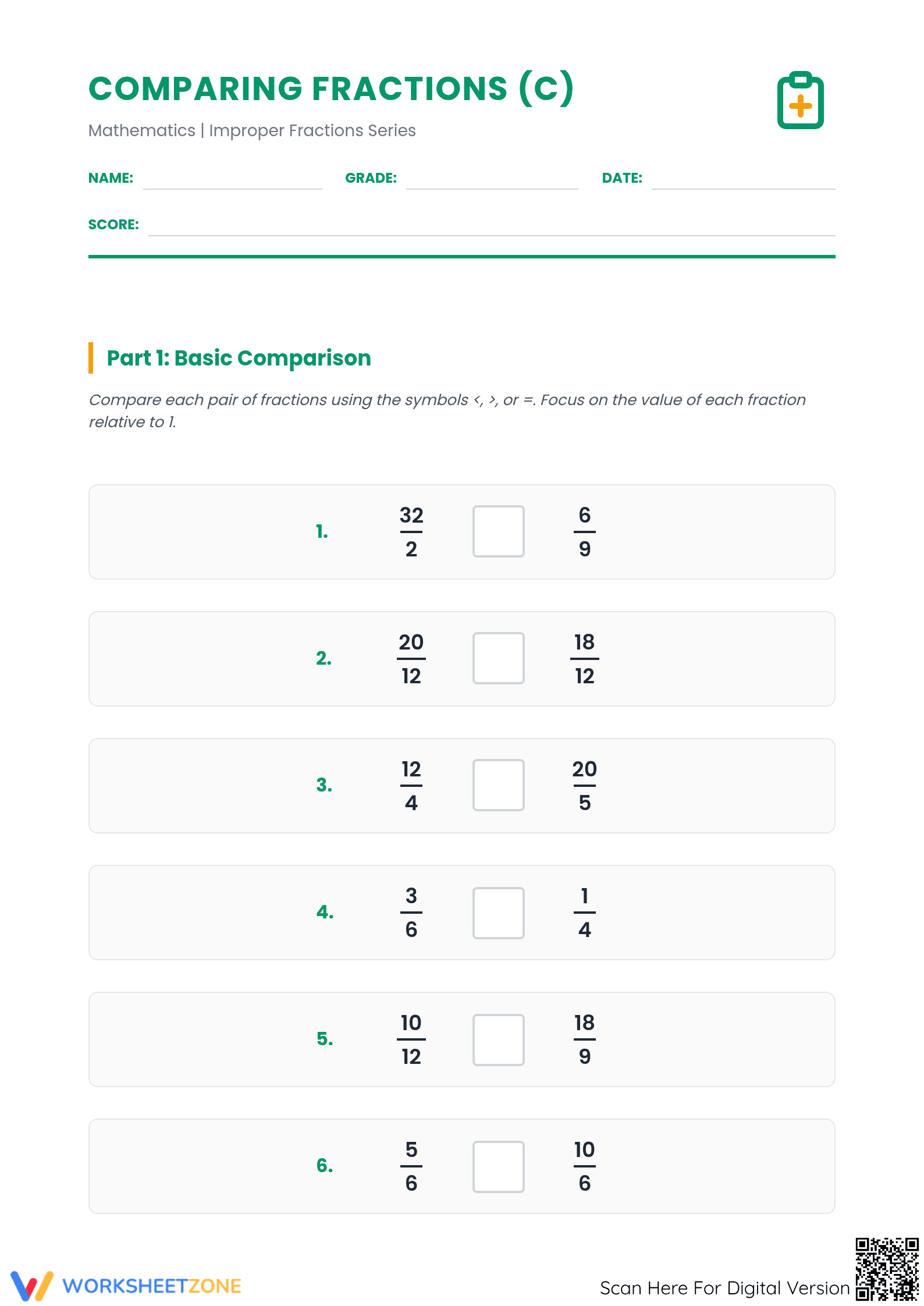


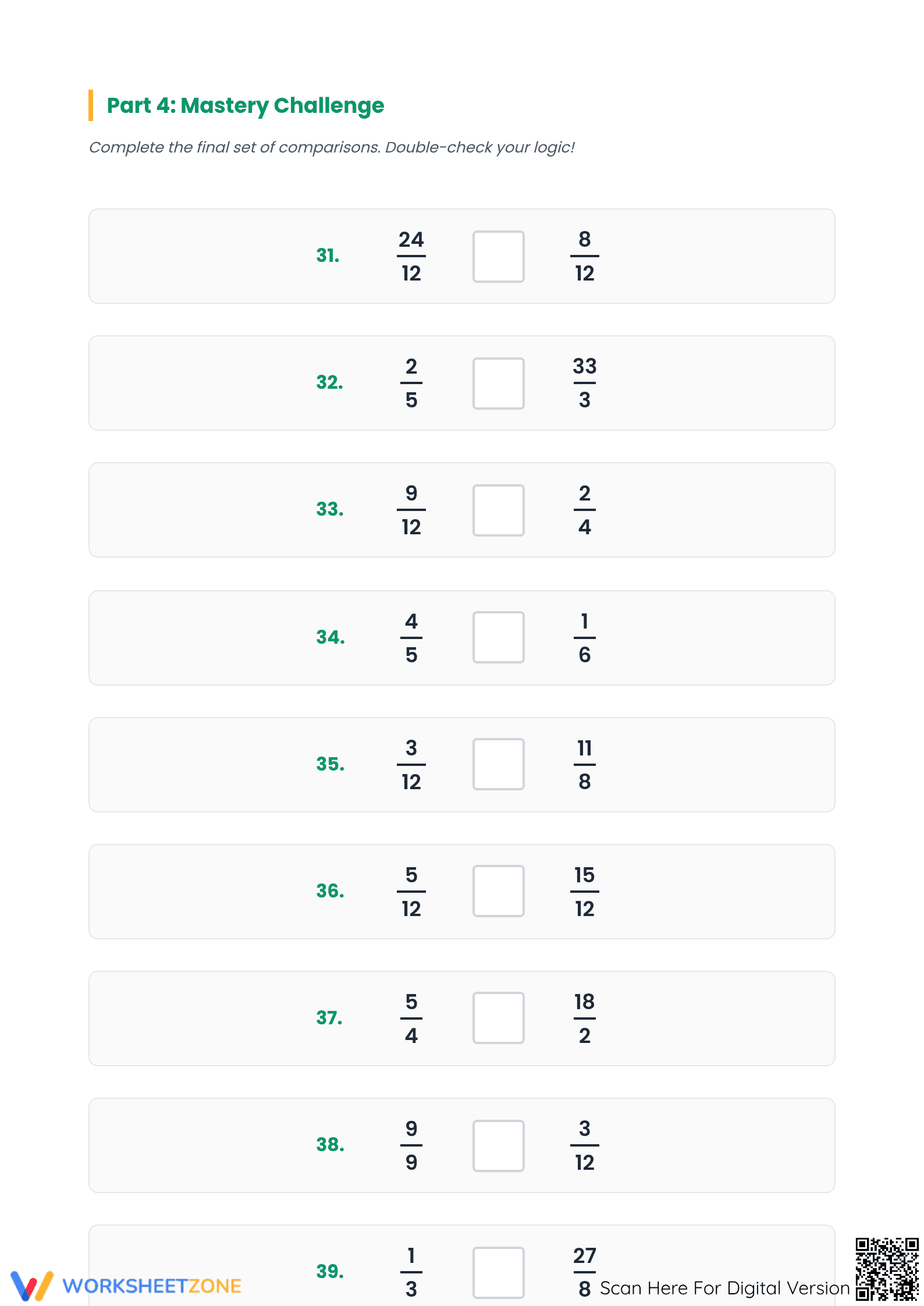

Printable Comparing Improper Fractions Worksheet | Grade 4
Paste this activity's link or code into your existing LMS (Google Classroom, Canvas, Teams, Schoology, Moodle, etc.).
Students can open and work on the activity right away, with no student login required.
You'll still be able to track student progress and results from your teacher account.
This comprehensive Grade 4 math worksheet focuses on the critical skill of comparing fractions, with a specific emphasis on improper fractions and their relationship to simple fractions and whole numbers. Students will evaluate 40 different pairs of fractions, developing the mathematical fluency needed to recognize fraction values across diverse formats. This resource ensures that learners move beyond simple visual models to true numerical comprehension.
At a Glance
- Grade: 4 · Subject: Math (Fractions)
- Standard:
CCSS.MATH.CONTENT.4.NF.A.2— Compare two fractions with different numerators and different denominators- Skill Focus: Improper Fraction Comparison
- Format: 5 pages · 40 problems · Answer key included · PDF
- Best For: Independent practice or small group intervention
- Time: 25–35 minutes
Inside this 5-page PDF, teachers will find a structured progression of tasks designed to build confidence. The worksheet includes 40 unique comparison problems categorized into basic, intermediate, and advanced reasoning sections. Each problem provides a clear workspace with comparison boxes for symbols (<, >, =), and the included answer key allows for immediate feedback and student self-correction.
Skill Progression
- Guided Practice: The first 10 problems focus on basic comparisons where numerators or denominators are often related, allowing students to establish a baseline of 1 as a reference point.
- Supported Practice: Problems 11 through 30 introduce varied denominators, requiring students to find common values or utilize cross-multiplication strategies across 20 focused tasks.
- Independent Practice: The final 10 tasks present mastery-level challenges involving complex improper fractions, ensuring students can apply their reasoning skills without additional scaffolding.
This sequence follows a gradual-release model, transitioning students from simple recognition to complex mathematical reasoning.
Standards Alignment
This resource is strictly aligned to the primary standard CCSS.MATH.CONTENT.4.NF.A.2: "Compare two fractions with different numerators and different denominators, e.g., by creating common denominators or numerators, or by comparing to a benchmark fraction such as 1/2." It also supports work within 4.NF.B.3. Both standard codes can be copied directly into lesson plans, IEP goals, or district curriculum mapping tools.
How to Use It
This worksheet is ideal for use during the independent practice phase of a lesson on fraction comparisons. Teachers can assign specific pages based on student progress or use the entire set as a comprehensive unit review. For a formative assessment tip, observe students as they work on the "Intermediate Challenge" section; students who struggle to find common denominators may need targeted intervention on equivalent fractions. Most students complete the set within 30 minutes.
Who It's For
The material is designed for fourth-grade students mastering the fractions domain, though it serves as excellent remediation for fifth-grade learners or an extension for advanced third graders. It pairs naturally with a number line anchor chart or direct instruction on improper-to-mixed number conversion. The clear layout is especially helpful for students who benefit from structured, non-distracting worksheets.
According to the RAND AIRS 2024 analysis of mathematics curricula, consistent practice with improper fractions is essential for preventing the common misconception that the denominator always represents the total number of parts in a single whole. This worksheet addresses that gap by presenting fractions where the numerator exceeds the denominator, forcing a deeper engagement with fractional value. By engaging with these 40 targeted problems, students develop the computational fluency required for more advanced algebraic concepts. The repetition of the CCSS.MATH.CONTENT.4.NF.A.2 standard across multiple pages ensures that students encounter various numerical combinations, reinforcing the plain-English skill of comparing values with accuracy and speed. This systematic approach aligns with evidence-based instructional design for upper elementary mathematics.


