


























Views
Downloads

Printable Comparing Simple and Improper Fractions Worksheet
Paste this activity's link or code into your existing LMS (Google Classroom, Canvas, Teams, Schoology, Moodle, etc.).
Students can open and work on the activity right away, with no student login required.
You'll still be able to track student progress and results from your teacher account.
Strengthen students' understanding of rational numbers with this three-page practice set. It bridges basic fraction models with the abstract comparison of improper fractions and mixed numbers. Through visual estimations and word problems, students develop fluency for advanced middle school mathematics, confidently evaluating fraction magnitude.
At a Glance
- Grade: 4–5 · Subject: Mathematics
- Standard:
CCSS.MATH.CONTENT.4.NF.A.2— Compare two fractions with different numerators and denominators by creating common denominators or benchmarks- Skill Focus: Comparing improper fractions and mixed numbers
- Format: 3 pages · 18 problems · Answer key included · PDF
- Best For: Independent practice or small group intervention
- Time: 25–35 minutes
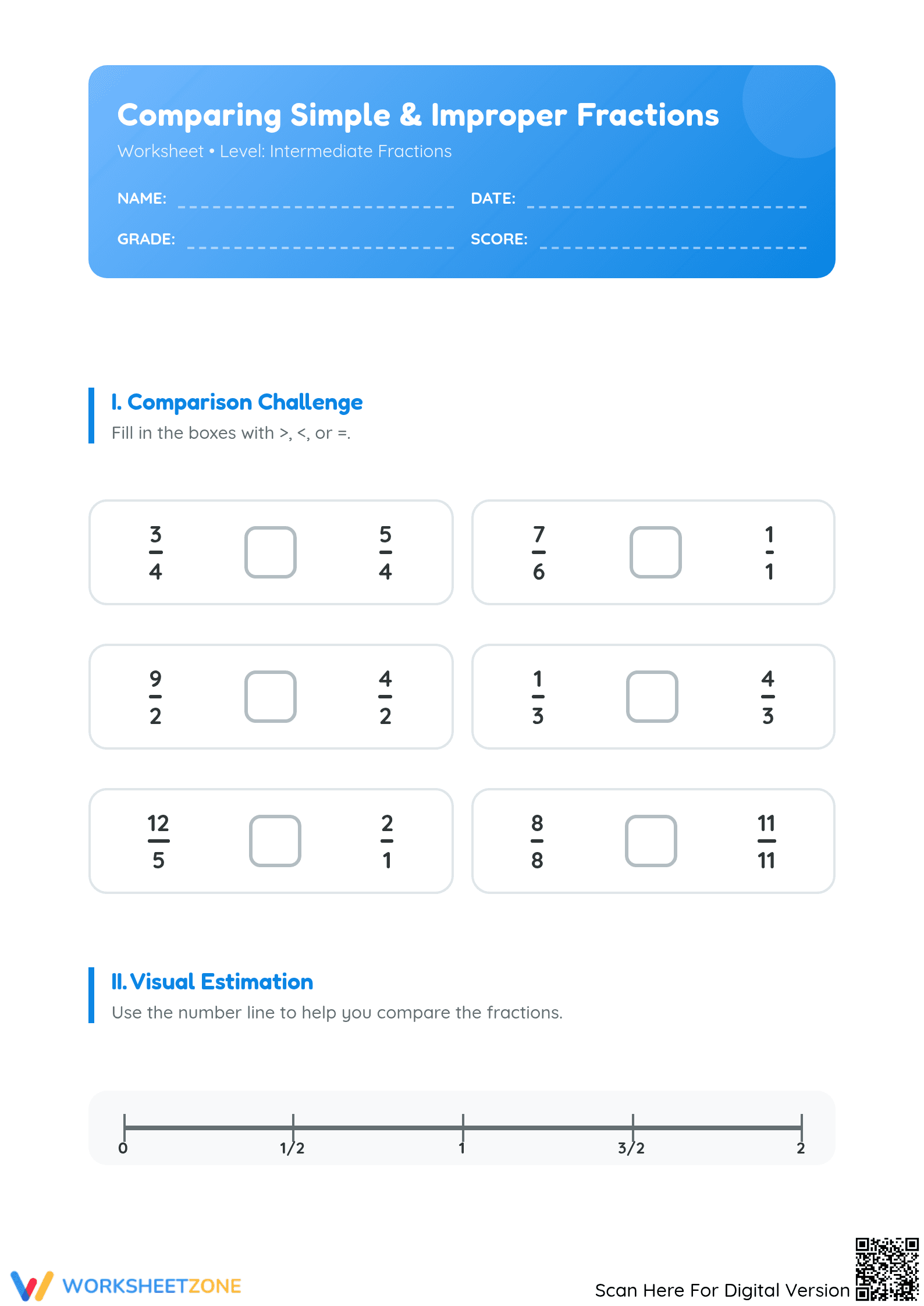
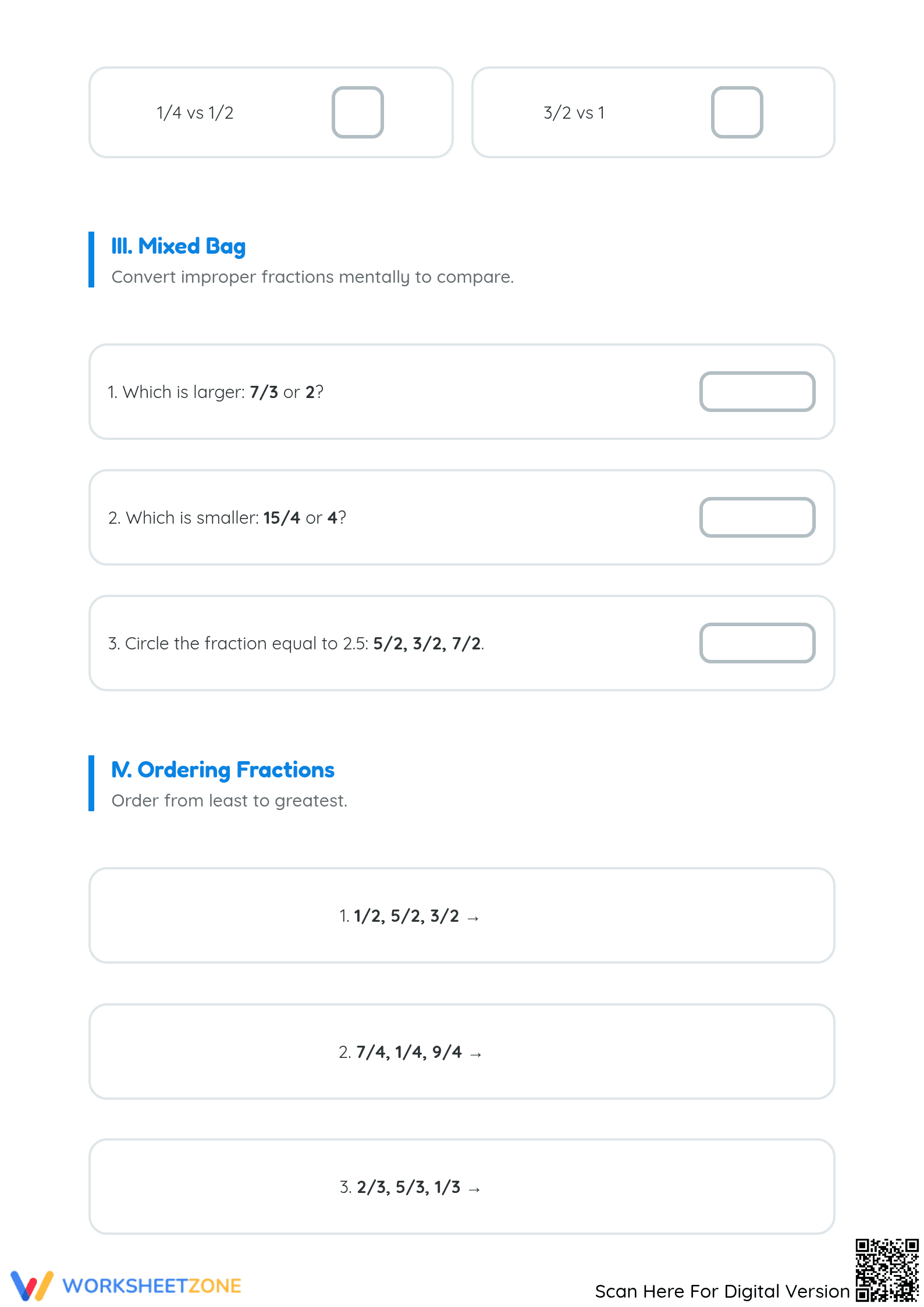
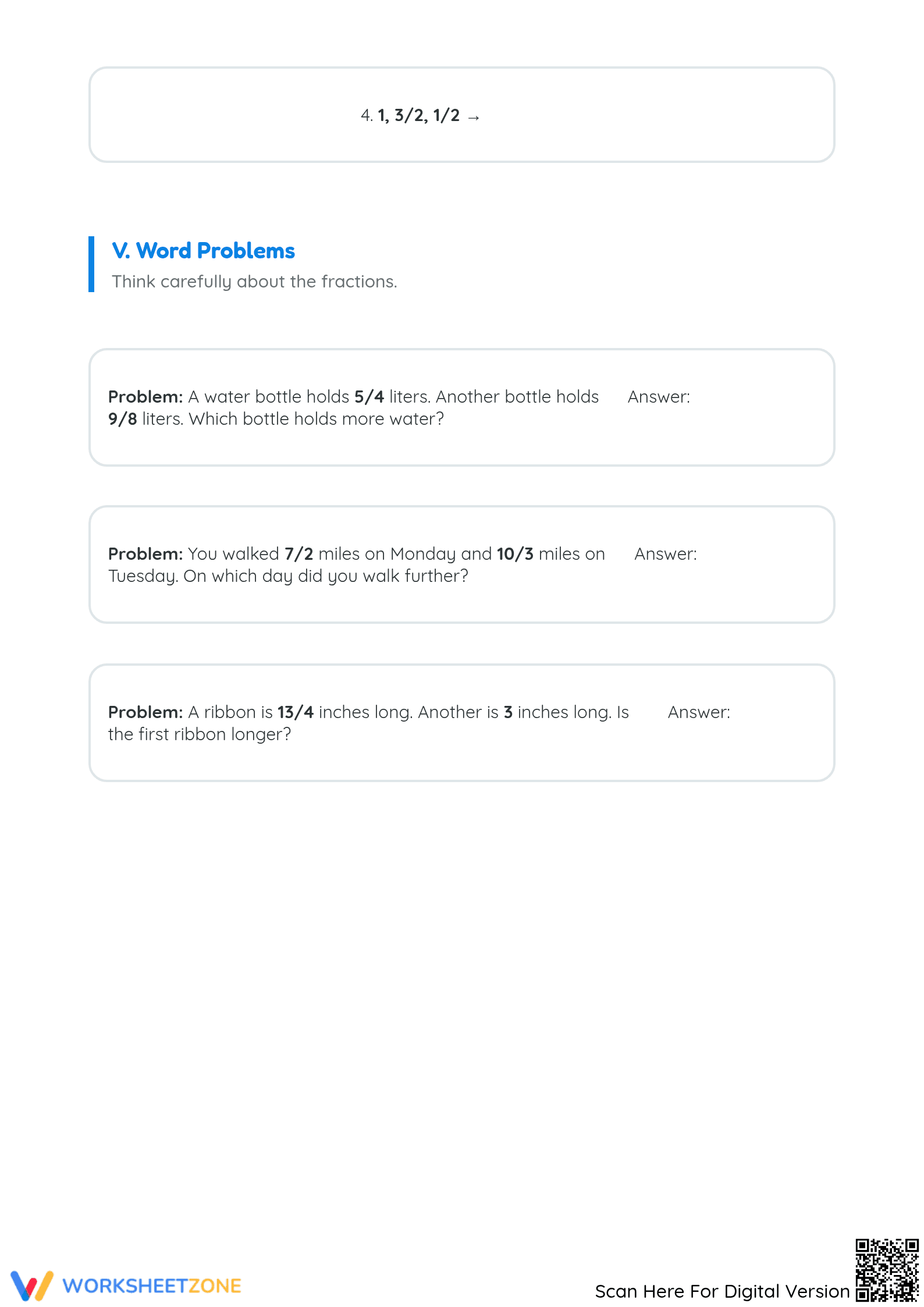
This PDF provides three distinct pages of practice. The first page includes six direct comparison challenges and visual estimation using a benchmark number line. The second page focuses on mental conversions and ordering sets of three fractions. The final page offers three realistic word problems applying comparison skills to measurement scenarios. A full answer key ensures immediate feedback.
Skill Progression and Scaffolding
- Guided practice: Sections I & II offer 8 problems with visual aids like number lines to compare improper fractions against benchmarks.
- Supported practice: Sections III & IV include 7 problems for mental math strategies and ordering three-fraction sequences, encouraging common denominators or mixed number conversions.
- Independent practice: Section V features 3 word problems, requiring students to apply comparison skills in real-world contexts.
This gradual release model ensures mastery before complex application.
Standards Alignment
Aligned to `CCSS.MATH.CONTENT.4.NF.A.2`, this resource teaches students to compare fractions with different numerators and denominators using common denominators or benchmark fractions like 1/2. It also supports `CCSS.MATH.CONTENT.5.NF.A.2` by preparing students for word problems involving fraction addition and subtraction. Standard codes are provided for lesson plans, IEPs, or curriculum mapping.
Instructional Use Cases
Ideal for independent practice after direct instruction on improper fractions, this worksheet can be used to check initial understanding. The word problem section serves as a formative assessment to gauge mastery. Observe students' strategies (mixed numbers or common denominators) to identify intervention needs. Expected completion time is 30 minutes.
Target Student Population
Designed for Grades 4-5 general education, this set also remediates middle school students struggling with number sense. Differentiate by providing a multiplication chart for common denominators. It pairs well with a number line anchor chart or digital lessons on converting improper fractions. Varied task types ensure accessibility for diverse learning styles.
Research highlights that strong fraction sense predicts success in higher math. This worksheet targets the misconception that fractions larger than one follow different rules, by including both improper (e.g., 7/2) and simple fractions (e.g., 1/2). This encourages a deeper understanding of denominator relationships and whole-number benchmarks. Aligned with CCSS.MATH.CONTENT.4.NF.A.2, the 18 problems focus on comparing fractions with different numerators and denominators, facilitating the cognitive shift needed for diverse rational number formats. Such focused practice is recommended for high-quality math instruction, ensuring durable student outcomes and curriculum-aligned mastery.


