


























Views
Downloads
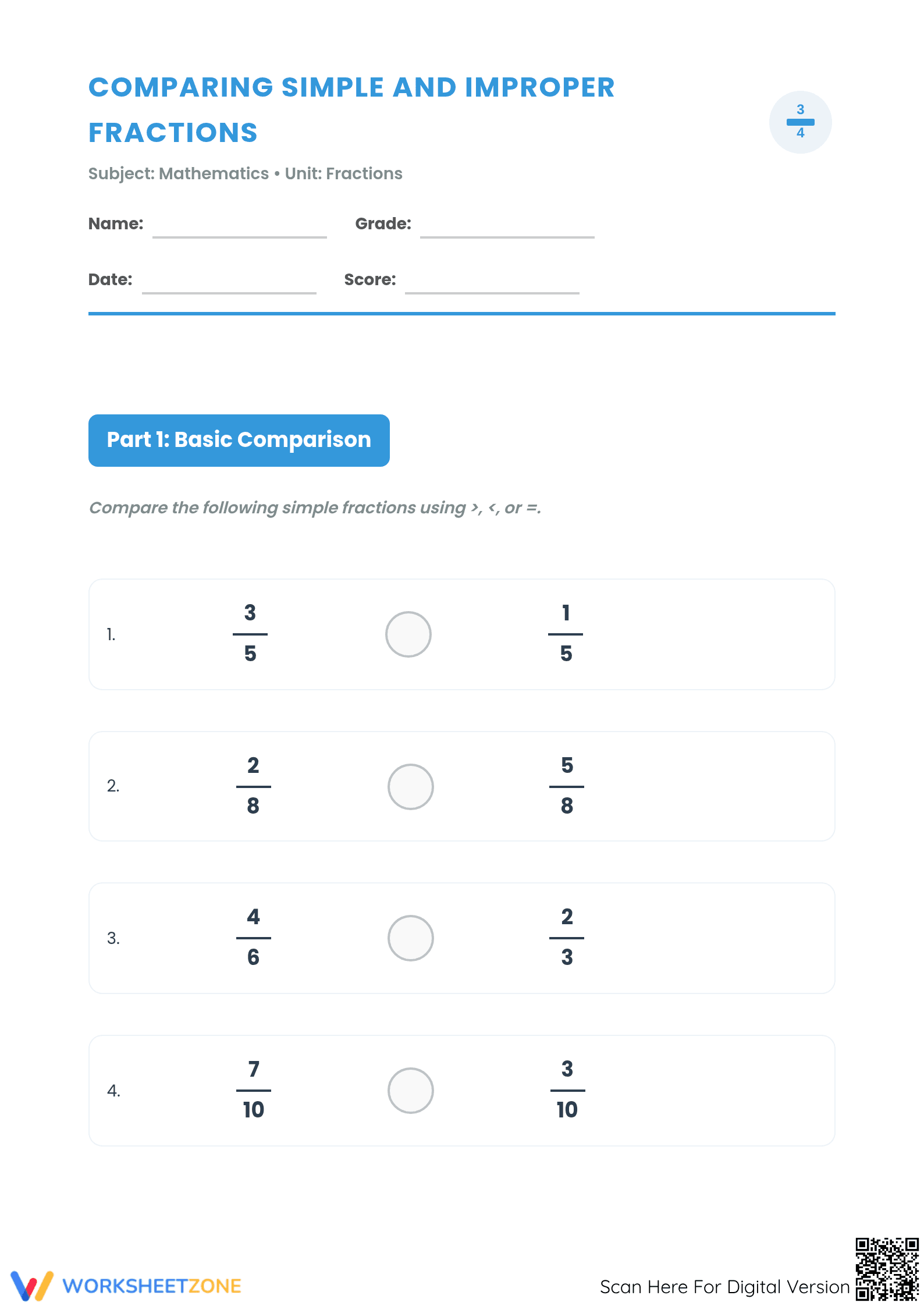
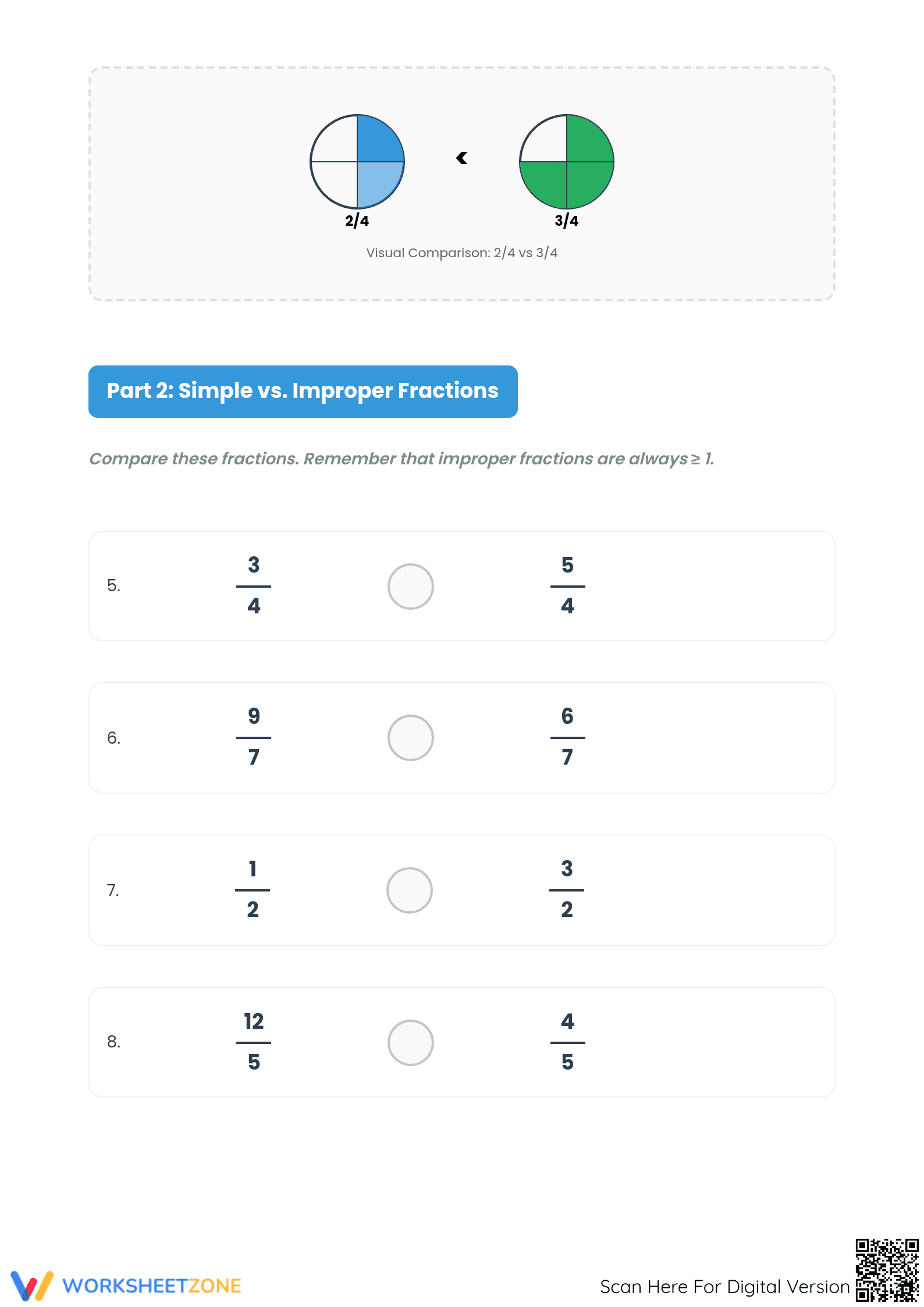
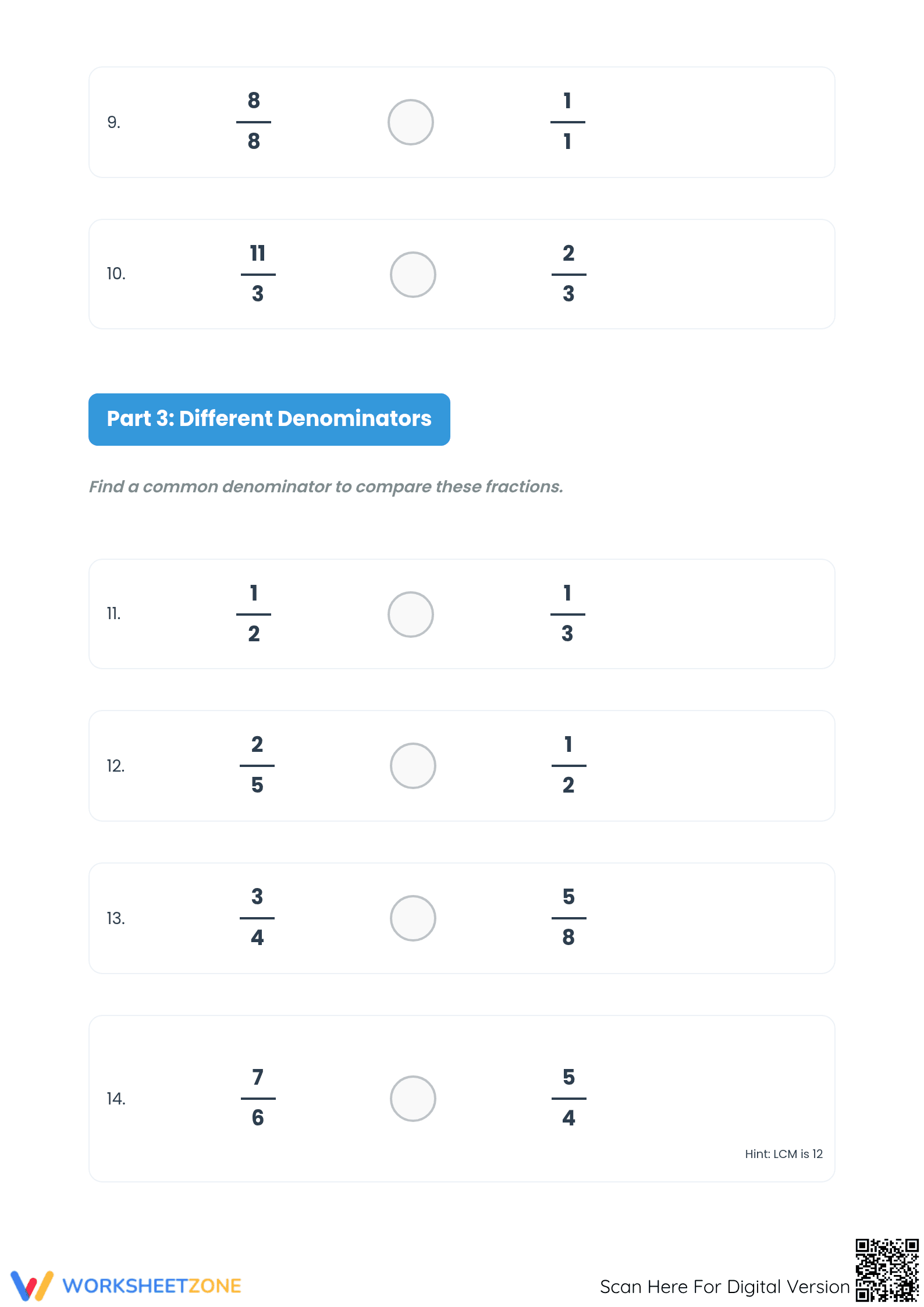
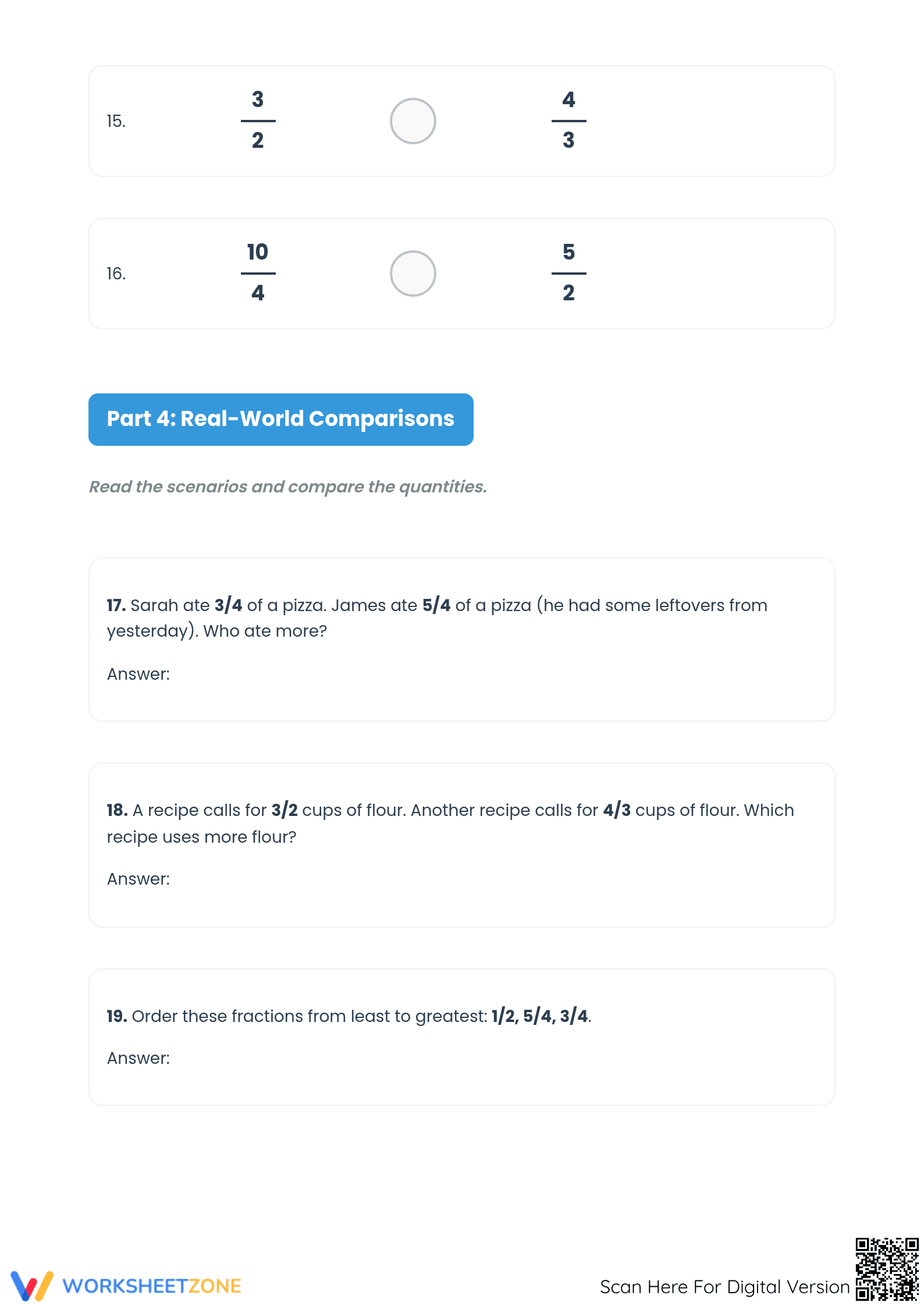

Comparing Simple & Improper Fractions | Printable Worksheet
Paste this activity's link or code into your existing LMS (Google Classroom, Canvas, Teams, Schoology, Moodle, etc.).
Students can open and work on the activity right away, with no student login required.
You'll still be able to track student progress and results from your teacher account.
Mastering fraction magnitude is a critical milestone in elementary mathematics. This comprehensive worksheet helps students build a deep conceptual understanding by comparing simple and improper fractions. Through a series of structured exercises, learners progress from basic visual comparisons to complex real-world scenarios, ensuring they can confidently determine fraction relationships across various contexts.
At a Glance
- Grade: 4 · Subject: Mathematics
- Standard:
CCSS.MATH.CONTENT.4.NF.A.2— Compare fractions with different numerators and denominators by creating common denominators- Skill Focus: Simple and Improper Fraction Comparison
- Format: 5 pages · 25 problems · Answer key included · PDF
- Best For: Guided practice or homework reinforcement
- Time: 30–45 minutes
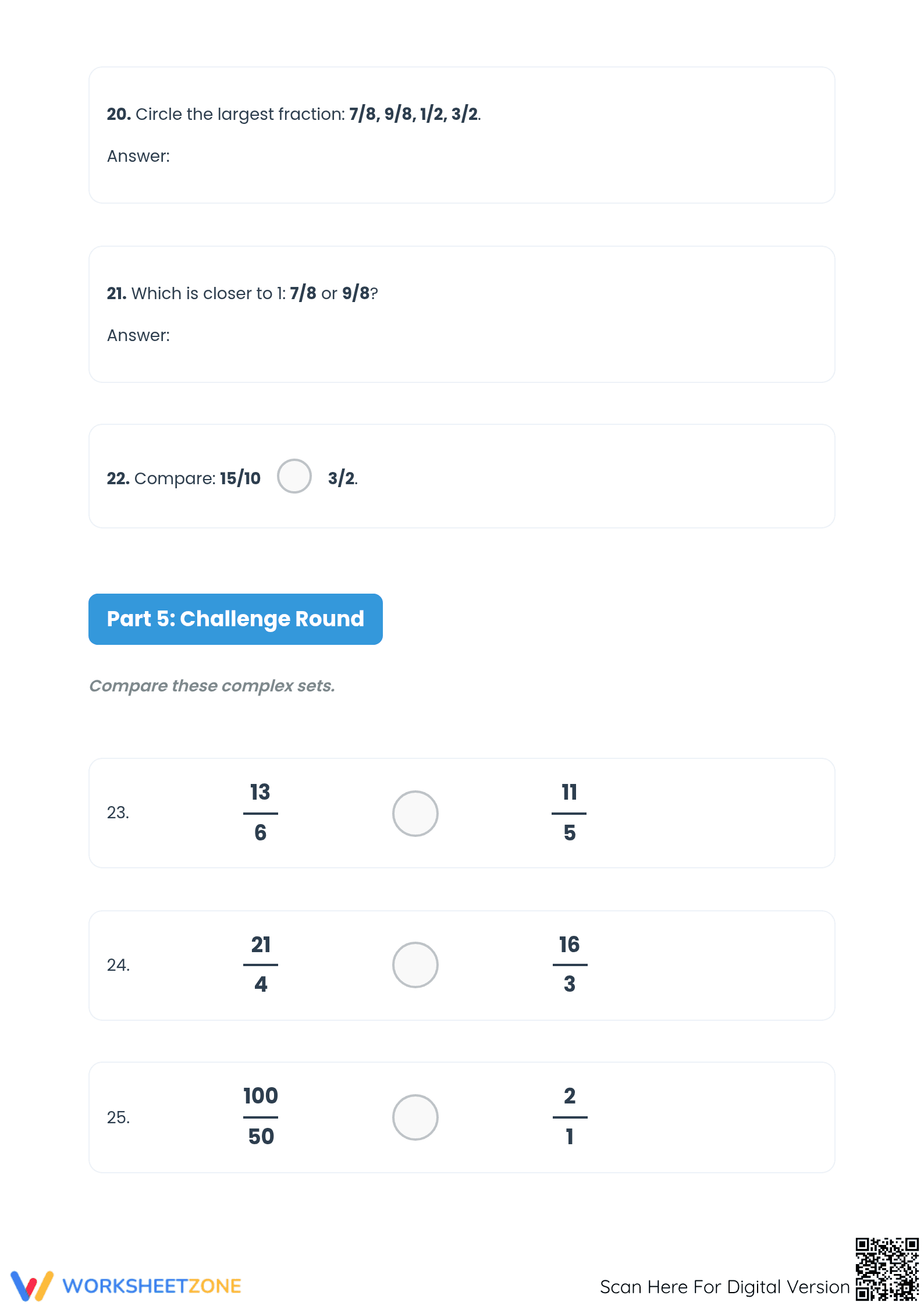
This extensive five-page PDF resource contains twenty-five carefully sequenced problems designed to bridge the gap between simple fraction concepts and improper fraction applications. The worksheet features visual aids, like shaded fraction circles, alongside numerical comparisons and complex word problems. A full answer key is included to facilitate quick grading and immediate student feedback for independent learners.
Skill Progression
- Guided Practice: Students begin with 4 problems using visual models and like denominators to anchor their understanding of relative fraction sizes.
- Supported Practice: Learners tackle 10 problems comparing improper fractions against proper ones, utilizing hints for finding least common multiples (LCM).
- Independent Practice: Students solve 11 complex tasks including real-world word problems and a challenge round involving three-way fraction ordering.
This structure follows the gradual-release model, moving from concrete visual support to abstract numerical reasoning.
Standards Alignment
The primary alignment is CCSS.MATH.CONTENT.4.NF.A.2, which requires students to compare two fractions with different numerators and denominators by creating common denominators or comparing to a benchmark. This worksheet directly supports this by requiring students to find common denominators and evaluate fraction sizes relative to 1. Both standard codes can be copied directly into lesson plans, IEP goals, or district curriculum mapping tools.
How to Use It
Use this set during the "We Do" phase of instruction after introducing improper fractions. Teachers can project the visual models on the second page to anchor the discussion on why improper fractions are always greater than or equal to one. For a formative assessment, observe students during Part 3 to see if they accurately identify the least common denominator before performing the final comparison.
Who It's For
This resource is tailored for Grade 4 students but serves as an excellent intervention tool for Grade 5 and 6 learners who require additional support with fraction magnitude. The inclusion of word problems makes it particularly useful for students who need to practice applying mathematical concepts to everyday situations, such as recipe measurements or sharing food in fractional amounts.
Research from EdReports 2024 emphasizes that a student's ability to accurately compare fractions is one of the strongest predictors of future success in algebra and higher-level mathematics. This worksheet addresses this critical need by providing multiple entry points into fraction magnitude, moving from concrete visual models to abstract symbolic representations. By explicitly including improper fractions, the resource challenges the common misconception that a fraction must always be less than one, a hurdle identified in NAEP performance data as a major barrier to middle school math readiness. The structured progression mirrors the instructional recommendations found in the RAND AIRS 2024 reports, which advocate for high-dosage practice that blends procedural fluency with conceptual depth. This design ensures students do not merely memorize cross-multiplication tricks but instead develop a robust mental number line for all fraction types, creating a foundation for proportional reasoning.


