


























Views
Downloads

Comparing Simple and Improper Fractions | Essential Math
Paste this activity's link or code into your existing LMS (Google Classroom, Canvas, Teams, Schoology, Moodle, etc.).
Students can open and work on the activity right away, with no student login required.
You'll still be able to track student progress and results from your teacher account.
Master the complexities of fractional magnitude with this comprehensive workbook. This resource guides students through the nuances of comparing simple and improper fractions using logic and number sense. By engaging with 30 distinct problems, learners develop the essential skills required to evaluate relationships between varied fraction types with complete confidence and accuracy.
At a Glance
- Grade: 4–6 · Subject: Math (Fractions)
- Standard:
4.NF.A.2— Compare two fractions with different numerators and denominators using operators- Skill Focus: Simple and Improper Fraction Comparison
- Format: 5 pages · 30 problems · Answer key included · PDF
- Best For: Mastery-based independent practice and assessment
- Time: 30–45 minutes
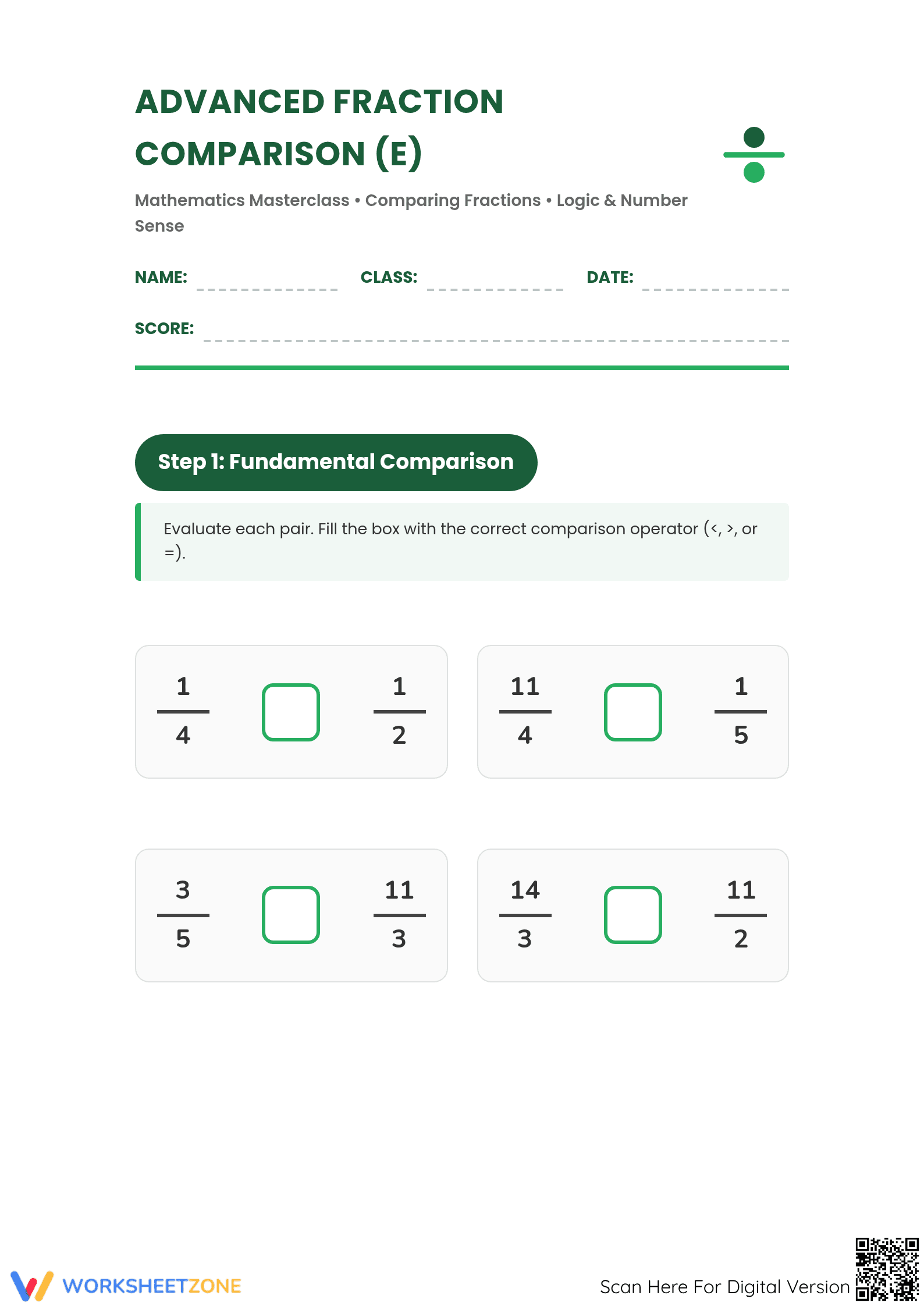
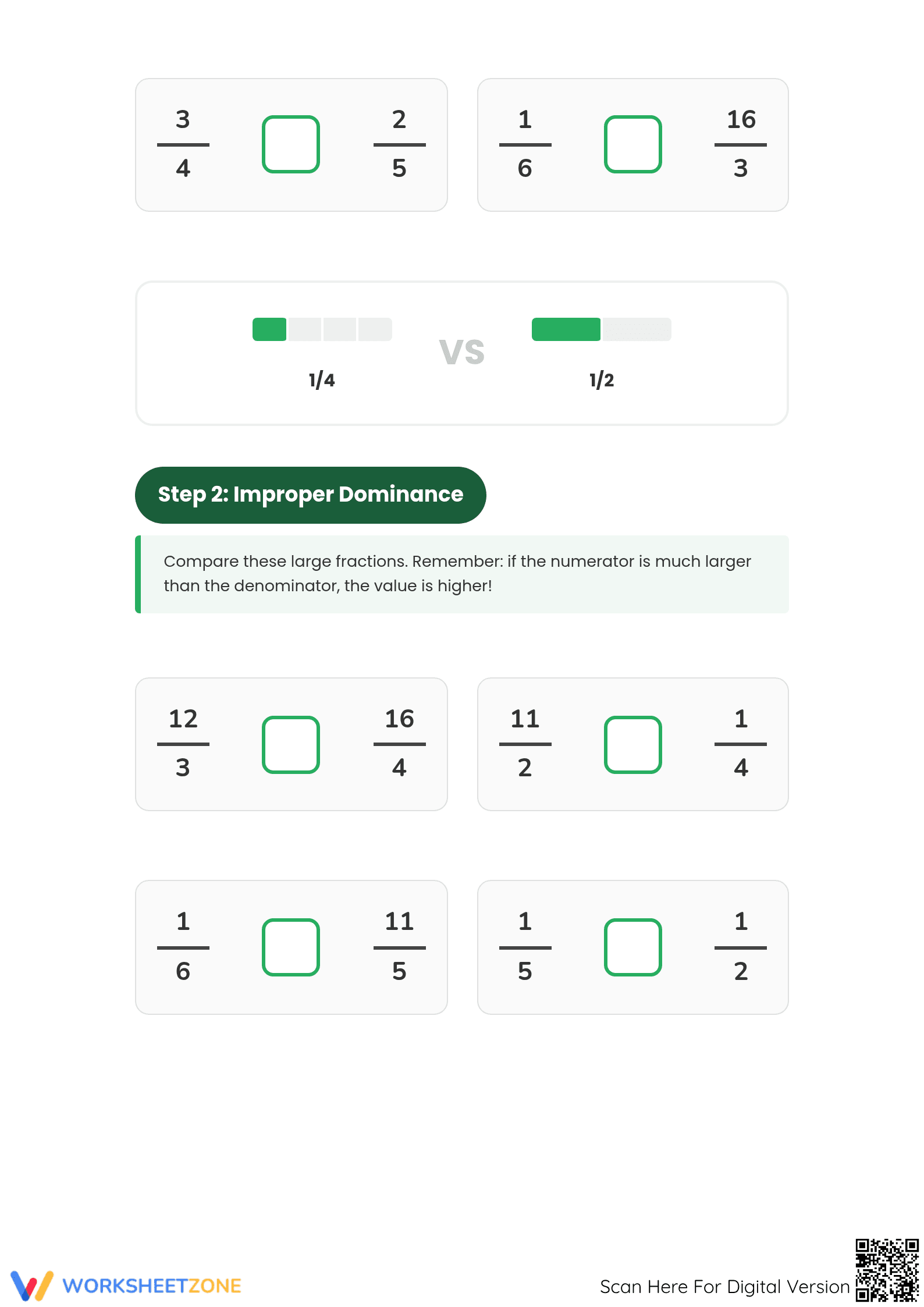
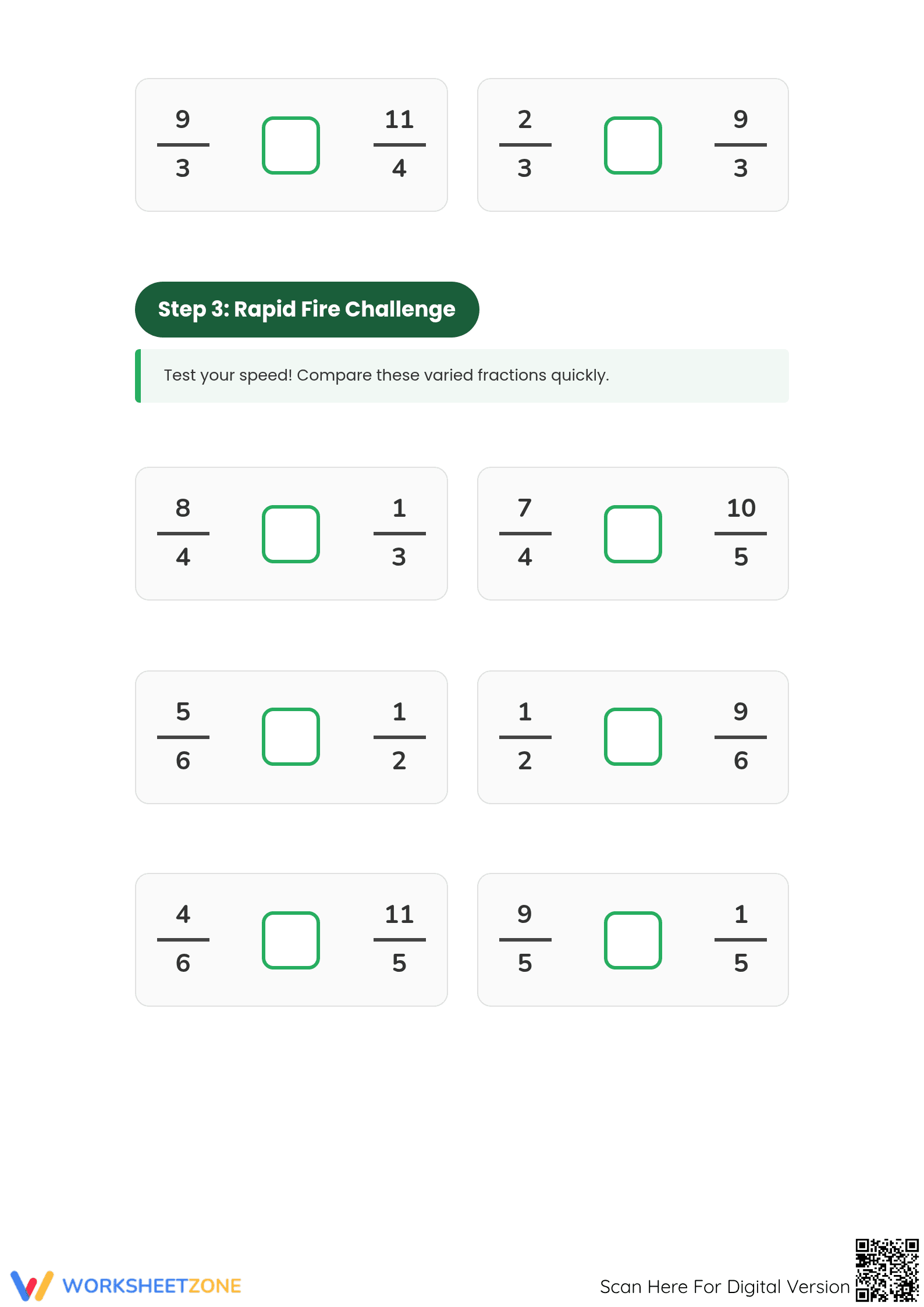
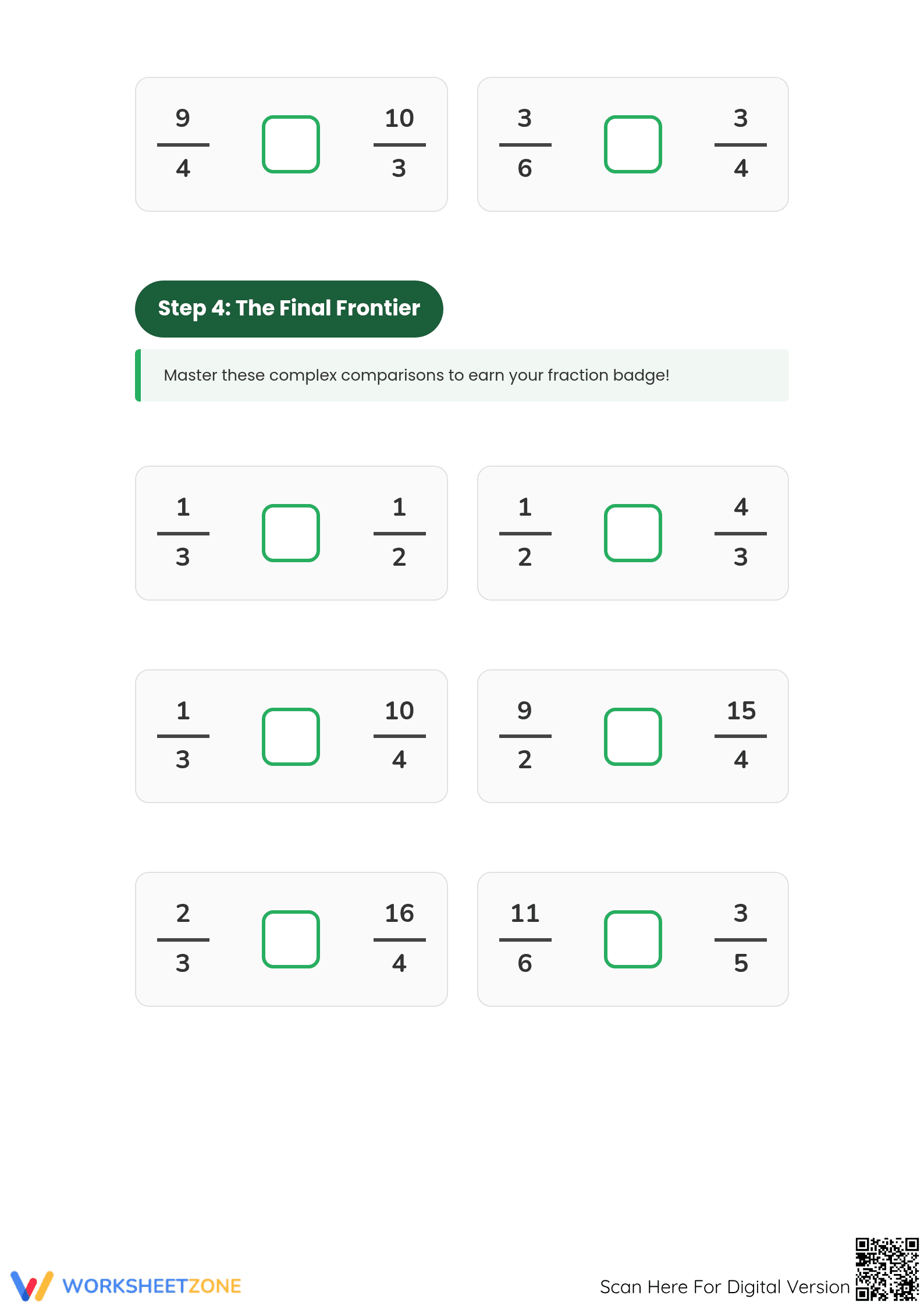
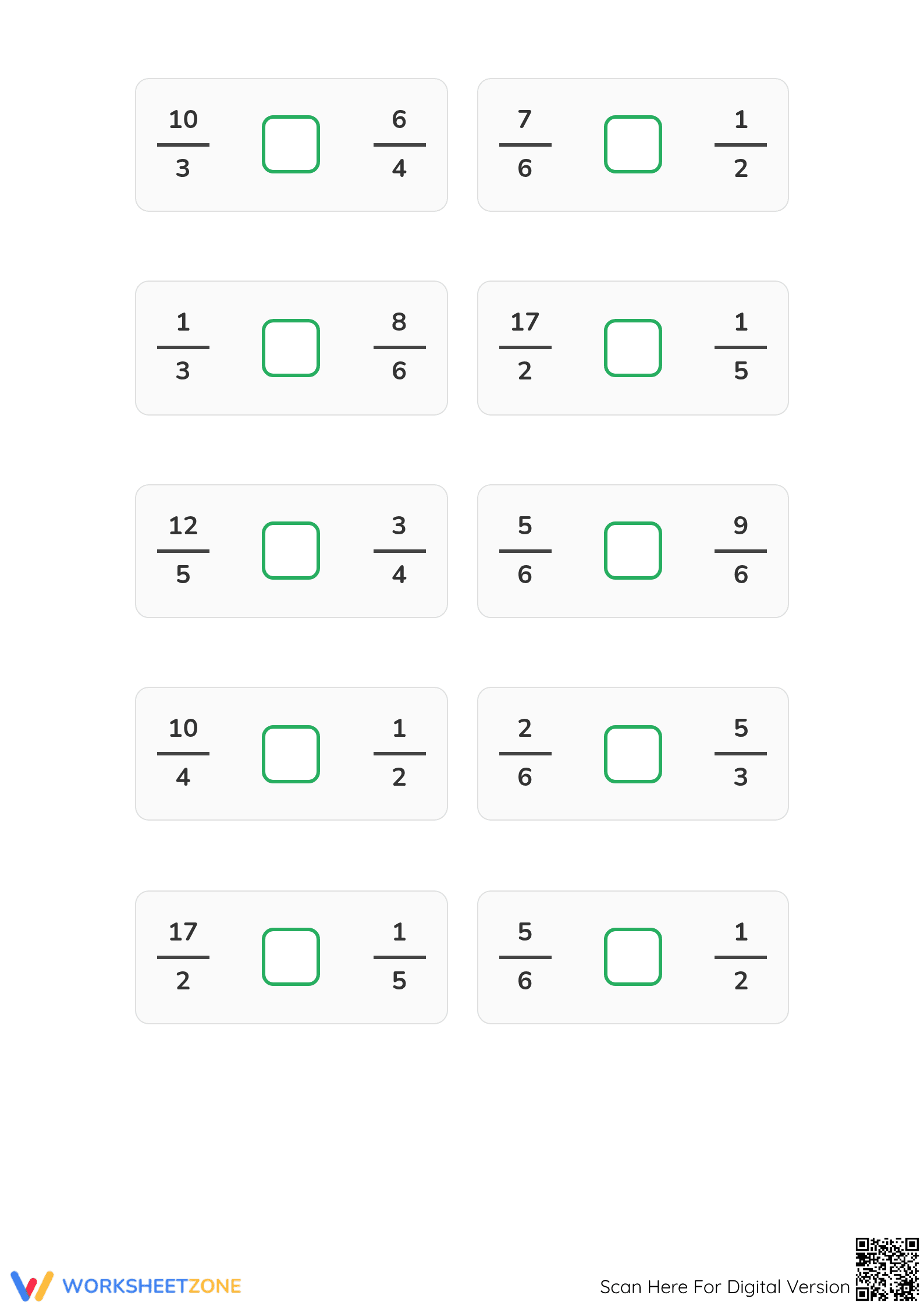
This 5-page printable packet features 30 carefully curated comparison tasks. The worksheet is organized into four distinct phases: Fundamental Comparison, Improper Dominance, Rapid Fire Challenge, and The Final Frontier. Each page introduces increased complexity, moving from basic unit fractions to large-scale improper fractions. A full answer key is provided to facilitate immediate feedback and efficient grading for busy classroom teachers.
- Guided Practice: Step 1 focuses on fundamental comparison, providing students with basic fraction pairs and visual benchmarks to establish a baseline for fractional magnitude and operator usage.
- Supported Practice: Step 2 introduces "Improper Dominance," where students apply specific logic to large-numerator fractions, focusing on the rule that values increase as the numerator grows relative to the denominator.
- Independent Practice: The "Final Frontier" phase presents 30 high-challenge problems that require students to apply multiple strategies quickly and accurately without scaffolds.
This phase-based approach ensures that students follow a gradual-release model, moving from I Do to We Do and finally to You Do with high-complexity improper sets.
Standards Alignment
This resource is specifically aligned to standard 4.NF.A.2. Students compare two fractions with different numerators and different denominators by creating common denominators or comparing to a benchmark fraction. The inclusion of improper fractions extends this goal into Grade 5 and 6 readiness. This standard code can be copied directly into lesson plans, IEP goals, or district curriculum mapping tools.
How to Use It
This worksheet is ideal for the independent practice portion of a fractions unit after students have learned about common denominators and benchmark fractions. Use the "Rapid Fire Challenge" as a timed formative assessment to gauge student fluency and identify those needing intervention. Teachers should observe whether students are drawing visual models or using mental benchmarks, as this indicates their current level of conceptual development. Expected completion time ranges from 30 to 45 minutes.
Who It's For
Designed for students in Grades 4 through 6, this resource is particularly effective for learners who have mastered basic fractions but struggle with improper values. It serves as an excellent extension for advanced Grade 4 students or a necessary remedial review for Grade 7 learners approaching pre-algebraic ratios and proportions. Pair this with a number line anchor chart for students requiring extra visual scaffolding.
Effective instruction in rational number systems requires students to develop a robust internal model of magnitude. This worksheet leverages a scaffolded four-step progression, from fundamental comparisons to complex improper fractions, to internalize the relationship between numerators and denominators. By transitioning from visual cues to abstract numeric reasoning, students build cognitive flexibility for advanced algebraic operations. This resource provides high-volume, structured practice necessary for students to meet the rigorous demands of standard 4.NF.A.2, specifically the ability to compare two fractions with different numerators and denominators, facilitating the conceptual shift from additive to multiplicative reasoning for long-term mathematical proficiency.


