


























Views
Downloads


Essential Comparing Proper and Improper Fractions Worksheet
Paste this activity's link or code into your existing LMS (Google Classroom, Canvas, Teams, Schoology, Moodle, etc.).
Students can open and work on the activity right away, with no student login required.
You'll still be able to track student progress and results from your teacher account.
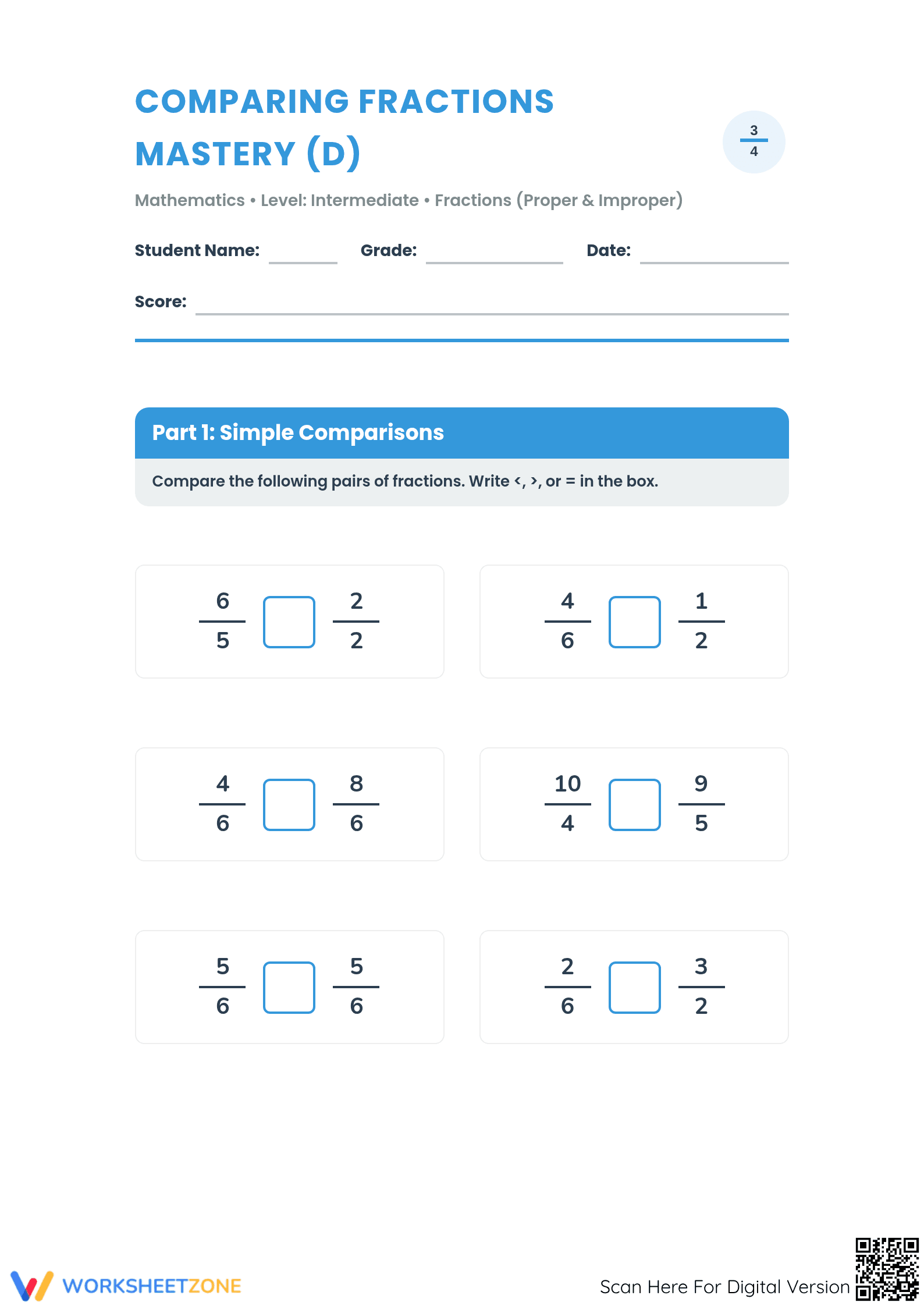
This comprehensive 4-page math packet provides structured practice for students learning to compare the magnitude of proper and improper fractions. By evaluating fractions with like and unlike denominators, learners develop a concrete understanding of fractional values relative to one whole. This essential resource ensures students achieve fluency in using comparison symbols accurately.
At a Glance
- Grade: 4 · Subject: Math
- Standard:
CCSS.MATH.CONTENT.4.NF.A.2— Compare two fractions with different numerators and denominators using symbols- Skill Focus: Magnitude comparison of proper and improper fractions
- Format: 4 pages · 34 problems · Answer key included · PDF
- Best For: Small group intervention and fraction mastery
- Time: 25–40 minutes
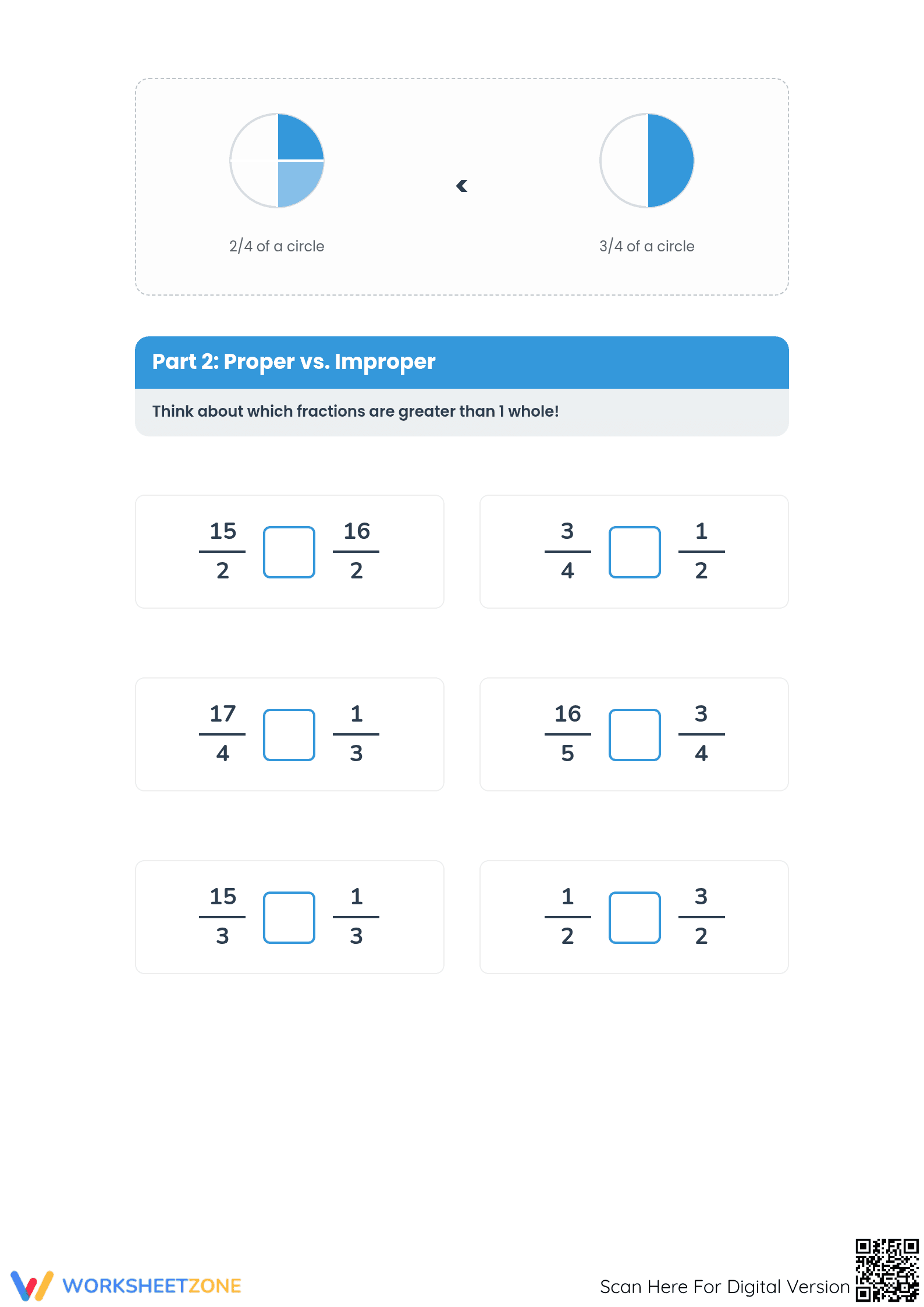
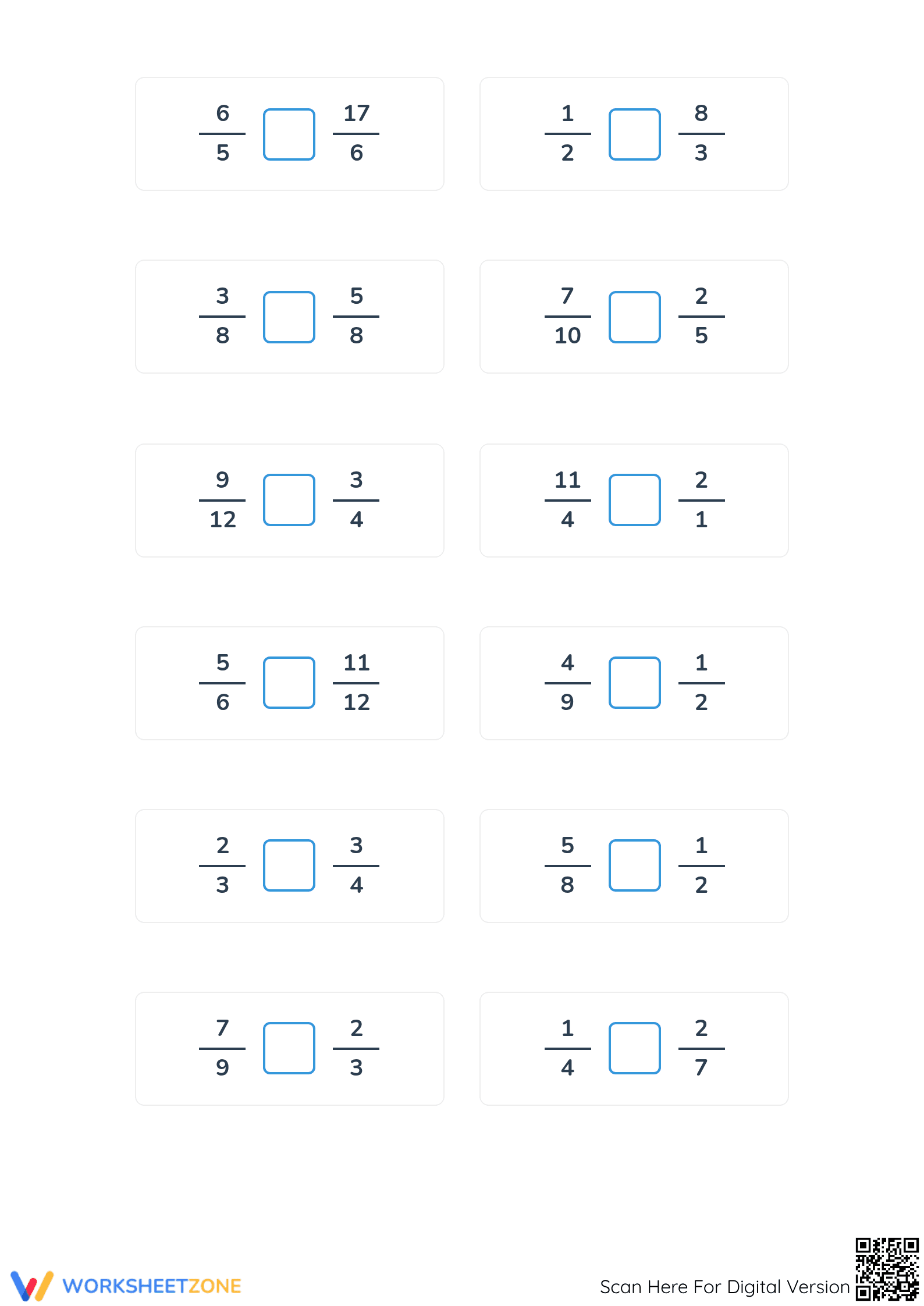
Across four detailed pages, this worksheet offers 34 distinct comparison tasks. The content is organized into four logical parts, starting with simple visual-supported comparisons and ending with a challenge mode. Every page is clearly formatted with large, readable fractions and dedicated boxes for comparison symbols. A complete answer key is included for immediate grading and student self-correction.
Skill Progression
- Guided Practice: Part 1 uses 6 simple comparisons to establish a baseline for magnitude recognition using common denominators.
- Supported Practice: Parts 2 and 3 provide 14 problems comparing proper vs. improper forms, requiring students to identify fractions greater than one whole.
- Independent Practice: The final 14 problems, including Challenge Mode, require common denominator calculations for precise comparison of unlike fractions.
This gradual release model ensures students build confidence before tackling complex unlike denominators and mixed fractional forms.
Standards Alignment
The primary alignment is CCSS.MATH.CONTENT.4.NF.A.2, requiring students to compare two fractions with different numerators and denominators. It supports mastery of fractional magnitude and comparison symbols. Both standard codes can be copied directly into lesson plans, IEP goals, or district curriculum mapping tools.
How to Use It
This resource is best utilized during the "Independent Practice" phase of a lesson or as a follow-up homework assignment after direct instruction on improper fractions. For formative assessment, observe students during Part 2 to see if they recognize that any improper fraction is greater than a proper fraction without calculation. Expected completion time ranges from 25 to 40 minutes depending on proficiency.
Who It's For
This worksheet is designed for upper elementary students in Grades 4 and 5, though it remains a valuable remediation tool for middle school learners. It is particularly effective for students who struggle with the abstract nature of fractions greater than one. Pair this with a fraction tile set or a visual number line to provide additional concrete scaffolding for tiered learners.
The instructional design of this resource aligns with the National Assessment of Educational Progress (NAEP) findings which emphasize that magnitude comparison of fractions is a primary indicator of overall mathematical proficiency in middle childhood. By requiring students to evaluate the relationship between proper and improper fractions, the worksheet addresses common misconceptions regarding the "wholeness" of fractions. Fisher & Frey (2014) highlight the efficacy of gradual release models, which are mirrored here through the transition from simple visual comparisons to complex common-denominator calculations. This Grade 4-5 tool provides the necessary repetitions for students to internalize the logic of numerators and denominators. Aligned to CCSS.MATH.CONTENT.4.NF.A.2, it serves as a robust evidence-based intervention for learners struggling with fractional equivalency. The inclusion of 34 distinct tasks ensures that students move beyond surface-level guessing toward a deeper, reproducible mastery of fraction magnitude comparison.


