




























Views
Downloads
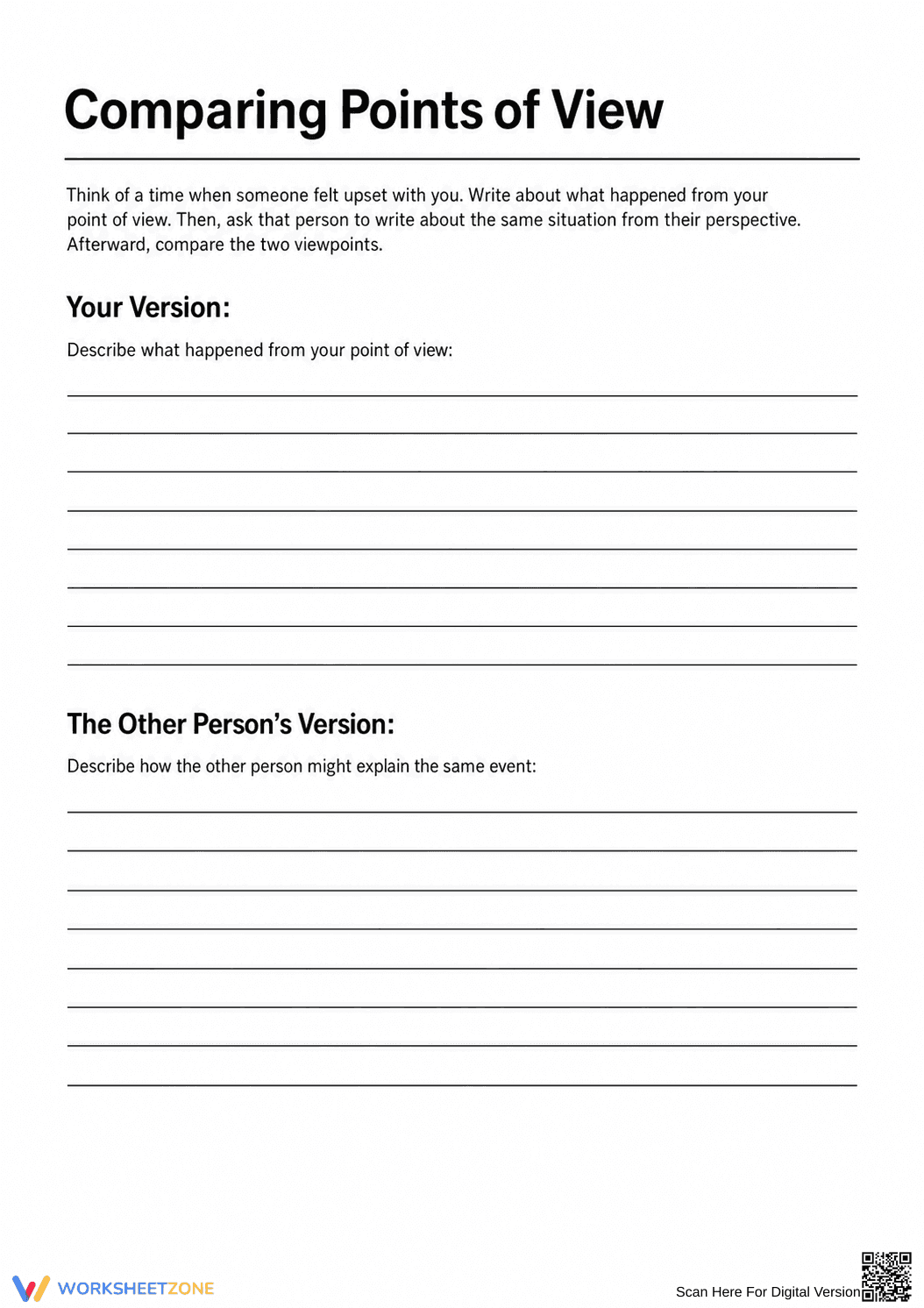

Grade 12 Point of View — Printable No-Prep Worksheet

Paste this activity's link or code into your existing LMS (Google Classroom, Canvas, Teams, Schoology, Moodle, etc.).
Students can open and work on the activity right away, with no student login required.
You'll still be able to track student progress and results from your teacher account.
This perspective-taking worksheet helps students analyze conflicts by documenting a personal disagreement from two distinct angles. By articulating their own experience alongside another person's account, learners develop the critical social-emotional capacity to recognize subjective bias and improve interpersonal communication outcomes.
At a Glance
- Grade: 12 · Subject: Social Skills
- Standard:
CCSS.ELA-LITERACY.W.11-12.3— Write narratives to develop real experiences- Skill Focus: Perspective-taking and conflict analysis
- Format: 1 page · 2 tasks · No answer key · PDF
- Best For: Conflict resolution and empathy building
- Time: 15–20 minutes
The resource consists of a single-page PDF structured into two primary narrative zones. The first section provides ample lined space for the student to recount a specific incident where a conflict occurred. The second section mirrors this layout, prompting the student to reconstruct the event from an external viewpoint. Because responses are highly individualized, an answer key is not applicable.
The zero-prep workflow for this resource is designed for immediate implementation in high-pressure environments like counseling sessions or advisory periods. First, print the single-page PDF (30 seconds). Second, distribute the sheet and provide the initial prompt for students to identify a recent interpersonal friction point (1 minute). Third, facilitate a brief follow-up discussion or peer-review session to compare the two accounts (10 minutes). Total teacher preparation time is under 2 minutes, making it an ideal sub plan or emergency social-emotional learning activity.
This worksheet aligns with CCSS.ELA-LITERACY.W.11-12.3, which focuses on writing narratives to develop real experiences or events using well-chosen details and well-structured event sequences. By requiring students to pivot between first-person and third-person perspectives, it also supports the analysis of point of view. Both standard codes can be copied directly into lesson plans, IEP goals, or district curriculum mapping tools.
Use this worksheet during the "during instruction" phase of a social-emotional learning unit on communication. It serves as a powerful formative assessment tool; observe whether students can identify specific emotional triggers in the alternate version that differ from their own. Alternatively, assign it as a reflective homework task following a classroom disagreement to de-escalate tension. Expected completion time ranges from 15 to 20 minutes depending on the depth of the narrative.
This resource is tailored for Grade 12 students, college-level learners, and adults in social skills training programs. It is particularly effective for students with IEP goals related to social interaction or pragmatic language. Pair this worksheet with a direct instruction lesson on "I-statements" or an anchor chart detailing the ladder of inference to maximize the instructional impact.
Research by Fisher & Frey (2014) emphasizes that perspective-taking is a foundational component of metacognitive development in adolescent and adult learners. This worksheet operationalizes that research by forcing a structural shift in narrative voice, which is essential for achieving the mastery levels described in CCSS.ELA-LITERACY.W.11-12.3 where students write narratives to develop real experiences. By documenting two versions of the same event, students engage in the perspective-shifting required for advanced rhetorical analysis and conflict mediation. According to the RAND AIRS 2024 report on social-emotional learning, structured writing prompts that target empathy significantly improve classroom climate and reduce disciplinary incidents in secondary education. This 1-page tool provides the necessary scaffolding for students to move beyond self-centered narratives toward a more objective understanding of social dynamics, making it a vital asset for any high school or adult education curriculum focused on interpersonal effectiveness and communication.


