


























Views
Downloads

Comparing Numbers with Touch Dots | Printable Grade K
Paste this activity's link or code into your existing LMS (Google Classroom, Canvas, Teams, Schoology, Moodle, etc.).
Students can open and work on the activity right away, with no student login required.
You'll still be able to track student progress and results from your teacher account.
This comparing numbers worksheet builds early numerical fluency by guiding students to evaluate single-digit quantities using multisensory touch points. Learners identify greater and smaller numbers from zero through nine before practicing formal inequality symbols, establishing a firm conceptual foundation for comparing written numerals.
At a Glance
- Grade: Kindergarten · Subject: Math
- Standard:
CCSS.MATH.CONTENT.K.CC.C.7— Compare two numbers between 1 and 10 presented as written numerals- Skill Focus: Comparing single-digit numbers using touch dots and relational symbols
- Format: 2 pages · 20 problems · Answer key included · PDF
- Best For: Guided math intervention and independent practice
- Time: 15–20 minutes
What's Inside
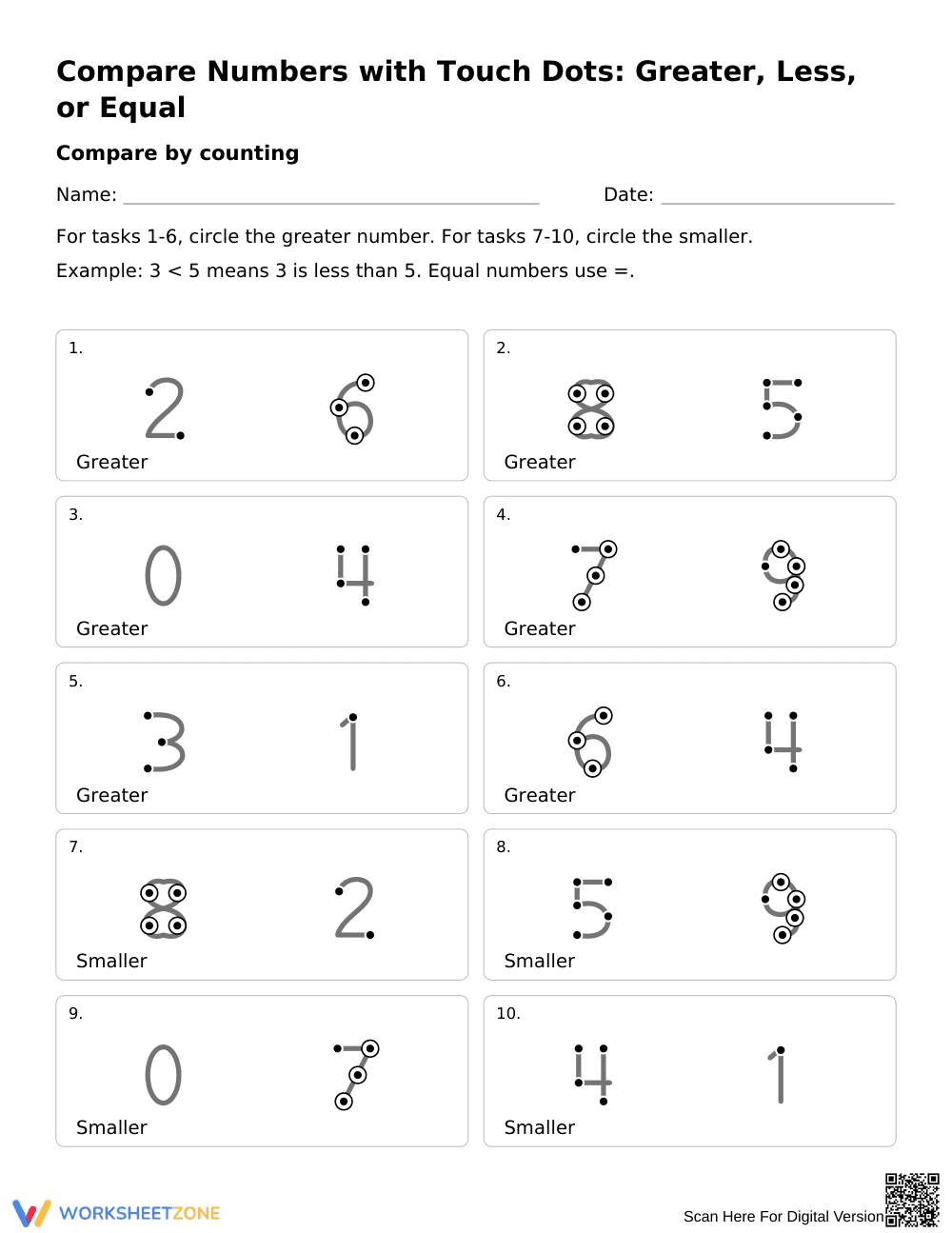
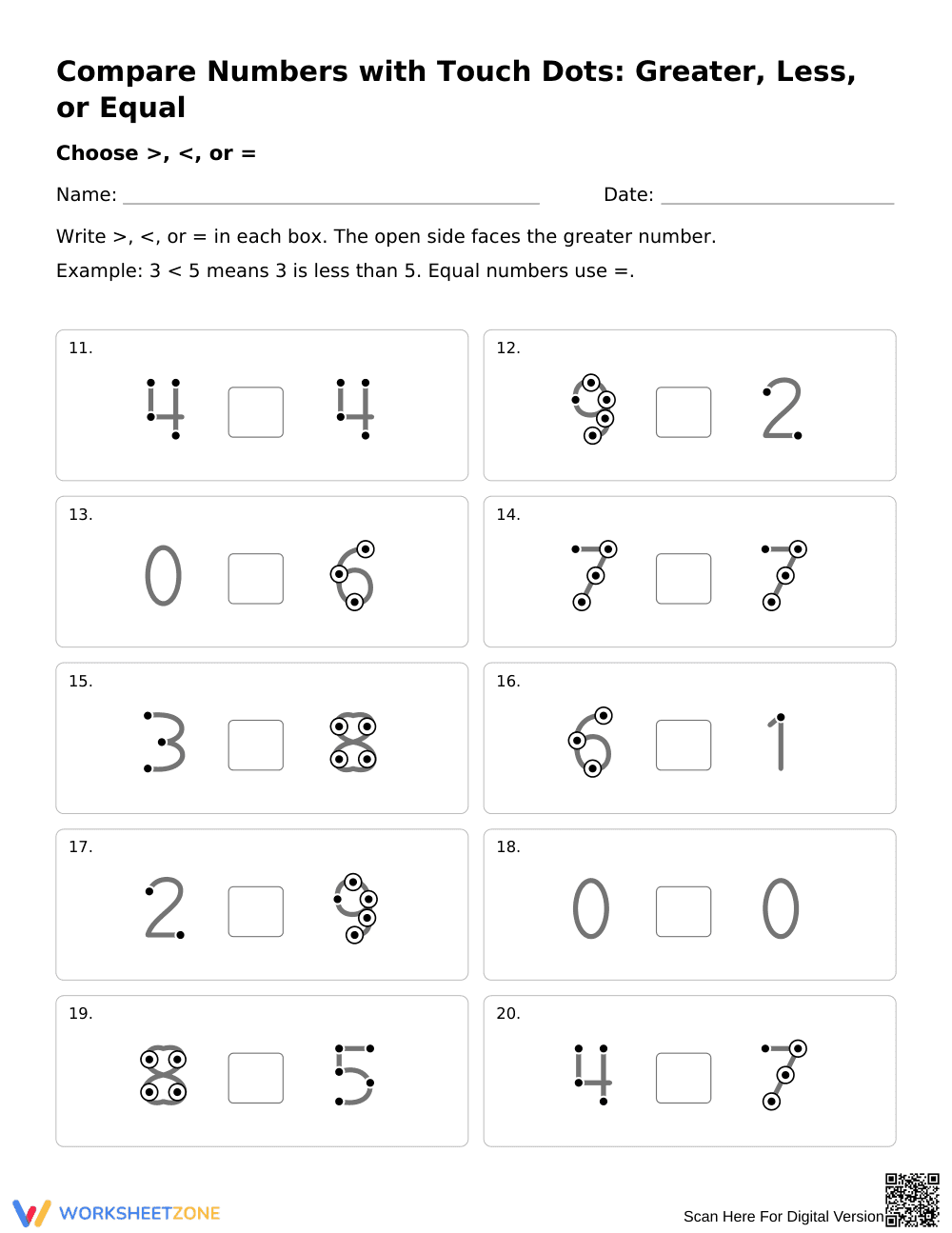
This two-page printable resource includes 20 comparison tasks alongside a complete one-page answer key. The first page features ten counting exercises where students circle either the greater or smaller numeral. The second page provides ten comparison boxes where students write greater than, less than, or equal symbols. Tactile touch dots on every numeral support accurate one-to-one counting.
Skill Progression
- Guided practice (Problems 1–6): Students count touch dots to circle the greater number using visual anchors.
- Supported practice (Problems 7–10): Learners locate the smaller number with reduced prompting to reinforce directional comparison vocabulary.
- Independent practice (Problems 11–20): Students write comparison symbols (>, <, or =) independently within dedicated answer boxes.
This sequence follows the gradual-release model, transitioning learners smoothly from supported counting to autonomous symbol application.
Standards Alignment
The primary focus aligns with `CCSS.MATH.CONTENT.K.CC.C.7`: Compare two numbers between 1 and 10 presented as written numerals. Comparative symbol practice also supports `CCSS.MATH.CONTENT.1.NBT.B.3`. Both standard codes can be copied directly into lesson plans, IEP goals, or district curriculum mapping tools.
How to Use It
Use page 1 during small-group instruction to guide students through dot-counting routines. Assign page 2 after instruction as an independent check or exit ticket. Watch whether students touch dots sequentially or guess by visual size; tracking finger placement provides quick formative assessment data. Students typically complete all 20 problems in 15 to 20 minutes.
Who It's For
This worksheet is ideal for kindergarten students, first-grade intervention groups, and special education classrooms utilizing multisensory math strategies. Teachers can provide physical counters for extra support or ask advanced learners to read their completed statements aloud. Pair this page with an anchor chart illustrating comparison symbols to reinforce conceptual understanding.
Aligned to CCSS.MATH.CONTENT.K.CC.C.7, this printable math resource equips early learners to compare two numbers between 0 and 9 using multisensory touch-dot counting and relational symbols. By incorporating concrete touch points directly onto numeric digits, the worksheet scaffolds number sense development and strengthens quantitative reasoning for beginning mathematicians. As demonstrated in Fisher & Frey (2014), structured scaffolds that transition systematically from guided visual practice to independent symbolic application accelerate conceptual retention and reduce cognitive overload during initial skill acquisition. Students first identify relative quantity through targeted circling exercises before recording standard inequality notation including greater than, less than, and equal signs across 20 distinct problem scenarios. The inclusion of full answer keys supports reliable classroom checks, making this instructional tool an effective asset for general instruction, targeted tier-two math interventions, and foundational special education programming across elementary classrooms.


