


























Views
Downloads



Grade 5 Comparing Fractions — Printable No-Prep Worksheet
Paste this activity's link or code into your existing LMS (Google Classroom, Canvas, Teams, Schoology, Moodle, etc.).
Students can open and work on the activity right away, with no student login required.
You'll still be able to track student progress and results from your teacher account.
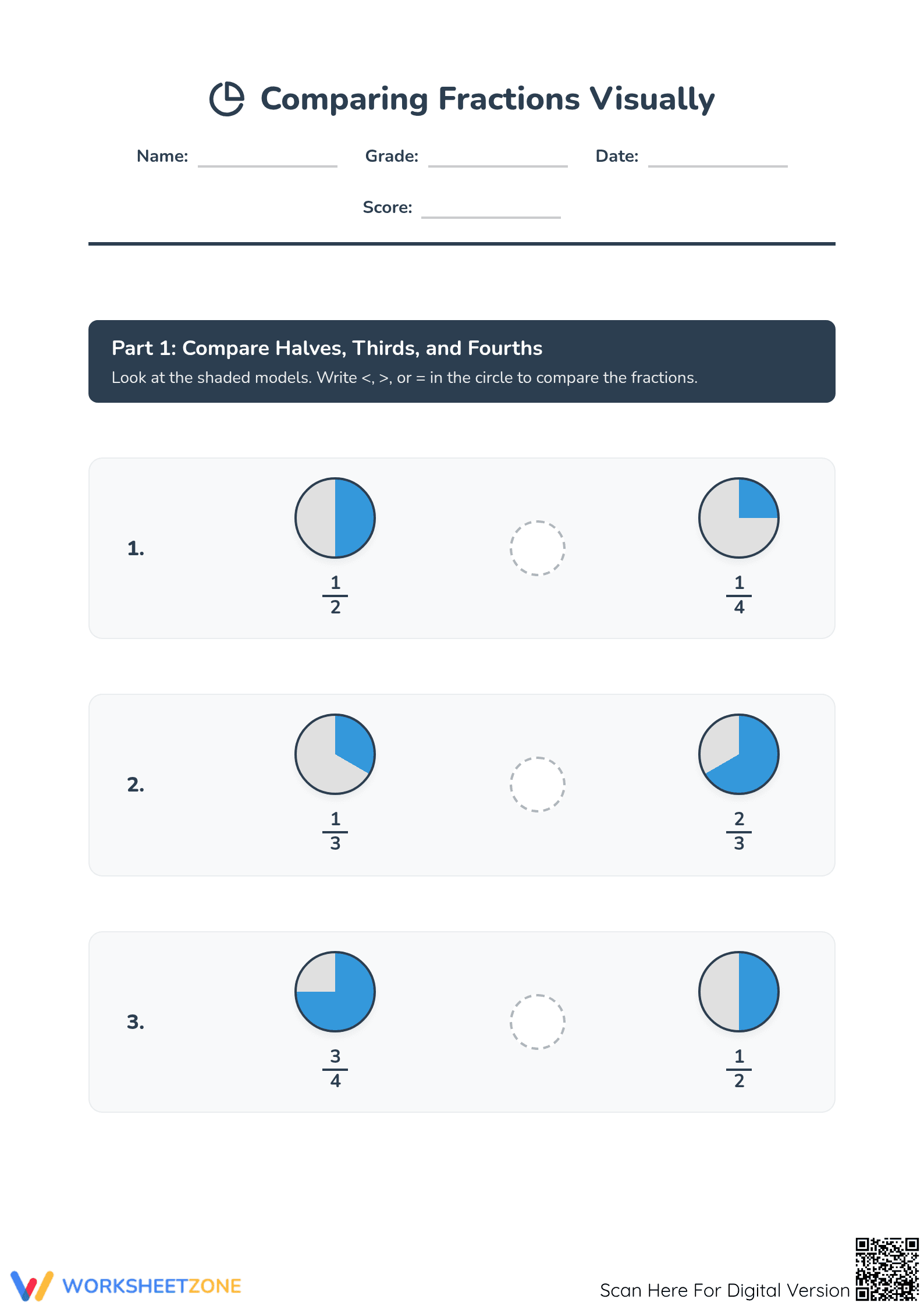
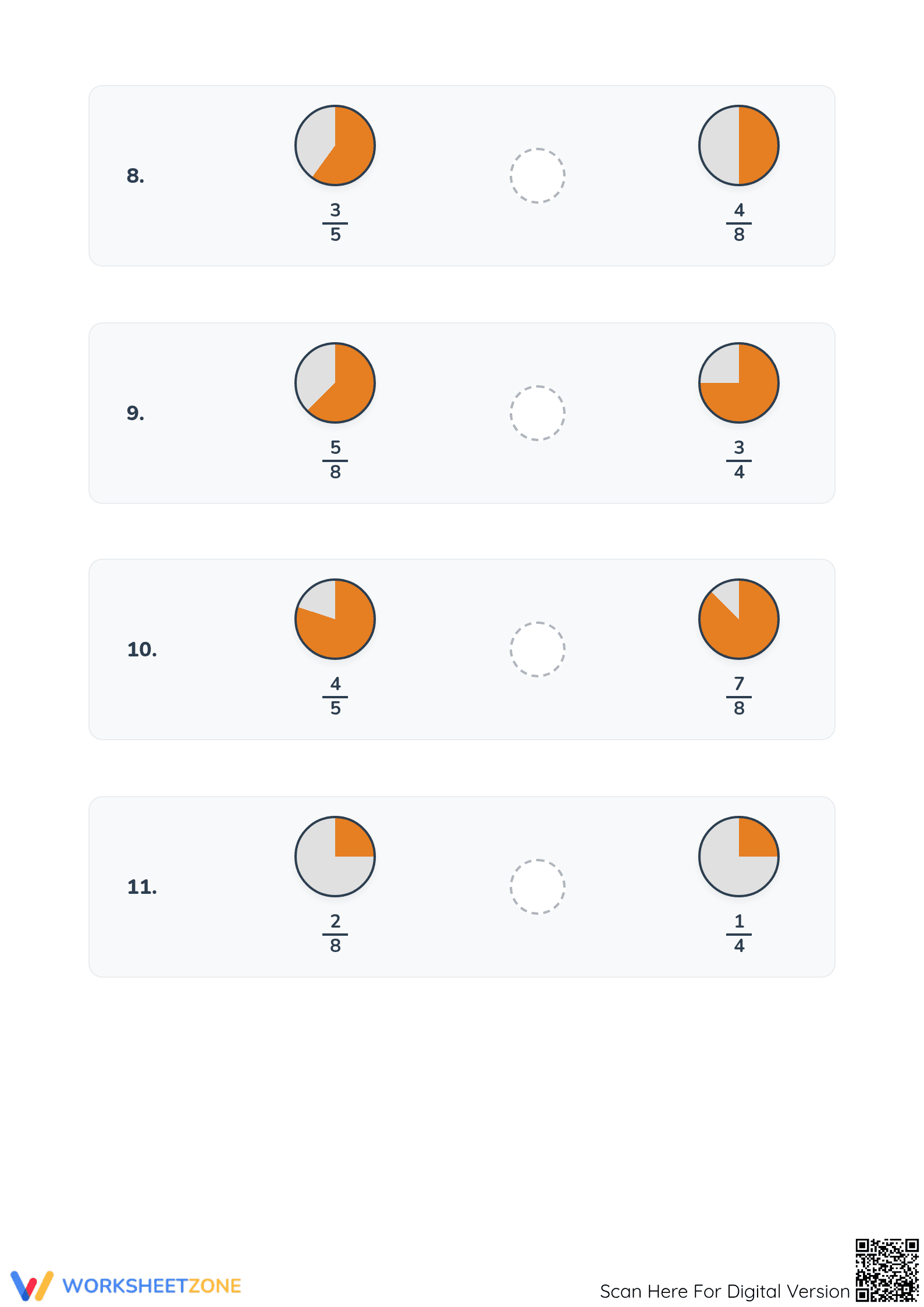
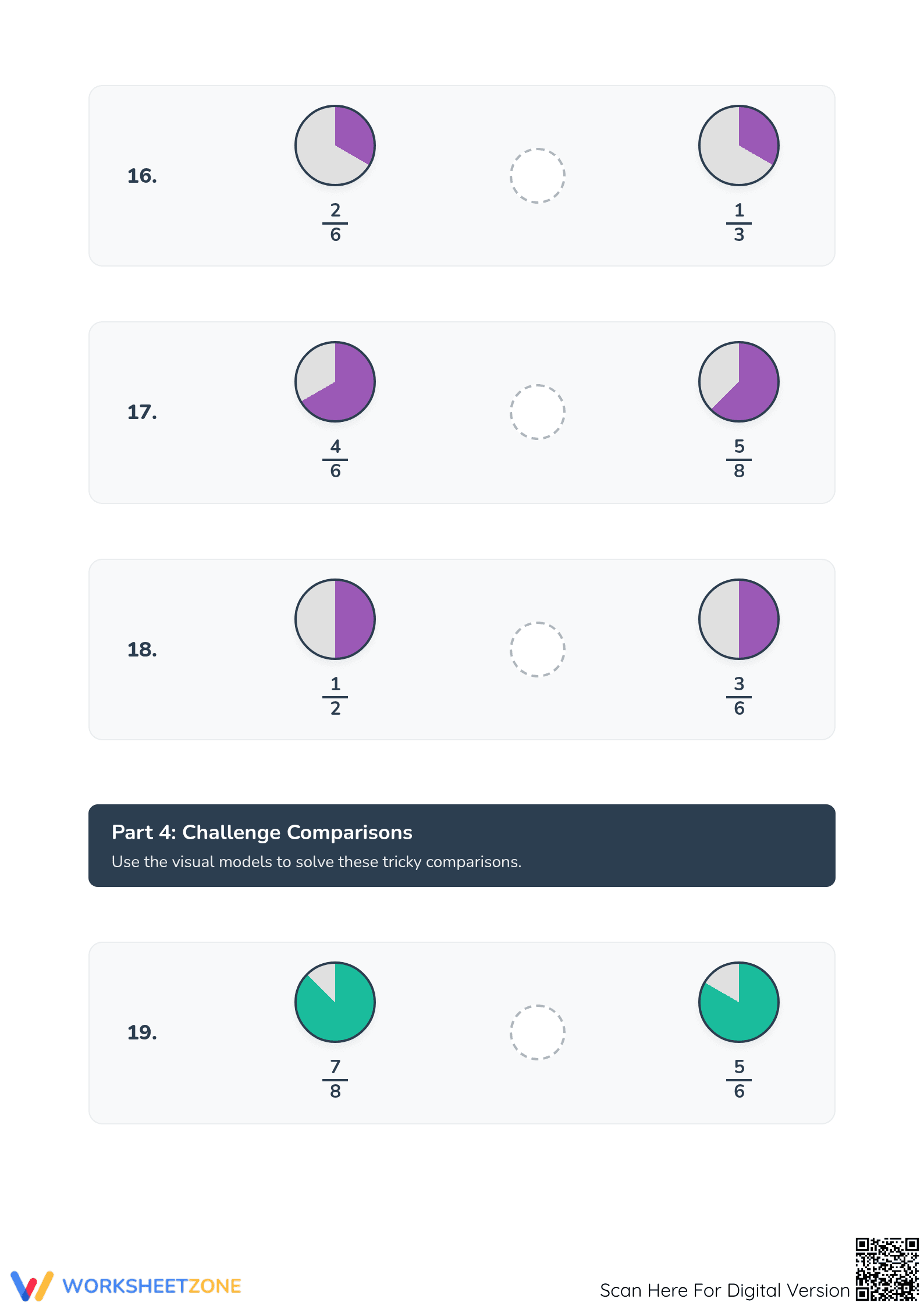
This worksheet gives Grade 5 students targeted practice comparing fractions with visual models. Learners will strengthen their ability to determine equivalence and relative size by analyzing shaded graphical representations. It builds a strong foundation for understanding fraction relationships before tackling more abstract comparisons and operations.
At a Glance
- Grade: 5 · Subject: Math
- Standard:
CCSS.MATH.CONTENT.4.NF.A.2— Compare two fractions with different numerators and denominators using visual models.- Skill Focus: Comparing Fractions Visually
- Format: 5 pages · 20 problems · Answer key included · PDF
- Best For: Independent practice, homework, or formative assessment.
- Time: 20–30 minutes
This resource includes a five-page worksheet with 20 problems for visually comparing fractions. Each task presents two fractions with graphical models, where students use >, <, or =. A complete five-page answer key is also provided for quick grading or student self-checking.
A Zero-Prep Workflow
Designed for immediate classroom use, this resource saves planning time. The process is simple:
- Print (1 minute): The five student pages are formatted for quick printing.
- Distribute (1 minute): Hand out the pages for independent work. The instructions are self-explanatory.
- Review (5-10 minutes): Use the included answer key to grade work efficiently.
With under two minutes of prep, this is a perfect activity for a sub plan or homework.
Alignment to Common Core
This worksheet directly aligns with CCSS.MATH.CONTENT.4.NF.A.2, where students use visual models to compare fractions. While a 4th-grade standard, it provides essential review for 5th graders, ensuring they have the conceptual underpinning for complex fraction operations. The standard code can be copied directly into lesson plans or curriculum maps.
How to Use in Your Classroom
Use this as an independent practice activity after a lesson on visual fraction models. The 20 problems offer enough data for a formative assessment. Observe how students interpret the visuals to check for misconceptions. Alternatively, assign it as homework to reinforce the concept. Most students can complete it in 20 to 30 minutes.
Who It's For
This worksheet is for 5th-grade students needing concrete practice with fraction comparison. It's also an excellent review for 6th graders. The clear visuals make it accessible for diverse learners. Pair this with hands-on fraction bars to provide a tactile learning experience before using the worksheet.
Supporting students' conceptual understanding of fractions is a critical instructional goal. This worksheet provides practice aligned with CCSS.MATH.CONTENT.4.NF.A.2, focusing on using visual models to compare fractions—a strategy proven to build foundational number sense. Research highlights the importance of connecting visual representations to symbolic notation. For instance, the RAND AIRS (2024) synthesis of effective math instruction emphasizes that proficiency with fractions is a key predictor of success in algebra. By giving students structured opportunities to analyze and compare graphical representations of fractions, this resource helps solidify their understanding of part-whole relationships. This visual approach ensures students develop the flexible, conceptual knowledge needed for more advanced mathematics, a finding consistent with analyses on the NAEP.


