


























Views
Downloads

Printable Compare Decimals Worksheet | Grade 4 Math
Paste this activity's link or code into your existing LMS (Google Classroom, Canvas, Teams, Schoology, Moodle, etc.).
Students can open and work on the activity right away, with no student login required.
You'll still be able to track student progress and results from your teacher account.
Mastering Decimal Comparison with Visual Models
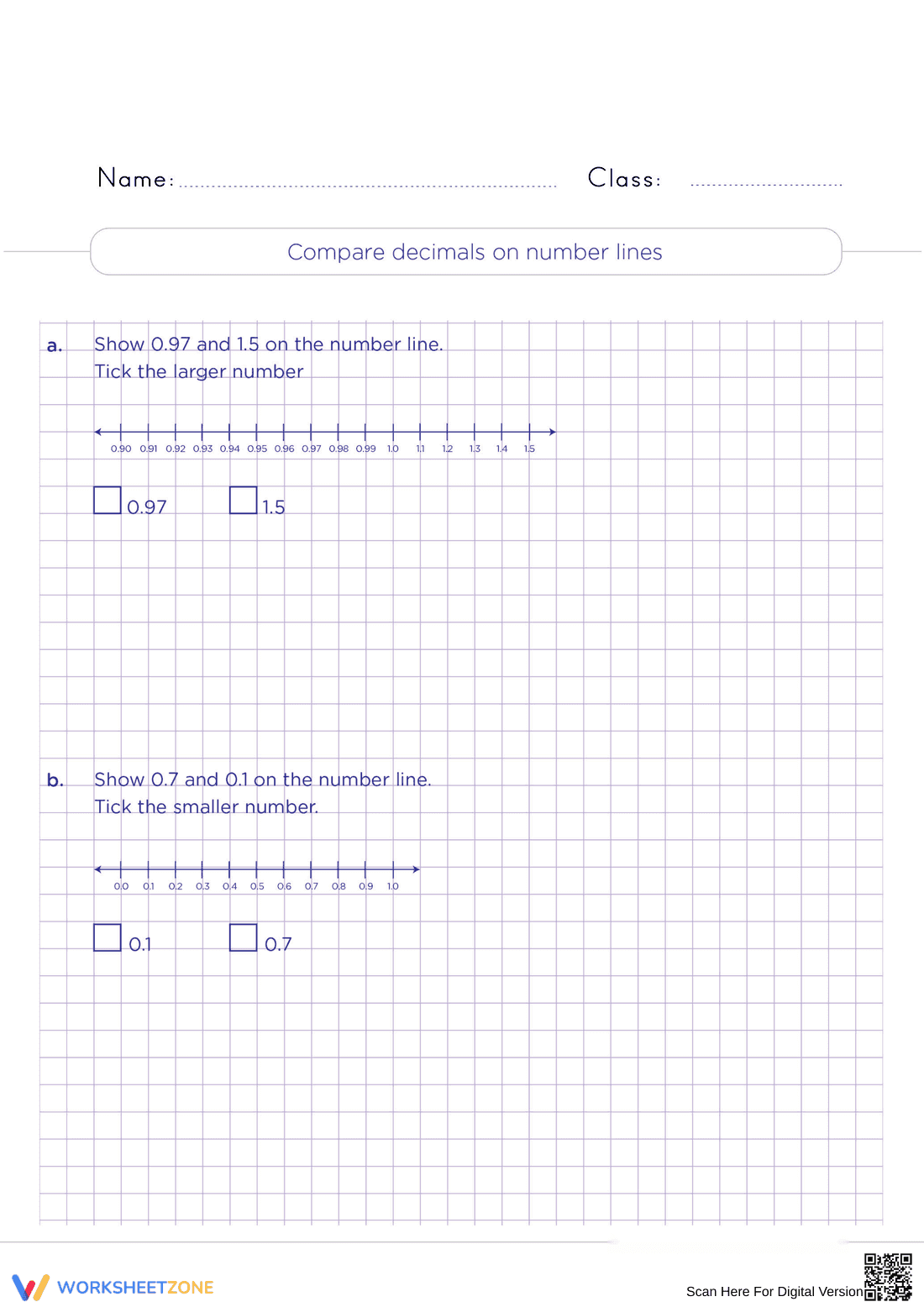
This worksheet offers targeted practice for Grade 4 students learning to compare decimals. Using clear number line models, learners visualize the position and value of different decimals, strengthening their foundational understanding. The exercises are designed to directly support skills needed to accurately compare and order numbers.
At a Glance
- Grade: 4 · Subject: Math
- Standard:
CCSS.MATH.CONTENT.4.NF.C.7— Compare two decimals to hundredths by reasoning about their size using a visual model.- Skill Focus: Comparing decimals on a number line
- Format: 2 pages · 2 problems · Answer key included · PDF
- Best For: Guided practice, independent work, formative assessment
- Time: 10–15 minutes
What's Inside
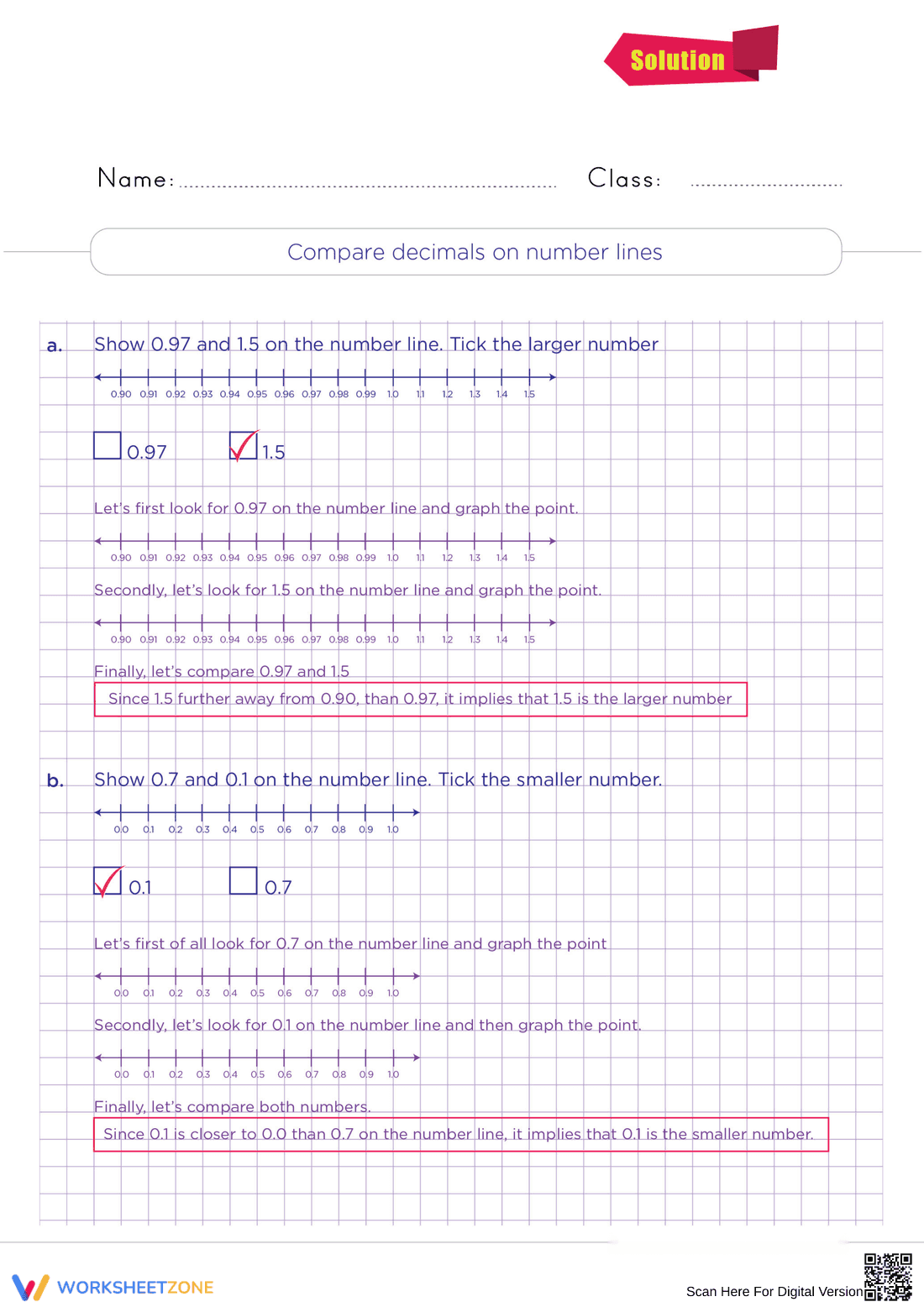
This resource includes a single-page worksheet with two distinct problems. Each problem provides a number line for students to plot and compare values. A separate answer key is included on the second page, showing the correct plot and a clear explanation for easy review by teachers or students.
A Progression of Skill
This worksheet follows a gradual release model to build student competence in comparing decimals.
- Guided Practice: The first problem (0.97 vs. 1.5) uses a significant visual difference on the number line to establish the core concept of placement and value.
- Supported Practice: The second problem (0.7 vs. 0.1) presents a more nuanced task, requiring students to reason about values on a different scale.
- Independent Practice: The clear layout allows students to complete both problems independently after a brief introduction, following an "I Do, We Do, You Do" teaching sequence.
Standards Alignment
This worksheet is directly aligned with Common Core standard CCSS.MATH.CONTENT.4.NF.C.7, which requires students to "Compare two decimals to hundredths by reasoning about their size... using a visual model." It provides a perfect visual model for justifying these conclusions. The standard code can be copied directly into lesson plans, IEP goals, or district curriculum mapping tools.
How to Use It
Use this worksheet after direct instruction on decimal place value and number lines. For a quick formative check, observe how students place decimals on the first problem. This reveals their understanding of place value before they even compare. The sheet also works as a focused homework assignment or station activity. Expect completion in 10-15 minutes.
Who It's For
This resource is designed for Grade 4 students but also suits Grade 5 students needing review. For learners who struggle, pre-teaching with a physical number line can be beneficial. This worksheet pairs well with a classroom anchor chart that shows a large, labeled number line with benchmark decimals clearly marked.
Developing proficiency in comparing decimals, as targeted by standard CCSS.MATH.CONTENT.4.NF.C.7, is a critical precursor to success in middle school mathematics, particularly with rational numbers and algebraic reasoning. The use of visual models like number lines is not just a procedural requirement but a key component of building deep conceptual understanding. Research from Fisher & Frey (2014) emphasizes that such visual and graphical representations are essential for making abstract mathematical ideas concrete for learners. This worksheet provides a standards-aligned tool for this exact purpose, enabling students to justify their reasoning about decimal size through a visual model rather than relying on abstract rules. This approach helps prevent common misconceptions about decimal value and provides teachers with a clear method for assessing student understanding of this fundamental skill in just a few minutes.


