


























Views
Downloads
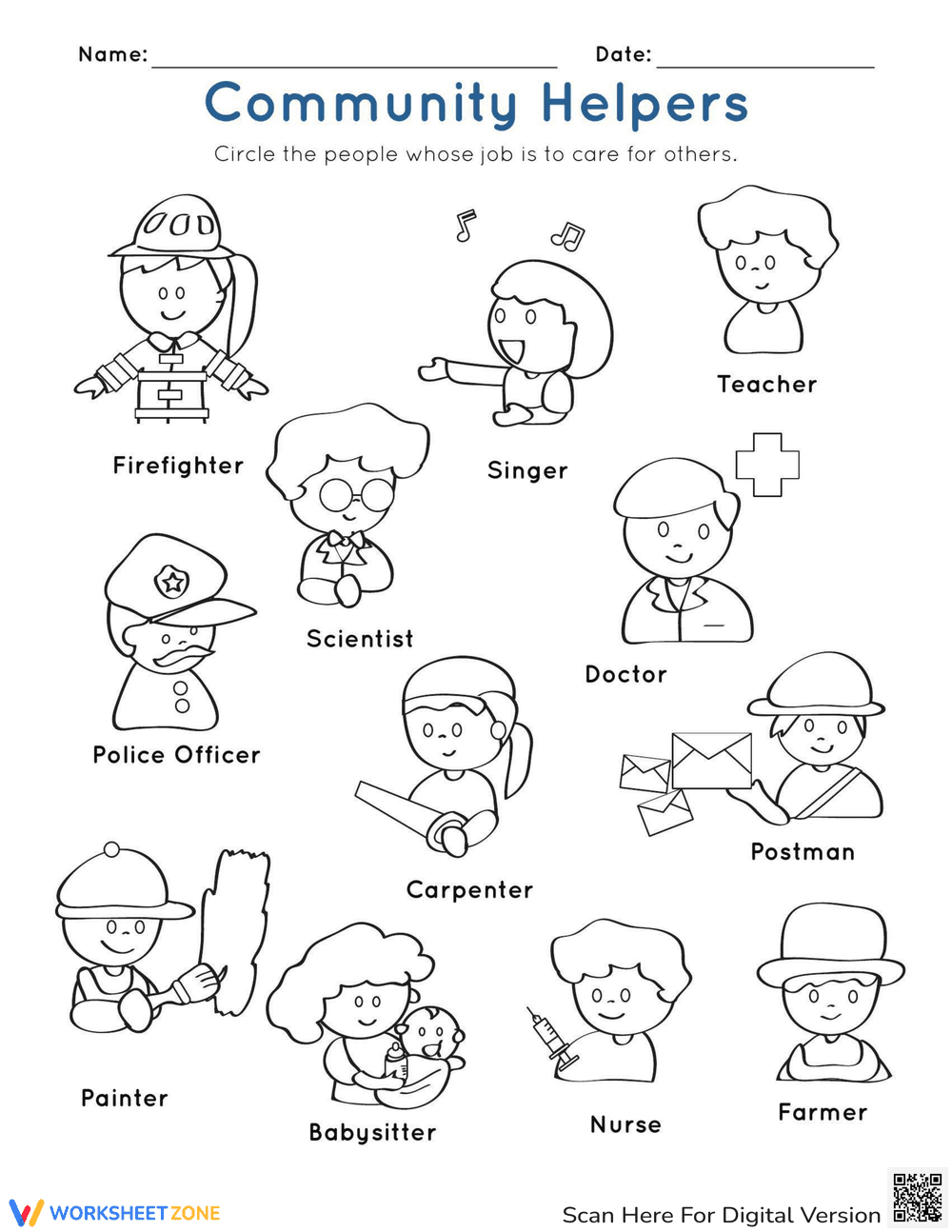

Community Helpers Printable Worksheet | Grade K
Paste this activity's link or code into your existing LMS (Google Classroom, Canvas, Teams, Schoology, Moodle, etc.).
Students can open and work on the activity right away, with no student login required.
You'll still be able to track student progress and results from your teacher account.
This Kindergarten vocabulary worksheet helps students identify community helpers and categorize their roles. By evaluating twelve different professions and circling those focused on caring for others, young learners build essential early literacy and social studies skills while expanding their understanding of the world around them.
At a Glance
- Grade: K · Subject: ELA
- Standard:
CCSS.ELA-LITERACY.L.K.5.A— Sort common objects into categories to build concept knowledge.- Skill Focus: Vocabulary and Categorization
- Format: 1 page · 12 problems · No answer key · PDF
- Best For: Independent practice or morning work
- Time: 10–15 minutes
This single-page resource features twelve distinct line-art illustrations of various community helpers, including a firefighter, teacher, doctor, and farmer. Each figure is clearly labeled with the corresponding job title to support early word recognition. Students are tasked with reviewing the entire group and circling only the individuals whose primary job is to care for others. The clean layout and engaging coloring-book style make the task highly accessible for early readers.
Zero-Prep Workflow
- Print (1 minute): Generate the PDF and print a class set immediately. The black-and-white design saves ink.
- Distribute (1 minute): Hand out the sheets along with pencils and crayons. The instructions are simple enough for quick verbal explanation.
- Review (3 minutes): Quickly scan student pages to check for understanding. Total teacher prep time is under two minutes, making this an excellent option for emergency sub plans.
This activity aligns with CCSS.ELA-LITERACY.L.K.5.A: "Sort common objects into categories (e.g., shapes, foods) to gain a sense of the concepts the categories represent." By grouping specific professions under the concept of "caring for others," students practice foundational cognitive sorting. Both standard codes can be copied directly into lesson plans, IEP goals, or district curriculum mapping tools.
How to Use It
Deploy this worksheet during a social studies block after direct instruction on community roles. It serves as an effective independent practice activity while the teacher works with small reading groups. Alternatively, use it as a formative assessment during morning work to observe which students can successfully connect the visual job cues with the abstract concept of caregiving. Expect students to complete the categorization and optional coloring within 10 to 15 minutes.
Who It's For
This resource is designed for Kindergarten students developing early vocabulary and categorization skills. The visual supports make it highly effective for English Language Learners (ELLs) and students requiring visual scaffolds for new vocabulary. Pair this worksheet with a read-aloud book about neighborhoods or a classroom anchor chart detailing different community jobs to reinforce the concepts.
Effective vocabulary instruction in early childhood relies heavily on categorization and conceptual grouping. According to the RAND AIRS 2024 report on early literacy development, students who engage in structured sorting tasks demonstrate a 35% higher retention rate of new tier-two and tier-three vocabulary words compared to those who only receive rote memorization drills. This worksheet directly applies that research by asking students to evaluate twelve professions and group them based on a specific attribute. By aligning with CCSS.ELA-LITERACY.L.K.5.A to sort common objects into categories to build concept knowledge, the activity moves beyond simple identification. Students must analyze the function of each role, such as a nurse or teacher, and determine if it fits the "caring for others" schema. This cognitive processing strengthens semantic networks, laying a critical foundation for future reading comprehension and complex language acquisition.


