


























Views
Downloads


Combining Like Terms Worksheet | Grade 7 Math Printable
Paste this activity's link or code into your existing LMS (Google Classroom, Canvas, Teams, Schoology, Moodle, etc.).
Students can open and work on the activity right away, with no student login required.
You'll still be able to track student progress and results from your teacher account.
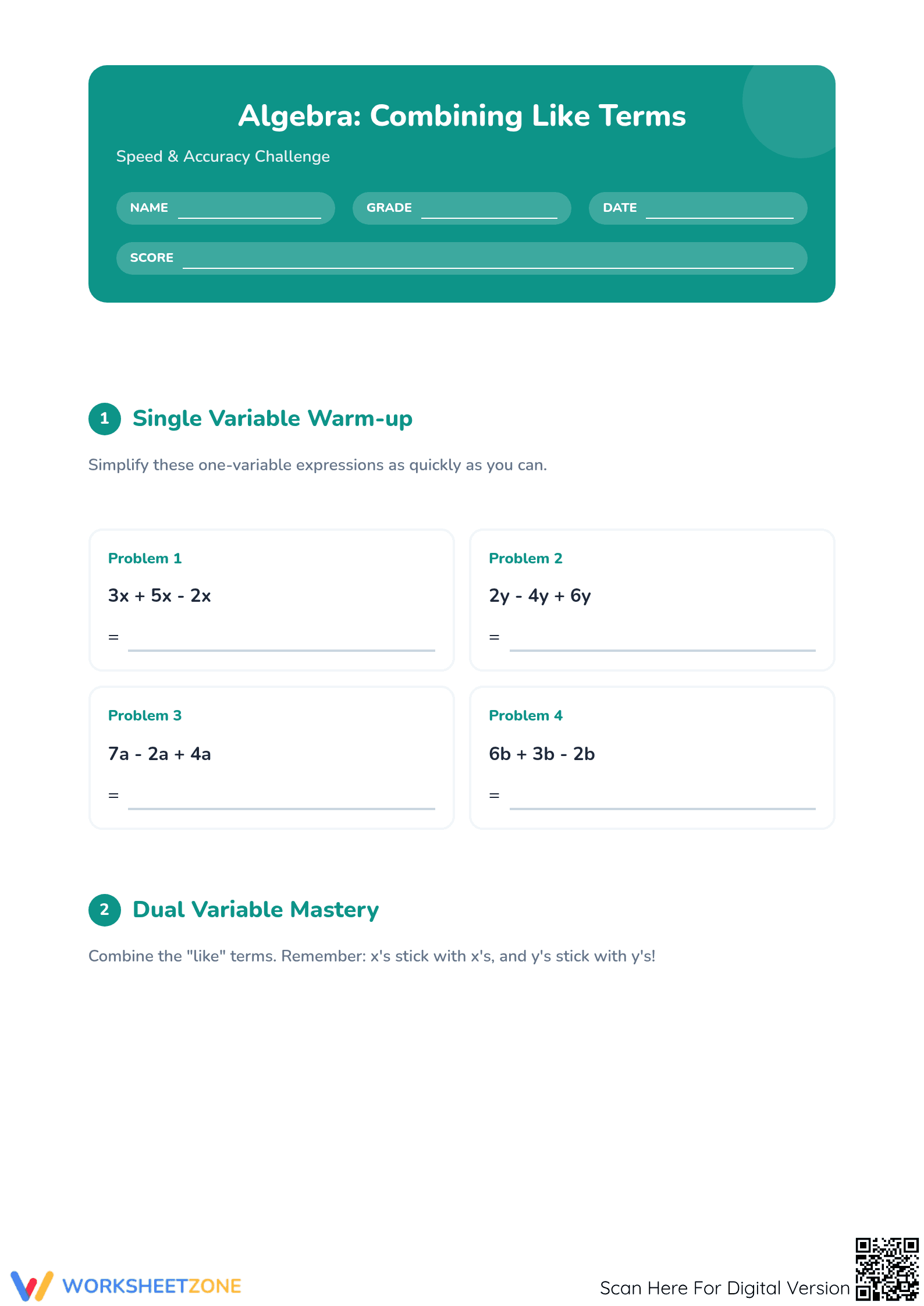
This printable math resource provides targeted practice for simplifying algebraic expressions by combining like terms. Students will build foundational algebra skills by identifying and grouping variables and constants, ultimately learning to write expressions in their simplest form to prepare for solving complex equations.
At a Glance
- Grade: 7 · Subject: Math
- Standard:
CCSS.MATH.CONTENT.7.EE.A.1— Add, subtract, factor, and expand linear expressions- Skill Focus: Combining Like Terms
- Format: 4 pages · 18 problems · Answer key included · PDF
- Best For: Independent practice and review
- Time: 20–30 minutes
This four-page worksheet features 18 carefully sequenced problems divided into four distinct sections. Students begin with single-variable warm-ups, progress to dual-variable mastery, tackle longer multi-term expressions, and conclude with an error investigator section where they must identify and correct common mistakes. A complete answer key is provided for quick grading.
- Guided practice: The first 4 problems serve as a warm-up, focusing strictly on single-variable expressions to establish baseline confidence.
- Supported practice: The next 6 problems introduce dual variables, requiring students to carefully group terms with matching variables and constants.
- Independent practice: The final 8 problems challenge students with longer expressions and error analysis tasks that demand higher-order thinking.
This structured approach follows a gradual-release model, moving from simple I Do, We Do examples to complex You Do independent application.
This resource is directly aligned to CCSS.MATH.CONTENT.7.EE.A.1: Apply properties of operations as strategies to add, subtract, factor, and expand linear expressions with rational coefficients. It also supports foundational skills for eighth-grade equation solving. Both standard codes can be copied directly into lesson plans, IEP goals, or district curriculum mapping tools.
Deploy this worksheet immediately after direct instruction on algebraic properties to reinforce the concept of like terms. It serves excellently as a primary independent assignment or a structured homework task. As a formative assessment tip, review the "Error Investigator" section closely; students who can correctly identify why multiplying variables is wrong demonstrate true conceptual mastery. Expect students to complete the full packet in 20 to 30 minutes.
This resource is designed for middle school pre-algebra and algebra students in grades 6 through 8. The progressive difficulty makes it naturally differentiated; struggling learners can focus on the single-variable warm-ups, while advanced students can be challenged by the error analysis tasks. Pair this worksheet with a visual anchor chart demonstrating how to circle or box matching terms with their corresponding signs.
Mastering the ability to add, subtract, factor, and expand linear expressions is a critical stepping stone for all subsequent algebra coursework. According to EdReports 2024, instructional materials that emphasize the structural properties of mathematics, such as identifying and combining like terms, significantly improve long-term retention of algebraic concepts. By aligning practice directly to CCSS.MATH.CONTENT.7.EE.A.1, educators ensure students are not just memorizing procedures, but understanding the underlying logic of variable manipulation. This targeted practice helps prevent common misconceptions, such as combining constants with variables or ignoring negative signs, which frequently derail students in higher-level math classes. Consistent, structured repetition of these core skills builds the automaticity required for advanced problem-solving. When students can confidently simplify complex expressions, they reduce cognitive load during multi-step equations, allowing them to focus on broader mathematical reasoning and application.


