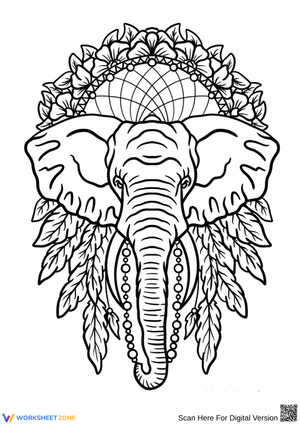
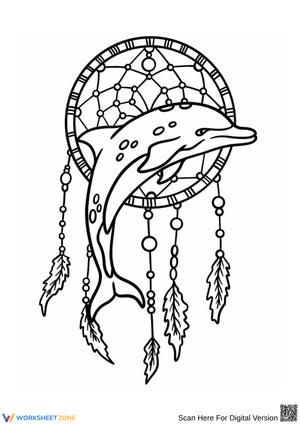
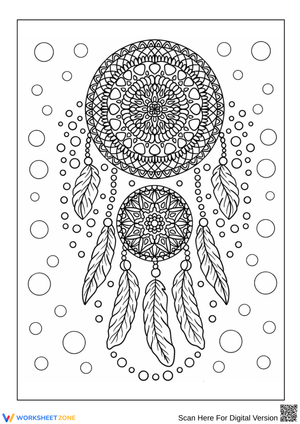
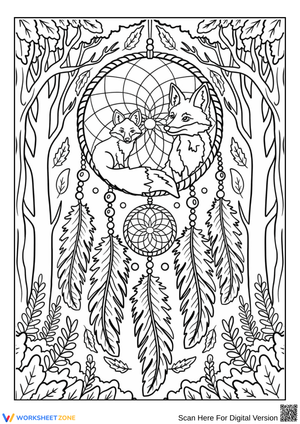
This set of dreamcatcher coloring pages ranges from a single round hoop with a loose, wide-strand web to teardrop-shaped designs stacked with three or four hanging feathers. Some sheets add small beads along the feather quills, while others surround the hoop with a mandala-style border of dots and swirls. A few pages include tiny paw prints or leaf shapes woven into the outer strands, giving colorists extra small spaces to fill. Every page keeps the classic round-or-teardrop hoop shape recognizable, so the set stays consistent even as the feather count changes from sheet to sheet.
Line Style and Skill Level, From Simple Hoops to Fine Webs
Younger kids do best with bold, wide-line hoops where the web has only six or eight crossing strands and thick feather outlines that are easy to stay inside. Teens and adults can pick teardrop or mandala-style sheets with a tightly woven lattice, layered feather barbs, and clusters of small beads that call for colored pencils or fine-tip markers. Because line weight shifts page to page, a mixed set works well for a family table or a classroom table where colorists have different comfort levels.
Printing Setup and Coloring Tips for Crisp Webs
Print these coloring sheets on standard letter-size paper straight from the PDF, choosing 32-lb paper if you plan to use markers so ink does not bleed through to the next sheet. Crayons and colored pencils work fine on regular 20-lb copy paper. Earth tones such as rust, ochre, and sage suit a traditional look, while pastel or rainbow feathers give a brighter, modern finish. A one-page single design works for a quick print, while the full multi-page set is better for a themed coloring session or take-home packet.
Frequently Asked Questions
1. What art supplies work best on the web lines?
Colored pencils give the most control on narrow web strands since the tip can trace each crossing line without smudging. Fine-tip markers work well for bold outer feather sections but can bleed on thin copy paper, so pair them with 32-lb paper. Crayons suit the wider-lined beginner hoops best. Blending a light and dark shade of the same color on each feather barb adds subtle depth.
2. Are these designs appropriate for classroom activities?
Yes. A mixed set with both simple hoops and detailed webs lets a group work at the same table while each person picks a page that matches their patience level. The designs are quiet and screen-free, making them useful for indoor recess, an early-finisher activity, or a calm five-minute reset between lessons, without needing extra instructions beyond picking colors.
3. What is the story behind the dreamcatcher design?
Dreamcatchers began with the Ojibwe people, whose word for the craft, asabikeshiinh, means spider. Legend credits Asibaikaashi, the Spider Woman, with weaving the first web to catch bad dreams while letting good ones slip through to the sleeper below. That spiderweb story is why the center of every hoop, simple or intricate, is built from a woven net rather than a solid shape.












 Interactive Worksheet Maker
 Quiz Maker
 Word Search Maker
 Crossword Puzzle Maker
 Word Scramble Generator
 Sentence Scramble Generator
 Handwriting Worksheet Generator
 Name Tracing Generator
 Fill In The Blank Generator