


























Views
Downloads

Food Classification Worksheet | Grade K Essential
Paste this activity's link or code into your existing LMS (Google Classroom, Canvas, Teams, Schoology, Moodle, etc.).
Students can open and work on the activity right away, with no student login required.
You'll still be able to track student progress and results from your teacher account.
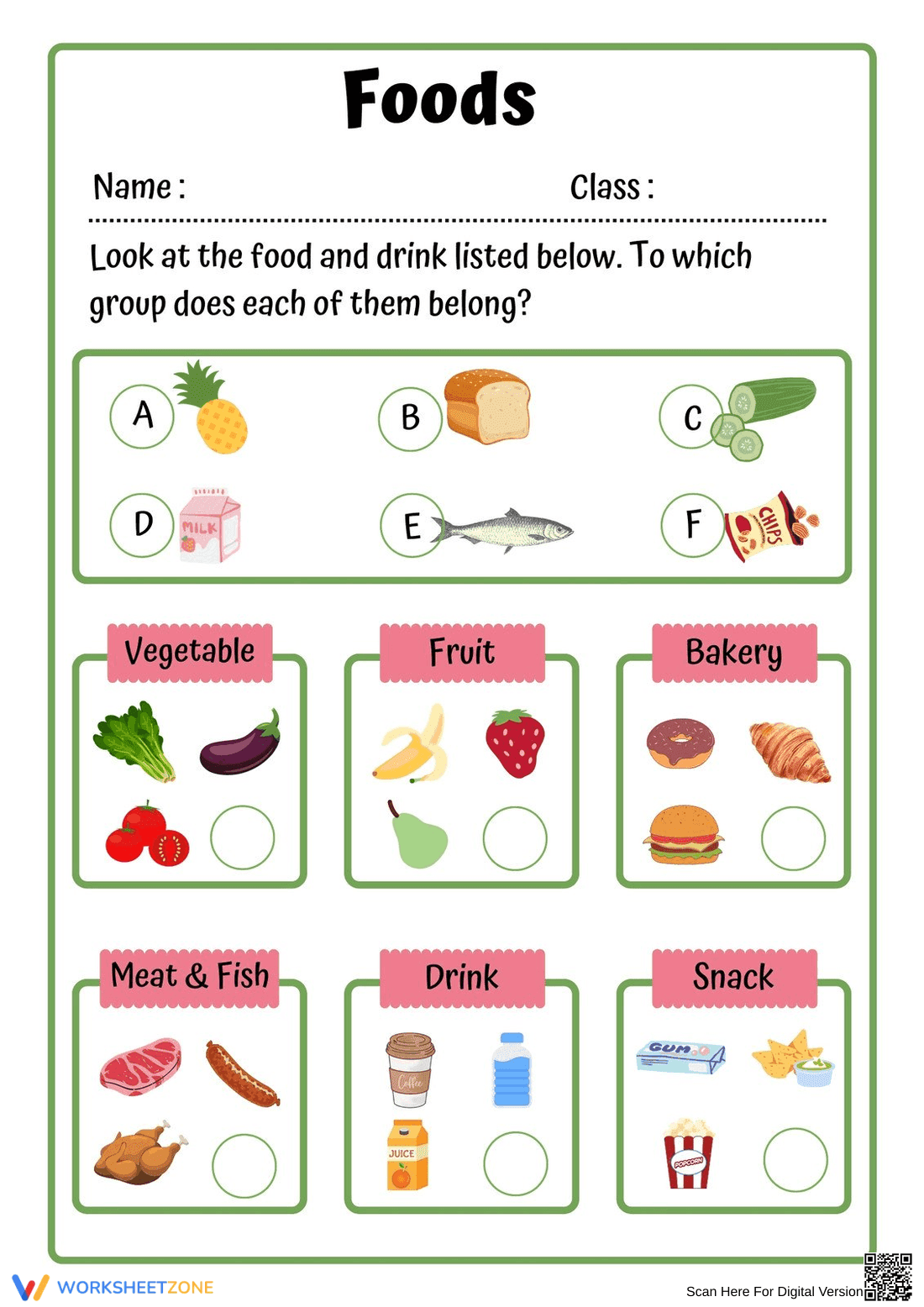
This Grade K food classification worksheet helps young learners identify and categorize common food items into six distinct groups. By matching illustrations to categories like Fruit or Bakery, students develop essential vocabulary and organizational thinking skills. It provides a clear, visual way to master basic sorting concepts in a single session.
At a Glance
- Grade: K · Subject: ELA & Science
- Standard:
CCSS.ELA-LITERACY.L.K.5.A— Sort common objects into categories to gain a sense of the concepts- Skill Focus: Food Group Classification
- Format: 1 page · 6 problems · Answer key included · PDF
- Best For: Independent practice or morning work
- Time: 10–15 minutes
The worksheet features six labeled food items (A-F) including pineapple, bread, and fish. Below the items are six category boxes: Vegetable, Fruit, Bakery, Meat & Fish, Drink, and Snack. Each box contains illustrative examples to guide the student. The layout is clean and uses high-contrast visuals to support early readers and English Language Learners.
This resource is designed for a zero-prep workflow. 1. Print: Select the single-page PDF and print enough copies for your class (30 seconds). 2. Distribute: Hand out the sheets as a quick transition activity or center task (1 minute). 3. Review: Use the included answer key for a rapid whole-class check or individual grading (1 minute). Total teacher prep time is under 2 minutes. It is an ideal sub-plan filler.
This activity aligns with `CCSS.ELA-LITERACY.L.K.5.A`, which requires students to sort common objects into categories to gain a sense of the concepts the categories represent. It also supports early science standards regarding healthy habits and identifying types of food. Both standard codes can be copied directly into lesson plans, IEP goals, or district curriculum mapping tools.
Use this worksheet during a Healthy Eating unit or as a vocabulary builder in ELA. It works best after a direct instruction lesson where you model sorting real-world objects. For a formative assessment, observe if students can correctly identify the Snack and Bakery distinction. Expected completion time is 10 to 15 minutes depending on the student's fine motor skills.
This is ideal for Kindergarten students, preschool graduates, or ELL students building basic noun categories. It pairs naturally with a food-themed anchor chart or a classroom sorting game using plastic food toys. The visual cues ensure that even non-readers can participate successfully in the classification task without constant teacher intervention.
According to the RAND AIRS 2024 report, visual classification tasks are fundamental for developing cognitive schemas in early childhood. This worksheet targets CCSS.ELA-LITERACY.L.K.5.A by requiring students to analyze 6 specific food items and assign them to logical groups. By engaging with Food Group Classification, learners move beyond simple identification toward higher-order organizational skills. Research from Fisher & Frey (2014) emphasizes that such scaffolded sorting activities bridge the gap between concrete observation and abstract categorization. This resource provides the necessary structure for students to demonstrate mastery of sorting common objects while building the linguistic foundations required for more complex scientific and literary analysis in later grades. It is a reliable tool for both general education and targeted intervention settings, providing 100% alignment with foundational literacy goals.


