


























Views
Downloads


Essential Grade 1 Counting — Printable No-Prep Worksheet
Paste this activity's link or code into your existing LMS (Google Classroom, Canvas, Teams, Schoology, Moodle, etc.).
Students can open and work on the activity right away, with no student login required.
You'll still be able to track student progress and results from your teacher account.
This Grade 1 counting and matching worksheet helps young learners build a strong foundation in number sense by connecting physical quantities to abstract numerals. Students practice one-to-one correspondence as they count colorful objects and identify the corresponding digit. This resource ensures students move beyond rote counting to true cardinality mastery.
At a Glance
- Grade: Grade 1 · Subject: Math
- Standard:
CCSS.MATH.CONTENT.K.CC.B.5— Count to answer how many questions about as many as 20 things- Skill Focus: One-to-one correspondence and numeral recognition
- Format: 2 pages · 8 problems · Answer key included · PDF
- Best For: Independent practice or morning work
- Time: 10–15 minutes
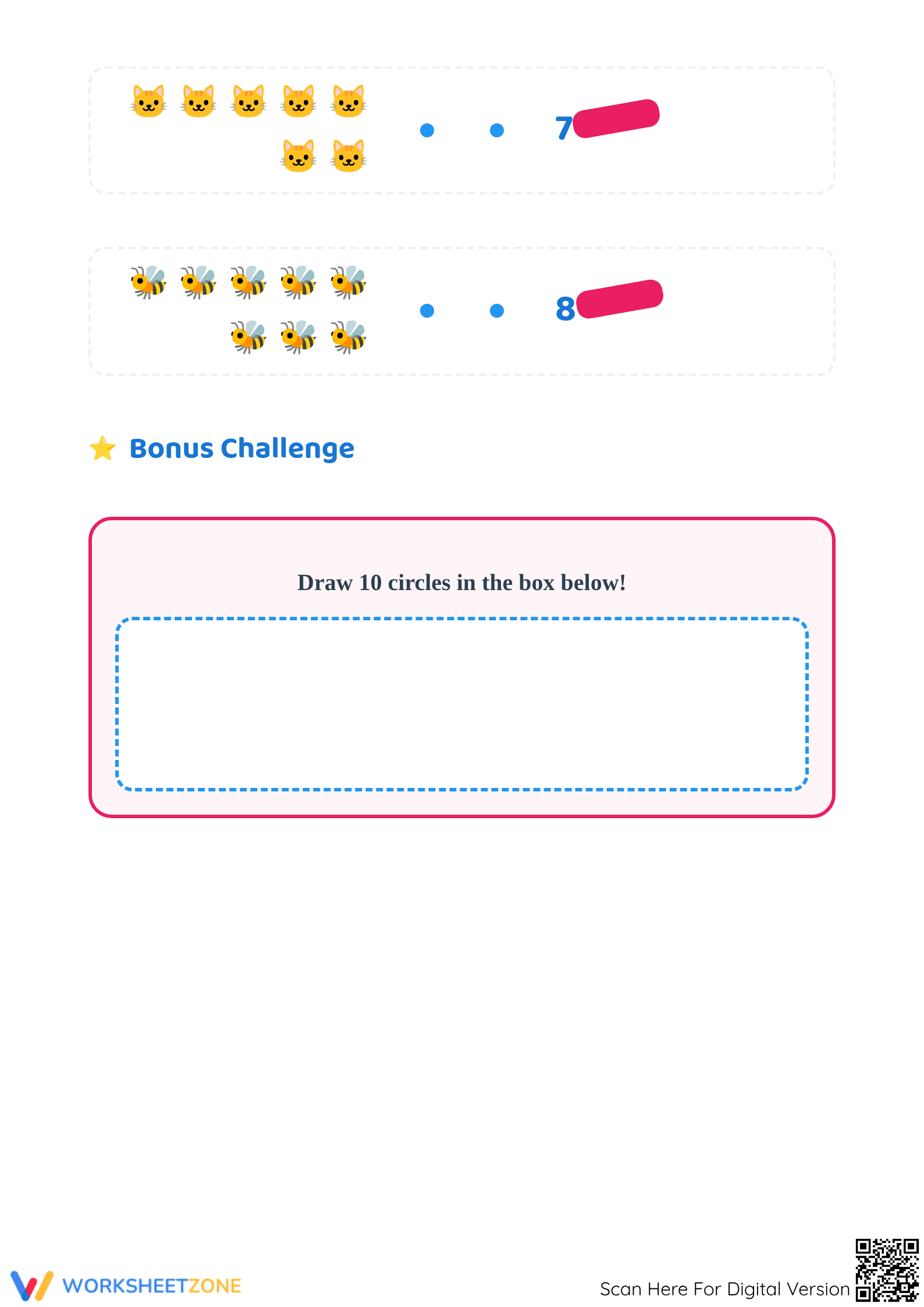
The packet contains two high-quality pages designed for clarity and engagement. The first page features four matching tasks using familiar icons like apples and cars. The second page increases the challenge with larger groups of cats and bees, concluding with a creative "Bonus Challenge" where students must draw exactly 10 circles. A full-color answer key is provided for quick grading or student self-correction.
This resource is designed for a zero-prep classroom environment. Step 1: Print the two-page PDF (30 seconds). Step 2: Distribute to students for independent work or as a center activity (1 minute). Step 3: Review the answers using the provided key or by projecting the digital version for a whole-class check (2 minutes). Total teacher prep is under two minutes, making it an ideal sub plan.
The primary focus is `CCSS.MATH.CONTENT.K.CC.B.5`, which requires students to count to answer "how many?" questions about sets of objects. By matching groups of up to 10 items to their written numerals, students demonstrate an understanding that the last number named tells the number of objects counted. This code can be copied directly into lesson plans or IEP goals.
Use this worksheet during the "You Do" phase of a gradual release lesson on counting. It serves as an excellent formative assessment tool; observe if students are using a "touch and count" strategy or if they are struggling with numeral recognition. The expected completion time is 10 to 15 minutes, making it perfect for a transition period or a quiet-time activity.
This worksheet is tailored for Kindergarten and Grade 1 students who are refining their counting skills. It is also highly effective for ELL students due to the heavy reliance on visual cues rather than complex text. Pair this with physical manipulatives like counting bears or an anchor chart showing numbers 1-10 for students needing extra support.
Research by Fisher & Frey (2014) emphasizes the importance of guided practice that transitions into independent application to solidify mathematical concepts in early childhood. This worksheet facilitates that transition by providing structured matching tasks that reinforce one-to-one correspondence, a critical precursor to addition and subtraction. According to the NAEP, early mastery of cardinality is one of the strongest predictors of later mathematical success. By engaging with the 8 specific tasks in this packet, students practice the exact cognitive load required to meet CCSS.MATH.CONTENT.K.CC.B.5 requirements. The inclusion of a drawing task further supports fine motor development alongside cognitive math skills. This resource provides the necessary repetition for students to internalize the relationship between quantities and symbols, ensuring they are prepared for more complex base-ten operations in subsequent units.


