




























Views
Plays


Printable Indian Economics Quiz | Grade 8 Social Studies

Paste this activity's link or code into your existing LMS (Google Classroom, Canvas, Teams, Schoology, Moodle, etc.).
Students can open and work on the activity right away, with no student login required.
You'll still be able to track student progress and results from your teacher account.
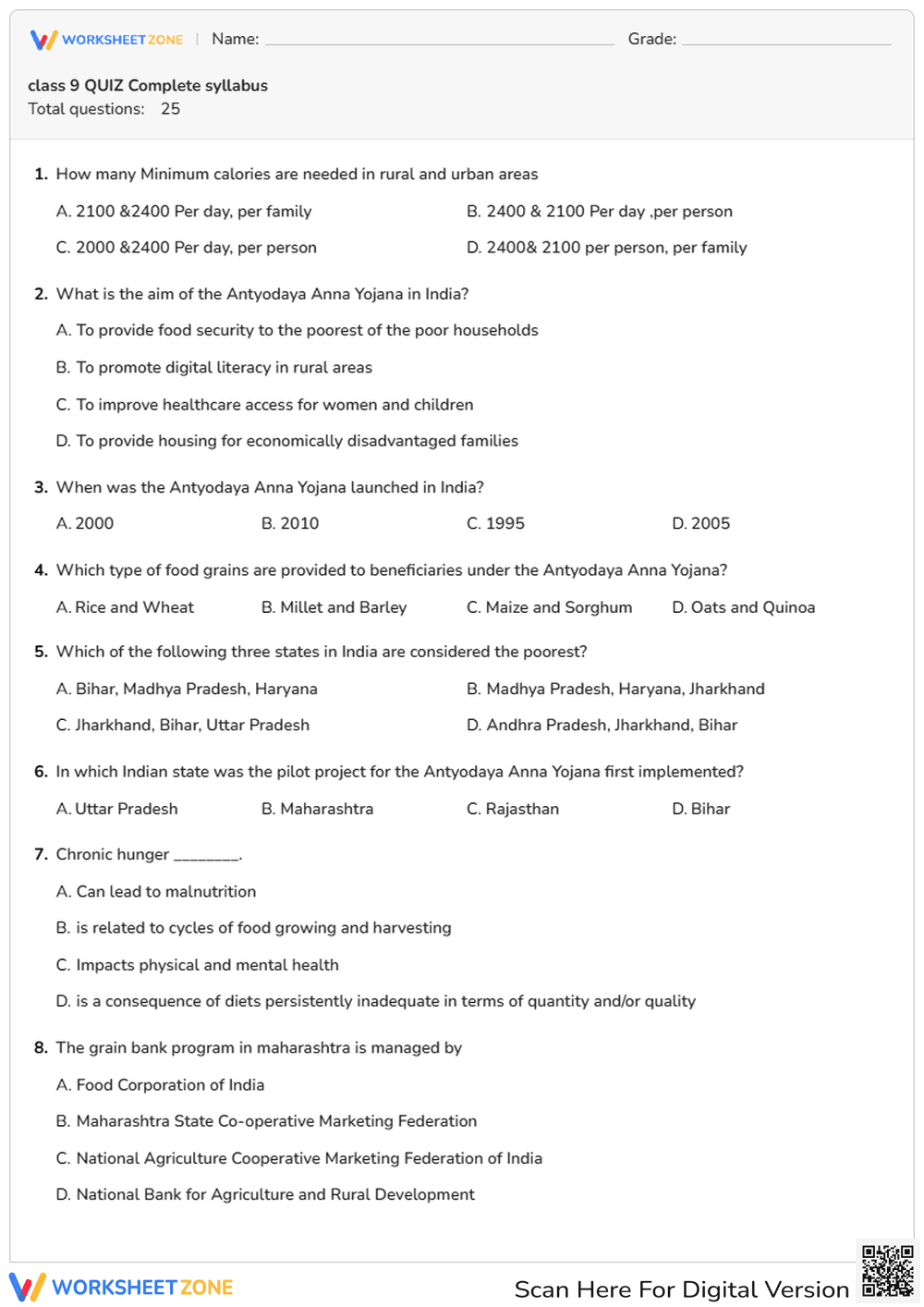
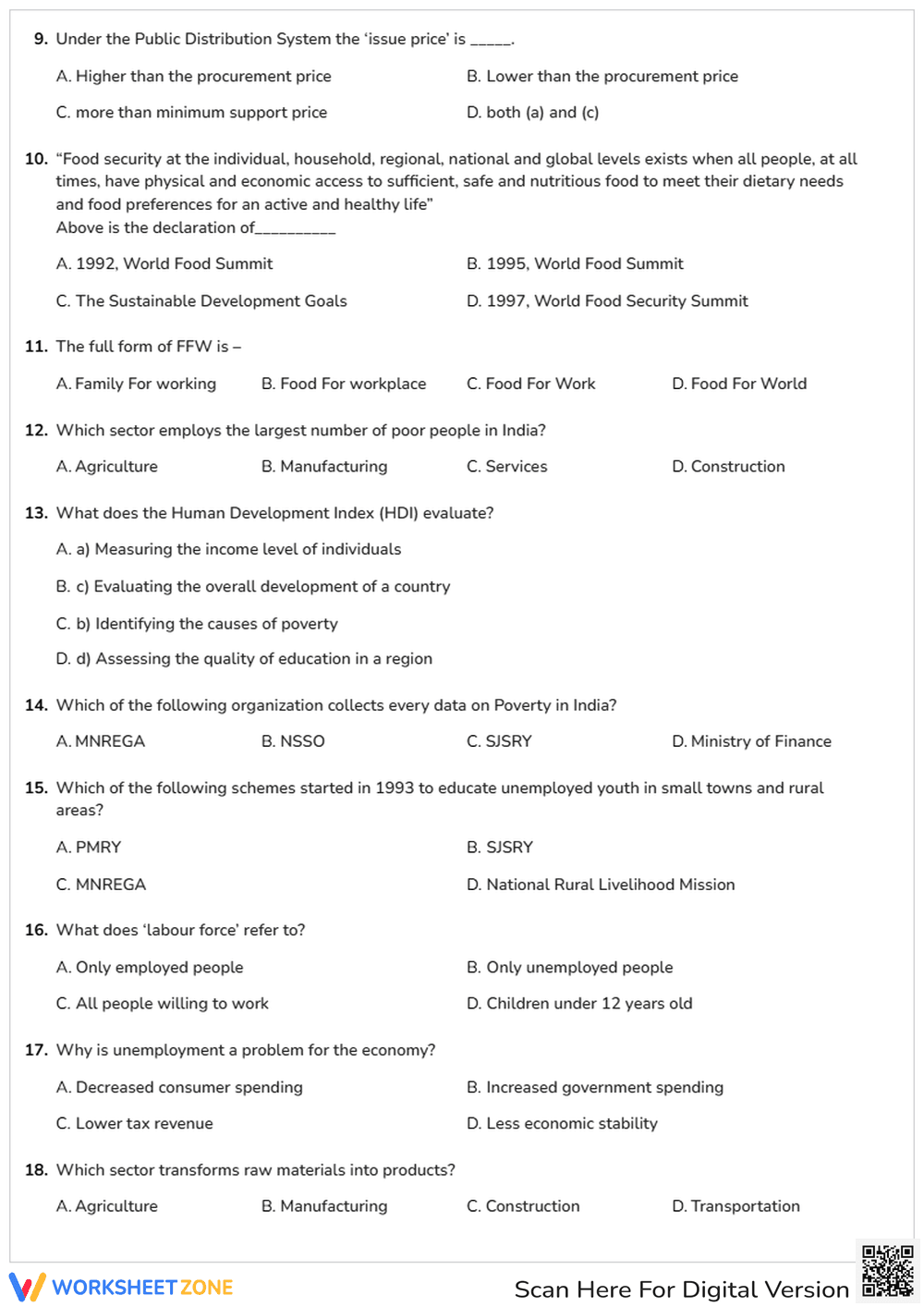
This Grade 8 social studies worksheet gives students 25 structured problems to assess their understanding of economic development, poverty eradication, and food security programs. By completing this comprehensive quiz, learners will demonstrate their knowledge of key government initiatives and economic indicators.
At a Glance
- Grade: 8 · Subject: Social Studies
- Standard:
C3.D2.Eco.1.6-8— Explain how economic decisions affect well-being- Skill Focus: Economic Policies & Food Security
- Format: 3 pages · 25 problems · PDF
- Best For: End-of-unit assessment
- Time: 30–45 minutes
This comprehensive three-page assessment features a mix of 19 multiple-choice questions and 6 short-to-long answer prompts. Students will navigate topics such as the Public Distribution System (PDS), Minimum Support Price (MSP), the Human Development Index (HDI), and various poverty alleviation programs. The structured format allows for quick grading on the multiple-choice section while providing space for critical thinking in the written responses.
- Print (1 min): Simply print the three-page PDF assessment. No special formatting or additional materials are required.
- Distribute (1 min): Hand out the quiz to students as a formal assessment, review activity, or independent practice assignment.
- Review (15 mins): Use the completed worksheets to identify knowledge gaps regarding economic policies and guide subsequent review sessions.
With under two minutes of total teacher prep time, this resource is an excellent addition to your emergency sub plan folder or end-of-unit assessment toolkit.
Aligned to primary standard C3.D2.Eco.1.6-8: Explain how economic decisions affect the well-being of individuals, businesses, and society. This assessment challenges students to evaluate the real-world impact of government interventions on poverty and food security. Both standard codes can be copied directly into lesson plans, IEP goals, or district curriculum mapping tools.
Summative Assessment: Deploy this 25-question quiz after completing a unit on global economics or Indian social policies. The combination of multiple-choice and free-response questions provides a well-rounded evaluation of student mastery. Expect completion to take 30 to 45 minutes.
Collaborative Review: Have students complete the multiple-choice section independently, then pair up to tackle the complex short-answer questions. As a formative assessment observation tip, listen to student discussions around question 25 to gauge their ability to critically examine the effectiveness of the public distribution system.
This resource is designed for middle school social studies students, particularly those studying global economics, geography, or contemporary world issues. The clear formatting makes it accessible for general education classrooms, while the essay questions at the end provide a natural extension for advanced learners. It pairs perfectly with direct instruction lessons on global poverty and government intervention strategies.
Integrating structured assessments on complex economic topics like food security and poverty alleviation is crucial for developing civic competence. Aligned with C3.D2.Eco.1.6-8, this resource requires students to explain how economic decisions affect well-being. According to RAND AIRS 2024, providing students with mixed-format assessments that combine recall with critical analysis significantly improves their ability to synthesize complex social studies concepts. By evaluating real-world programs such as the Antyodaya Anna Yojana and the Public Distribution System, learners bridge the gap between theoretical economics and practical societal impacts, fostering a deeper understanding of global development challenges.


