


























Views
Plays



Essential Civics Unit 2 Vocabulary Worksheet | Grade 6
Paste this activity's link or code into your existing LMS (Google Classroom, Canvas, Teams, Schoology, Moodle, etc.).
Students can open and work on the activity right away, with no student login required.
You'll still be able to track student progress and results from your teacher account.
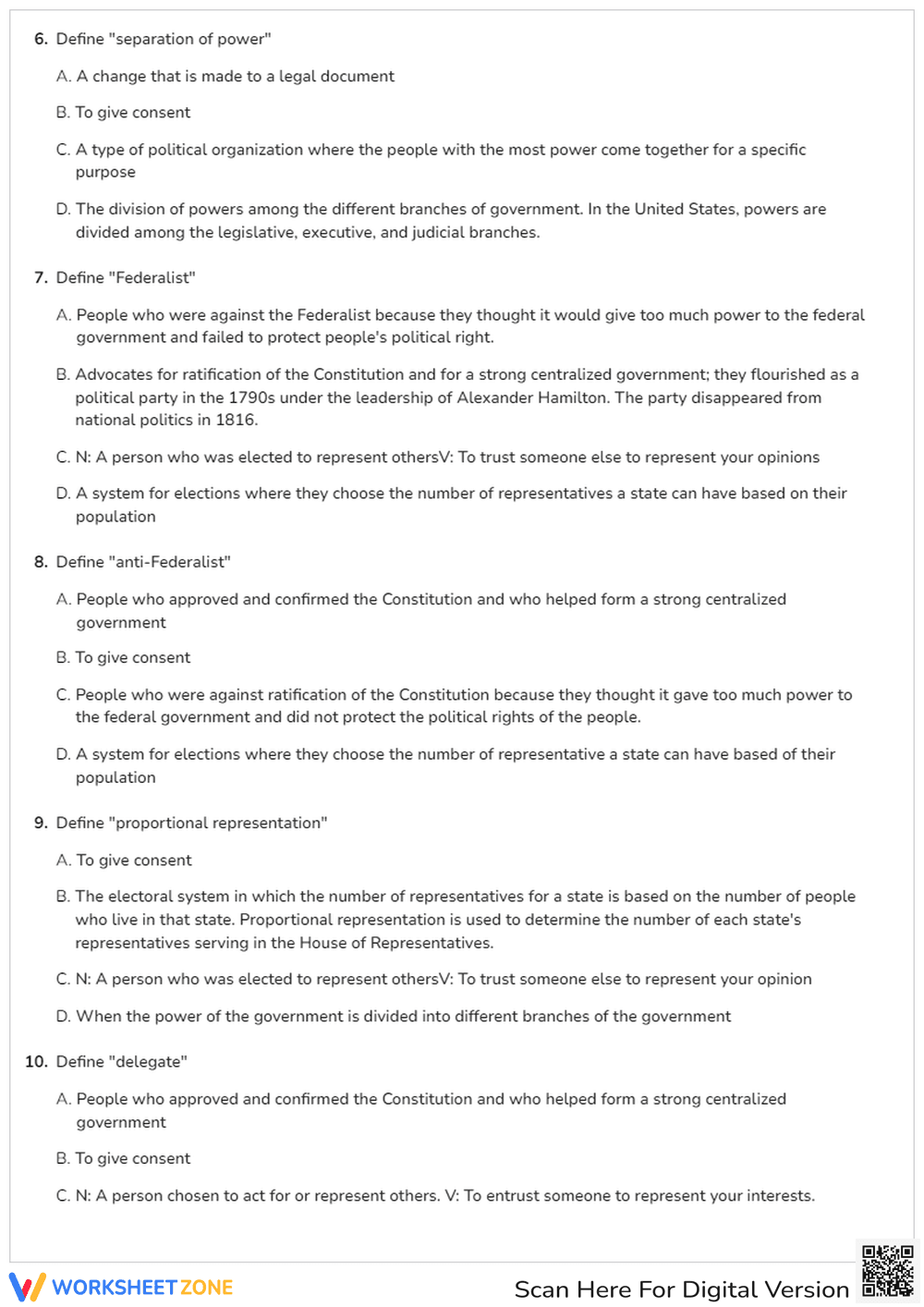
This Civics Unit 2 vocabulary worksheet helps students master the foundational terminology of the United States government. By identifying correct definitions for complex political concepts, learners build the background knowledge necessary for analyzing historical documents. This resource ensures students can distinguish between pivotal groups while understanding structural mechanics like proportional representation.
At a Glance
- Grade: 6 · Subject: Social Studies
- Standard:
CCSS.ELA-LITERACY.RH.6-8.4— Determine the meaning of domain-specific words and phrases in history- Skill Focus: Civics Vocabulary & US Foundations
- Format: 2 pages · 10 problems · Answer key included · PDF
- Best For: Unit review or formative assessment
- Time: 15–20 minutes
The worksheet contains 10 high-quality multiple-choice questions spread across two printable pages. Each question focuses on a single definition task, providing four distinct options that challenge students to discriminate between similar historical terms. Key vocabulary includes Confederation, Indigenous, Ratify, Amendment, and Separation of Powers. The layout is clean and professional, making it ready for immediate classroom distribution.
Skill Progression
- Guided Practice: The initial questions focus on concrete nouns and actions, such as "Indigenous" and "Ratify," allowing students to build confidence with foundational terms.
- Supported Practice: The middle section introduces structural concepts like "Separation of Powers" and "Framers," requiring students to recognize the mechanics of early American governance.
- Independent Practice: The final questions demand high-level discrimination between competing political ideologies, specifically "Federalist" versus "Anti-Federalist" and complex systems like "Proportional Representation."
This progression follows a gradual-release model, moving from basic identification to the analysis of nuanced political frameworks.
Standards Alignment
This resource is primarily aligned with `CCSS.ELA-LITERACY.RH.6-8.4`, which requires students to determine the meaning of symbols, key terms, and other domain-specific words as they are used in the context of history. Additionally, it supports understanding of the US Constitution's origins. Both standard codes can be copied directly into lesson plans, IEP goals, or district curriculum mapping tools.
How to Use It
Use this worksheet as a summative quiz at the end of a unit on the US Constitution or as a pre-assessment to gauge prior knowledge. During direct instruction, teachers can use individual questions as exit tickets to check for understanding of specific terms like "amendment." This activity typically takes 15 to 20 minutes to complete, providing a quick data point for formative assessment.
Who It's For
This worksheet is designed for Grade 4 through Grade 6 students studying American History. It is particularly effective for English Language Learners who benefit from clear, multiple-choice definitions of academic vocabulary. Pair this resource with a primary source analysis or a classroom anchor chart detailing the three branches of government for a comprehensive learning experience.
Mastery of domain-specific vocabulary is a critical predictor of reading comprehension in the social studies classroom. According to research from Fisher & Frey (2014), intentional word-building exercises allow students to access complex informational texts by reducing the cognitive load associated with unfamiliar terminology. This worksheet targets CCSS.ELA-LITERACY.RH.6-8.4 by isolating 10 essential terms, such as ratification and proportional representation, which are central to understanding the American political experiment. By providing structured multiple-choice options, the resource scaffolds the learning process, ensuring that students can accurately identify the roles of the Framers and the function of Amendments. This systematic approach to vocabulary acquisition supports long-term retention and prepares middle school learners for more rigorous historical inquiry and civic participation. The clear formatting and focused task count make it an efficient tool for both instruction and assessment in diverse classroom settings.


