


























Views
Downloads


Circumference and Area Worksheet | Essential Grade 7 Math
Paste this activity's link or code into your existing LMS (Google Classroom, Canvas, Teams, Schoology, Moodle, etc.).
Students can open and work on the activity right away, with no student login required.
You'll still be able to track student progress and results from your teacher account.
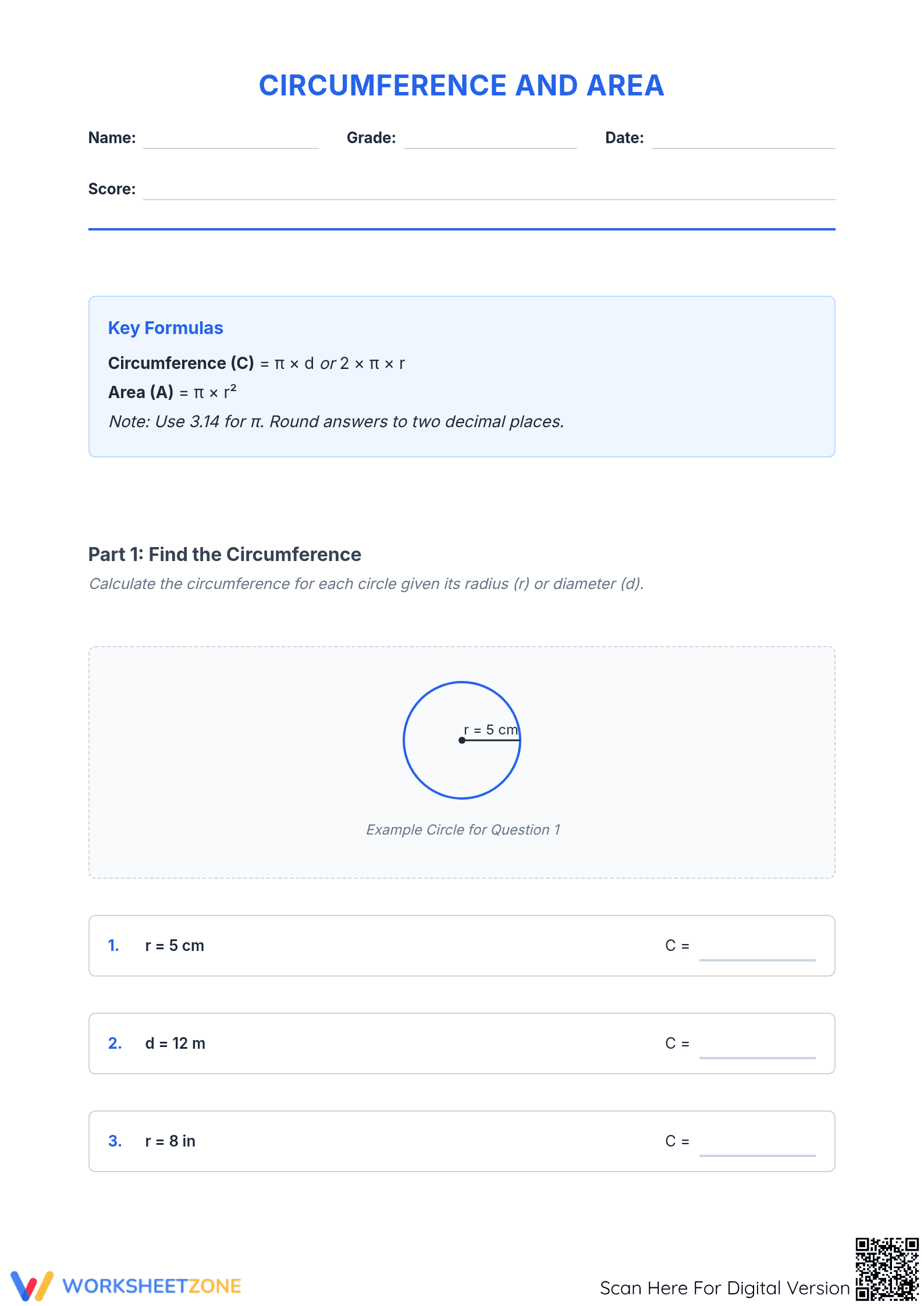
This Grade 7 math worksheet provides a comprehensive practice suite for mastering the properties of circles. Students transition from identifying basic radius and diameter measurements to calculating circumference and area using standard formulas. By applying geometry concepts to 24 structured problems, learners build the procedural fluency required for high-school-level spatial reasoning and algebra.
At a Glance
- Grade: 7 · Subject: Math
- Standard:
7.G.B.4— Use circle formulas for area and circumference to solve geometry problems- Skill Focus: Circle Geometry Calculations
- Format: 4 pages · 24 problems · Answer key included · PDF
- Best For: Independent practice and homework assignments
- Time: 30–45 minutes
What's Inside
This four-page PDF includes a formula reference header featuring pi (3.14) and rounding instructions. The packet contains eight circumference calculations, eight area problems, and a mixed practice section that requires finding the radius or diameter when the total measurement is known. Four real-world word problems conclude the set, accompanied by a complete four-page answer key.
Skill Progression
- Guided Practice: The first eight tasks provide explicit radius or diameter values, allowing students to focus solely on formula substitution and basic multiplication.
- Supported Practice: Questions 9 through 16 introduce area calculations, requiring students to square the radius before multiplying by pi, increasing the computational complexity.
- Independent Practice: The final eight problems demand higher-order thinking, involving inverse operations to find missing dimensions and multi-step word problems.
This structure follows the gradual-release model, ensuring students master basic computation before tackling abstract applications.
Standards Alignment
The primary focus is 7.G.B.4: "Know the formulas for the area and circumference of a circle and use them to solve problems; give an informal derivation of the relationship between the circumference and area of a circle." This standard code can be copied directly into lesson plans, IEP goals, or district curriculum mapping tools.
How to Use It
Use this resource as a summative assessment after a direct instruction lesson on circle parts. Alternatively, assign the first two pages as an in-class activity to gauge student understanding before assigning the word problems as a challenge for homework. Observe if students correctly identify the diameter-to-radius conversion in the mixed practice section.
Who It's For
Designed for Grade 7 general education classrooms, this resource also supports Grade 8 students requiring geometry intervention. The clear diagrams and formula key make it an excellent resource for English Language Learners (ELL) and students with IEPs who benefit from visual scaffolds and worked examples.
According to the RAND AIRS 2024 analysis of middle school mathematics achievement, the ability to manipulate geometric formulas represents a critical cognitive shift from arithmetic to algebraic thinking. This worksheet directly addresses that transition by requiring students to utilize 7.G.B.4 in both forward and inverse capacities. Research from Fisher & Frey (2014) emphasizes that procedural fluency in geometry is most effectively developed through high-repetition practice paired with immediate feedback loops, which the included answer key provides. By solving 24 varied problems, students move beyond simple memorization of pi toward a functional understanding of circular dimensions. This alignment ensures that the material meets the rigorous demands of state standards while maintaining accessibility for diverse learners. Educators can rely on this structured approach to provide the evidence-based practice necessary for long-term retention of spatial measurement concepts in secondary education.


