


























Views
Downloads


Pronoun Practice Worksheet | Grade 3 ELA Printable
Paste this activity's link or code into your existing LMS (Google Classroom, Canvas, Teams, Schoology, Moodle, etc.).
Students can open and work on the activity right away, with no student login required.
You'll still be able to track student progress and results from your teacher account.
This printable grammar worksheet helps third and fourth-grade students master the use of subject and object pronouns in context. By choosing the correct pronoun to complete each sentence and writing their own original examples, students build essential foundational language skills for clear, effective communication.
At a Glance
- Grade: 3 · Subject: ELA
- Standard:
CCSS.ELA-LITERACY.L.3.1.A— Explain the function of pronouns in sentences.- Skill Focus: Subject and Object Pronouns
- Format: 2 pages · 13 problems · Answer key included · PDF
- Best For: Independent practice and grammar centers
- Time: 15–20 minutes
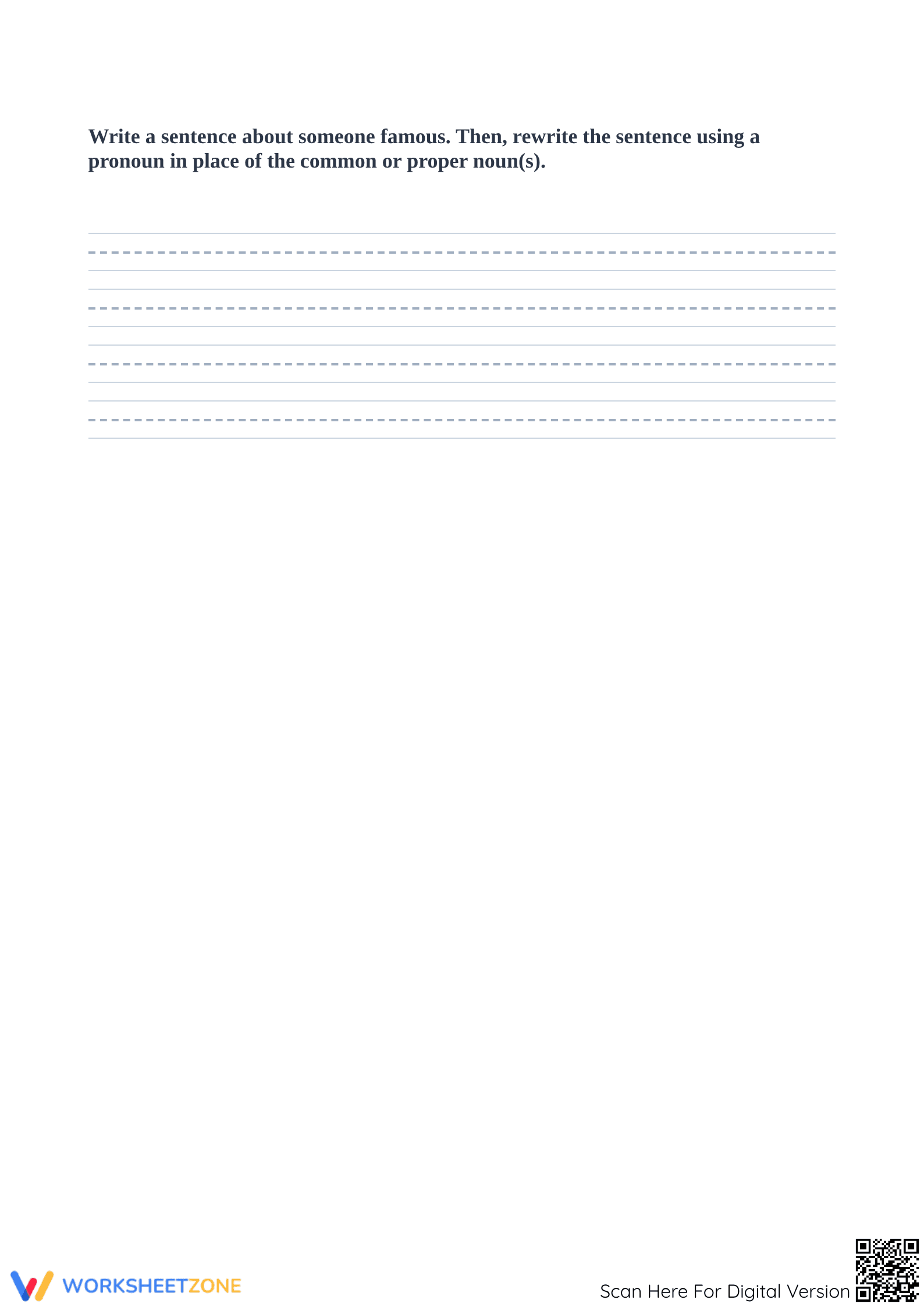
This two-page resource features a straightforward, distraction-free layout designed to keep students focused on the grammar mechanics. The first page contains twelve multiple-choice sentences where learners must circle the correct pronoun (e.g., he versus him, we versus us) to complete the thought. The second page provides an application task, prompting students to write an original sentence about a famous person and then rewrite it by replacing the proper nouns with appropriate pronouns. A complete answer key is provided for quick grading.
- Guided practice: Begin by reviewing the first few multiple-choice sentences together, discussing why a subject or object pronoun is needed.
- Supported practice: Students complete the remaining ten multiple-choice questions, relying on their understanding of sentence structure.
- Independent practice: The final writing task requires students to generate their own sentences, demonstrating full conceptual grasp.
This structure perfectly supports a gradual-release, I Do, We Do, You Do instructional model.
This worksheet is directly aligned to CCSS.ELA-LITERACY.L.3.1.A, requiring students to explain the function of nouns, pronouns, verbs, adjectives, and adverbs in general and their functions in particular sentences. It also supports fourth-grade review for standard English grammar conventions. Both standard codes can be copied directly into lesson plans, IEP goals, or district curriculum mapping tools.
Deploy this worksheet during your morning work routine or as a dedicated grammar center activity after direct instruction on pronouns. Teachers can use the multiple-choice section as a quick formative assessment to identify students who struggle with pronoun case. Expect most students to complete the entire two-page assignment within 15 to 20 minutes.
This resource is primarily designed for third and fourth-grade general education students, but it also serves as an excellent intervention tool for older English Language Learners (ELLs) who need explicit practice with English pronoun rules. Pair this worksheet with a classroom anchor chart detailing subject versus object pronouns for maximum impact.
Mastering the correct usage of pronouns is a critical step in developing reading comprehension and writing fluency. According to a recent EdReports 2024 analysis, explicit grammar instruction that requires students to apply rules in context significantly improves their overall syntactic awareness and reading comprehension scores. This worksheet targets CCSS.ELA-LITERACY.L.3.1.A, helping students explain the function of pronouns in sentences through targeted, repetitive practice. By transitioning from identifying the correct pronoun in a multiple-choice format to generating their own original sentences, learners internalize these essential grammar mechanics. Providing structured opportunities to practice subject and object pronouns ensures that students can construct clear, unambiguous sentences, a foundational skill for all future academic writing tasks. This targeted approach effectively bridges the gap between rote memorization and practical application in everyday student writing.


