


























Views
Downloads
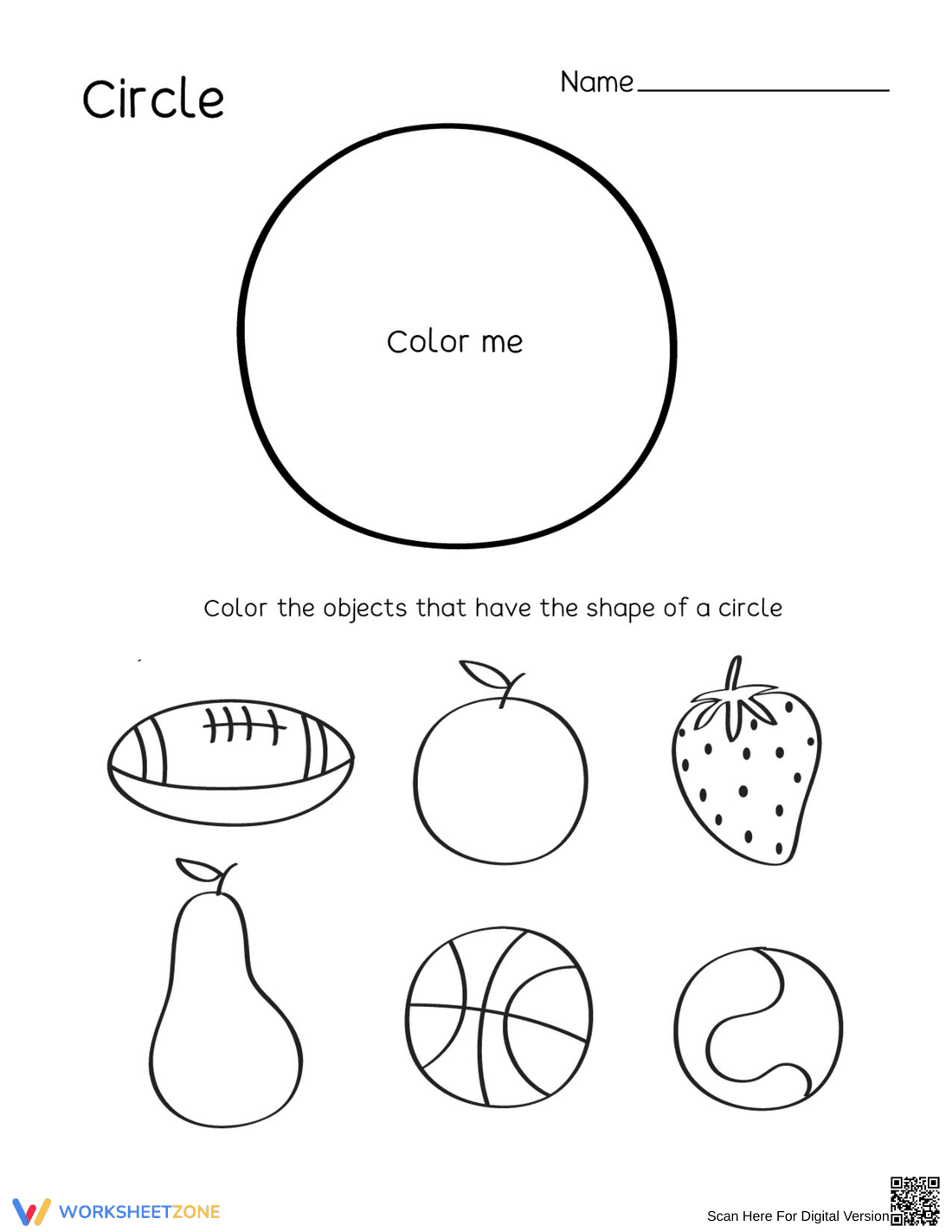

Printable Circle Shapes Worksheet | Grade K Math
Paste this activity's link or code into your existing LMS (Google Classroom, Canvas, Teams, Schoology, Moodle, etc.).
Students can open and work on the activity right away, with no student login required.
You'll still be able to track student progress and results from your teacher account.
This foundational geometry worksheet helps early learners identify and color circles among various everyday objects. Students build essential shape recognition skills by evaluating real-world items and selecting only the circular ones. This targeted practice strengthens visual discrimination and fine motor control simultaneously.
At a Glance
- Grade: K · Subject: Math
- Standard:
CCSS.MATH.CONTENT.K.G.A.2— Name shapes regardless of orientation or size- Skill Focus: Identifying circles
- Format: 1 page · 4 problems · No answer key · PDF
- Best For: Independent practice centers
- Time: 10–15 minutes
This single-page resource features one large focal circle for introductory coloring, followed by a visual discrimination task. The bottom section displays six distinct everyday objects, including a football, orange, strawberry, pear, basketball, and tennis ball. Students must evaluate each item's outline and color only the three objects that represent perfect circles. The clean layout minimizes visual clutter, keeping young learners focused on the primary geometry objective.
Zero-Prep Workflow
- Print (30 seconds): Generate the PDF and send it directly to the copier. No special paper or color ink required.
- Distribute (30 seconds): Hand out the sheets along with standard crayons or markers. The visual instructions are self-explanatory.
- Review (1 minute): Quickly scan student pages to verify they colored the orange, basketball, and tennis ball.
Total teacher prep time is under two minutes. This straightforward format makes it an excellent, reliable option for emergency sub plans or spontaneous center rotations.
Standards Alignment
Aligned to CCSS.MATH.CONTENT.K.G.A.2: Correctly name shapes regardless of their orientations or overall size. This activity directly supports the standard by requiring students to isolate the circle shape from non-circular distractors like ovals and irregular forms. Both standard codes can be copied directly into lesson plans, IEP goals, or district curriculum mapping tools.
How to Use It
Deploy this worksheet during morning work to activate prior knowledge about 2D shapes before a whole-group math lesson. Alternatively, place it in an independent math center for quiet practice while the teacher pulls small groups. Expected completion time ranges from 10 to 15 minutes. For formative assessment, observe students as they evaluate the football and the pear; if they color these, they may need a quick reteach on the difference between circles and ovals or irregular curves.
Who It's For
This resource is designed for Kindergarten students mastering basic 2D geometry. It serves well for general education classrooms and provides clear, unambiguous practice for special education students working on visual discrimination IEP goals. To differentiate for early finishers, ask them to flip the page and draw three more circular objects they see in the classroom. Pair this worksheet with a physical shape-sorting activity or a read-aloud book about shapes to reinforce the concept across multiple modalities.
Mastering early geometry concepts like those found in CCSS.MATH.CONTENT.K.G.A.2 requires explicit practice in visual discrimination. When students name shapes regardless of orientation or size, they build the cognitive foundation necessary for later spatial reasoning and advanced mathematics. According to the RAND AIRS 2024 report on early childhood mathematics, students who engage in targeted shape identification tasks demonstrate significantly higher retention of geometric properties than those who only receive verbal instruction. By requiring learners to evaluate real-world objects and isolate the circles from distractors, this worksheet aligns with evidence-based practices for early cognitive development. Consistent exposure to these focused visual tasks ensures that foundational geometry skills are firmly established before students progress to composing and decomposing complex shapes in subsequent grade levels.


