


























Views
Downloads
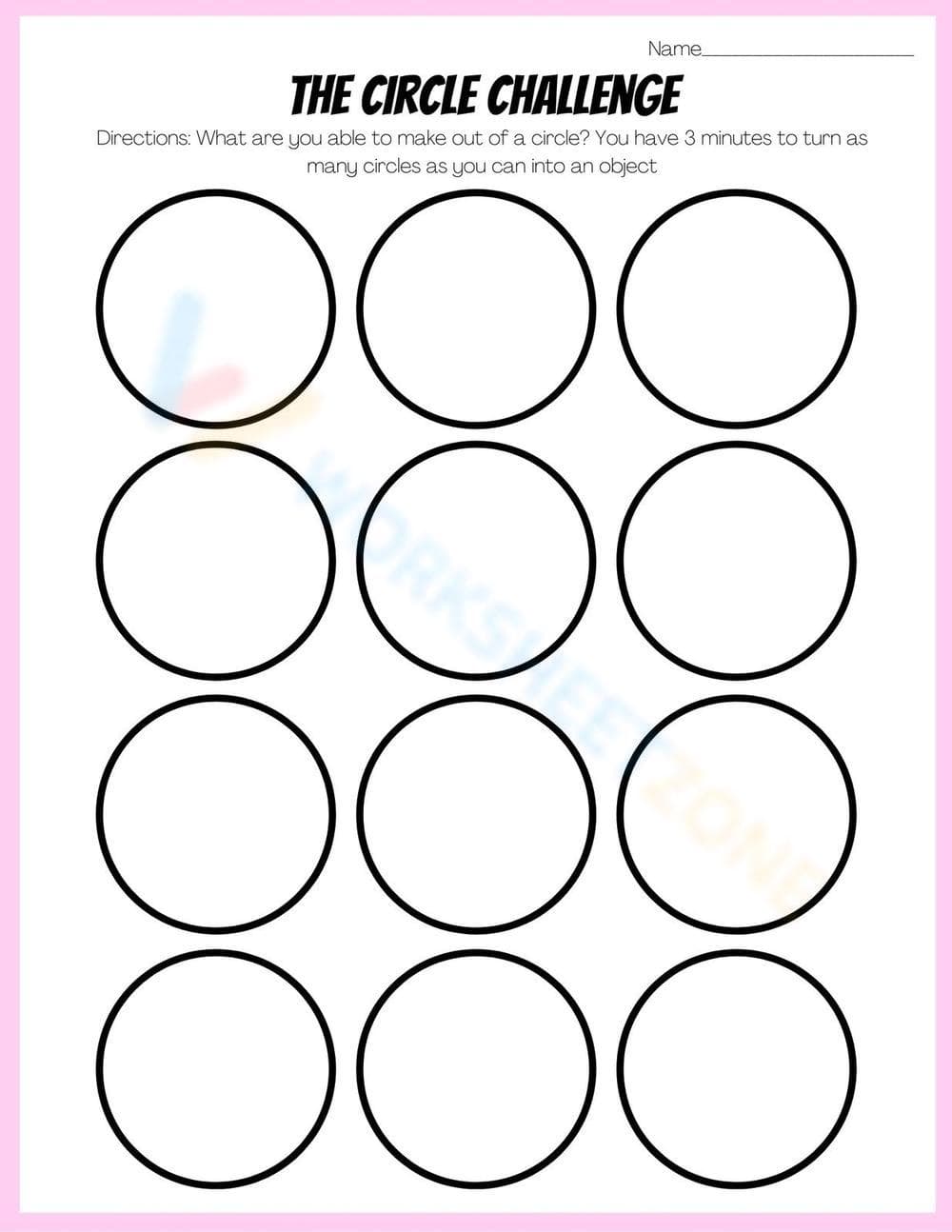

Printable Circle Challenge | Grade 3 Art
Paste this activity's link or code into your existing LMS (Google Classroom, Canvas, Teams, Schoology, Moodle, etc.).
Students can open and work on the activity right away, with no student login required.
You'll still be able to track student progress and results from your teacher account.
This printable Circle Challenge worksheet prompts students to use rapid creative thinking. By transforming blank circles into recognizable objects within a three-minute limit, learners practice brainstorming and visual expression. This engaging activity builds confidence and encourages problem-solving in a fun, low-stakes environment.
At a Glance
- Grade: 3 · Subject: Arts & Crafts
- Standard:
CCSS.ELA-LITERACY.W.3.10— Complete short tasks for specific purposes- Skill Focus: Creative thinking and drawing
- Format: 1 page · 12 problems · No answer key · PDF
- Best For: Brain breaks and warm-ups
- Time: 3–5 minutes
What's Inside
This single-page resource features twelve identical blank circles. The straightforward directions challenge students to turn as many circles as possible into unique objects within three minutes. Because this is an open-ended creative exercise, there is no answer key, allowing for limitless possibilities and encouraging students to share their visual interpretations.
Zero-Prep Workflow
This activity is designed for immediate classroom implementation with no teacher preparation required.
- Print (1 minute): Generate copies directly from the PDF.
- Distribute (1 minute): Hand out sheets face-down to build anticipation.
- Review (3 minutes): Allow students to quickly share their most creative objects with a partner.
With teacher prep time under two minutes, this is an ideal emergency sub plan or transition filler.
Standards Alignment
This activity aligns with CCSS.ELA-LITERACY.W.3.10, which requires students to write or create routinely over shorter time frames for a range of discipline-specific tasks, purposes, and audiences. While primarily a visual arts exercise, the rapid brainstorming process supports the cognitive flexibility needed for creative writing and problem-solving. Both standard codes can be copied directly into lesson plans, IEP goals, or district curriculum mapping tools.
How to Use It
This versatile worksheet works perfectly as a morning warm-up to activate creative thinking before a writing block. Alternatively, use it as a structured brain break during long periods of direct instruction. As students work, observe their approach to the time limit—this serves as an excellent formative assessment of their ability to manage stress and generate ideas rapidly. Expect the core activity to take exactly three minutes, with an additional two minutes for sharing and transition.
Who It's For
This resource is primarily designed for third-grade students, though its open-ended nature makes it highly accessible for a wide range of learners, including English Language Learners and students needing visual expression outlets. Differentiation happens naturally, as students work at their own pace and complexity level. Pair this challenge with a creative writing prompt where students must write a short story incorporating three of the objects they just drew.
Integrating rapid creative exercises like the Circle Challenge supports cognitive flexibility and divergent thinking in the elementary classroom. Aligned to CCSS.ELA-LITERACY.W.3.10, this task requires students to complete short tasks for specific purposes under strict time constraints. According to Fisher & Frey (2014), providing students with brief, structured opportunities for creative expression significantly increases their overall engagement and willingness to take academic risks in subsequent, more rigorous instructional tasks. By limiting the drawing activity to exactly three minutes, students are forced to bypass perfectionism and focus purely on rapid idea generation. This foundational cognitive skill translates directly into stronger brainstorming capabilities across all core academic subjects, particularly in narrative and informational writing blocks. Teachers can leverage these short bursts of creativity to build a more dynamic, responsive learning environment where visual communication is valued alongside traditional literacy.


