


























Views
Downloads
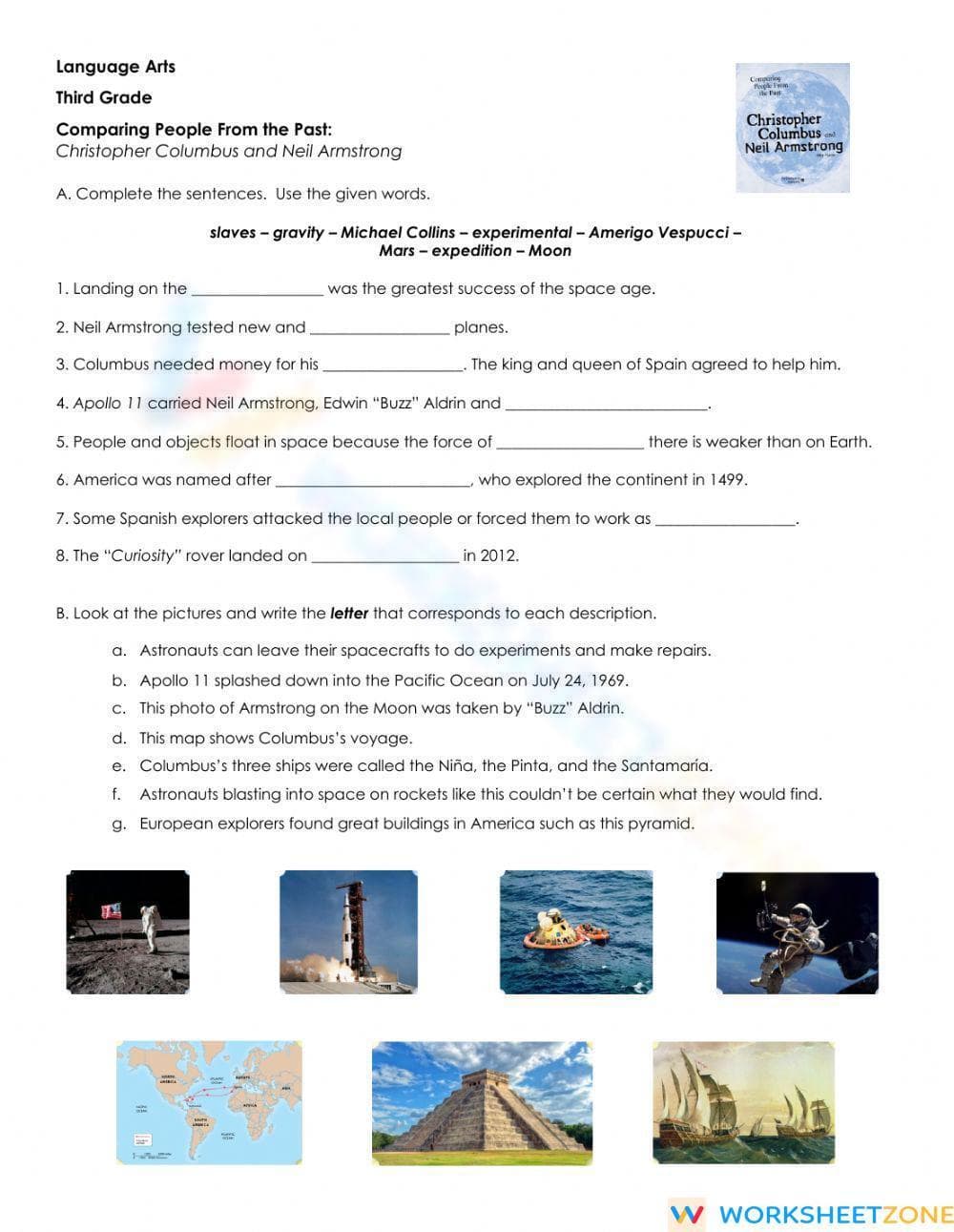

Essential Grade 5 Worksheet: Columbus & Armstrong Comparison
Paste this activity's link or code into your existing LMS (Google Classroom, Canvas, Teams, Schoology, Moodle, etc.).
Students can open and work on the activity right away, with no student login required.
You'll still be able to track student progress and results from your teacher account.
This reading comprehension worksheet provides a structured comparison between two pivotal explorers: Christopher Columbus and Neil Armstrong. Students analyze historical facts and space-age milestones to identify key similarities and differences in their journeys. By focusing on evidence-based details, learners develop a deeper understanding of how historical figures shape our collective understanding of global exploration.
At a Glance
- Grade: 5 · Subject: ELA
- Standard:
CCSS.ELA-LITERACY.RI.5.3— Explain the relationships between individuals in a historical text based on specific information.- Skill Focus: Comparing historical figures
- Format: 1 page · 15 problems · Answer key included · PDF
- Best For: Informational text analysis and social studies integration
- Time: 20–30 minutes
This comprehensive one-page resource features fifteen distinct tasks designed to challenge student recall and analytical thinking. The first section contains eight context-heavy fill-in-the-blank sentences utilizing a provided word bank with terms like Michael Collins and Amerigo Vespucci. The second half incorporates visual literacy, requiring students to match seven descriptive letters to high-quality photographs of the Moon landing and maritime exploration. A complete answer key is provided for efficient grading.
Implementing this resource into your daily routine is streamlined for maximum efficiency. First, print the single-page PDF for your class, which takes less than thirty seconds for a standard group. Next, distribute the sheets and allow students twenty minutes for independent completion; the self-contained word bank ensures students can progress without constant teacher intervention. Finally, review the answers as a whole group to clarify historical timelines, requiring approximately five minutes of total instructional time.
The primary alignment for this resource is CCSS.ELA-LITERACY.RI.5.3, which requires students to explain the relationships or interactions between two or more individuals, events, or ideas in a historical text based on specific information. This worksheet bridges the gap between basic recall and the complex synthesis required by higher-level informational text standards. These standard codes can be copied directly into lesson plans, IEP goals, or district curriculum mapping tools.
This worksheet serves as an ideal formative assessment tool following a unit on exploration. Use it as a mid-lesson check for understanding to ensure students can distinguish between maritime and aerospace achievements. During completion, circulate and observe if students are correctly identifying gravity as a space-specific concept versus an expedition as a shared trait; this provides immediate insight into their grasp of domain-specific vocabulary. Expect a completion time of twenty-five minutes.
This activity is tailored for Grade 5 students, though it is effective for Grade 4 or Grade 6 learners requiring reinforcement of informational text structures. It provides essential scaffolding for English Language Learners through the use of visual matching and a provided word bank. This resource pairs naturally with a classroom anchor chart comparing different modes of travel throughout history or a primary source passage about the Apollo 11 mission.
The ability to compare historical figures is a fundamental component of the CCSS.ELA-LITERACY.RI.5.3 standard. By analyzing the 15 specific tasks provided, students move beyond memorization into conceptual categorization. According to the RAND AIRS 2024 report, high-quality informational text resources integrating visual elements improve student retention of chronological relationships. This worksheet employs a dual-modality approach—combining textual sentence completion with visual image matching—to support diverse learning styles and ensure mastery. Educational research from Fisher & Frey (2014) highlights that such zero-prep materials are essential for maintaining instructional continuity during independent practice, allowing teachers to focus on targeted interventions while students engage in meaningful, standard-mapped work.


