


























Views
Downloads
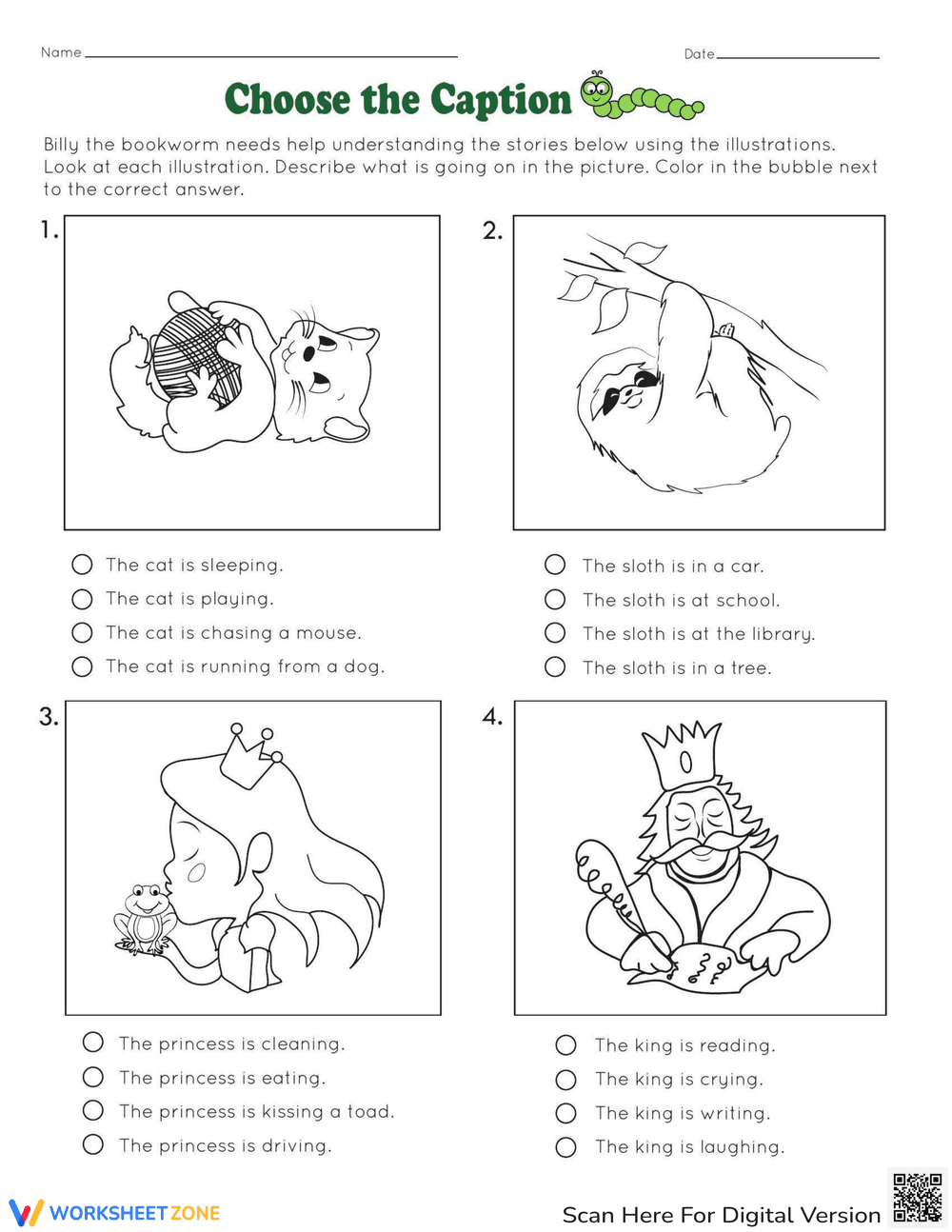

Kindergarten Picture Comprehension — Printable Worksheet
Paste this activity's link or code into your existing LMS (Google Classroom, Canvas, Teams, Schoology, Moodle, etc.).
Students can open and work on the activity right away, with no student login required.
You'll still be able to track student progress and results from your teacher account.
This kindergarten ELA worksheet builds picture comprehension skills by prompting young learners to match illustrations with descriptive sentences. Students analyze four distinct images and select the correct caption, establishing a strong foundation for early reading. This resource helps children connect visual cues to written text, improving literacy development.
At a Glance
- Grade: Kindergarten · Subject: English Language Arts
- Standard:
CCSS.ELA-LITERACY.RL.K.3— Identify characters, settings, and major events in a story using illustrations- Skill Focus: Picture comprehension and sentence matching
- Format: 1 page · 4 problems · Answer key included · PDF
- Best For: Independent morning work or quick reading assessment
- Time: 10–15 minutes
This single-page PDF features four high-quality illustrations depicting simple actions: a cat playing, a sloth in a tree, a princess kissing a toad, and a king writing. Below each image, students choose from four multiple-choice sentences to identify the correct description. The clean layout includes bubble-in options, name lines, and a complete answer key.
Zero-Prep Workflow
This resource features a zero-prep workflow designed to save classroom time. Teachers can implement this activity in under 2 minutes using three steps. First, print the single-page PDF. Second, distribute the sheets to students during transitions. Third, review completed worksheets using the answer key. This straightforward design makes it ideal for emergency sub plans or quiet desk work.
Standards Alignment
This activity aligns directly with the Common Core State Standard `CCSS.ELA-LITERACY.RL.K.3`, which requires students to describe the connection between illustrations and the story. By matching sentences to pictures, students practice identifying key details. Both standard codes can be copied directly into lesson plans, IEP goals, or district curriculum mapping tools.
How to Use It
Use this worksheet as a quick formative assessment during direct instruction. Administer it after reading a picture book to evaluate how well students translate visual narratives into text. Alternatively, assign it as a warm-up during ELA rotations. Teachers should observe whether students read all options. Completion time ranges from 10 to 15 minutes.
Who It's For
This worksheet is designed for kindergarten students developing early literacy, but also serves as an intervention tool for first graders needing sentence-level comprehension practice. English language learners benefit from the visual scaffolds. Pair this worksheet with a shared reading passage or an anchor chart detailing how illustrations help readers understand actions.
Early literacy research emphasizes the critical role of visual literacy in reading acquisition. According to the Fisher & Frey (2014) framework, structured visual aids scaffold the transition from decoding words to comprehending full sentences. This worksheet applies these principles by pairing clear illustrations with simple sentence structures, allowing young learners to practice comprehension strategies without cognitive overload. By isolating the skill of picture-to-text matching, the resource helps educators identify specific gaps in student understanding of narrative elements. This targeted practice aligns with evidence-based reading instruction guidelines that advocate for integrated visual and textual learning in early childhood classrooms. Implementing this structured activity supports the development of foundational reading comprehension skills required by standard CCSS.ELA-LITERACY.RL.K.3, ensuring students build the necessary visual analysis capabilities for future reading success.


