


























Views
Downloads
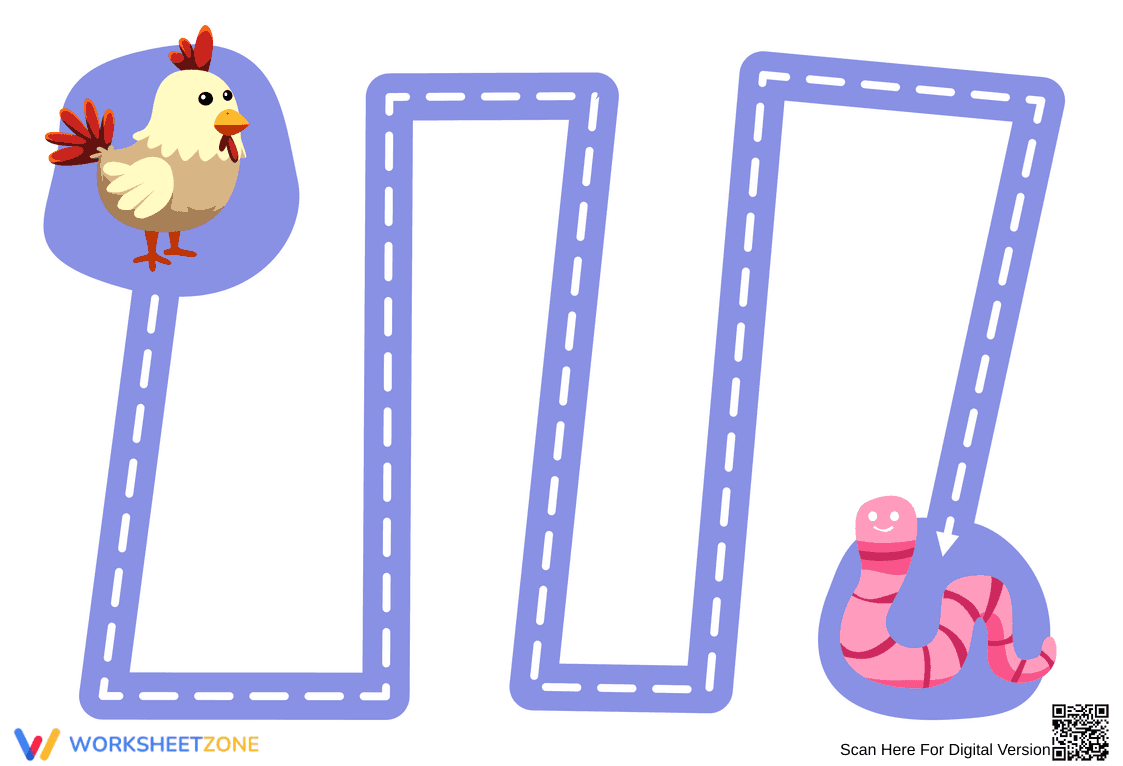

Line Tracing Worksheet | Essential Preschool Handwriting
Paste this activity's link or code into your existing LMS (Google Classroom, Canvas, Teams, Schoology, Moodle, etc.).
Students can open and work on the activity right away, with no student login required.
You'll still be able to track student progress and results from your teacher account.
This Preschool line tracing worksheet helps early learners develop the fine motor control necessary for successful handwriting. By following the path from the chicken to the worm, students practice steady hand movements and spatial awareness. It provides a fun, engaging way to bridge the gap between drawing and formal letter formation.
At a Glance
- Grade: Preschool · Subject: Handwriting
- Standard:
CCSS.ELA-LITERACY.L.K.1.A— Print many upper- and lowercase letters through pre-writing motor control- Skill Focus: Fine motor line tracing
- Format: 1 page · 1 complex path · No-prep · PDF
- Best For: Morning work or fine motor centers
- Time: 5–10 minutes
This single-page PDF features a high-contrast, dashed tracing path connecting a friendly chicken to a worm. The path includes multiple 90-degree turns and vertical/horizontal segments, designed to challenge a child's grip and wrist stability. The large, clear graphics ensure that young learners remain focused on the task without visual overwhelm.
Zero-Prep Workflow
- Print: Generate copies of the single-page PDF for your entire class or small group in under 1 minute.
- Distribute: Hand out the sheets with crayons, markers, or pencils for immediate student engagement.
- Review: Observe student grip and path accuracy as they work, providing verbal feedback in real-time.
This worksheet is an ideal grab-and-go option for substitute folders or transition periods, requiring less than 2 minutes of total teacher preparation time.
Standards Alignment
The primary alignment for this resource is CCSS.ELA-LITERACY.L.K.1.A, which focuses on the physical act of printing letters. While this is a pre-writing activity, it directly supports the muscular development and hand-eye coordination required to meet kindergarten literacy goals. Both standard codes can be copied directly into lesson plans, IEP goals, or district curriculum mapping tools.
How to Use It
Use this worksheet during small-group instruction to observe pencil grasp and pressure. It is particularly effective as a warm-up before a formal handwriting lesson. For a formative assessment, note if students can stay on the dashed line or if they shortcut the corners, which indicates a need for more wrist-strengthening activities. Expected completion time is between 5 and 10 minutes.
Who It's For
This resource is designed for preschoolers and kindergarteners who are beginning their handwriting journey. It is also suitable for occupational therapy sessions or for students with IEP goals related to fine motor precision. Pair this with a tactile tracing activity, such as a sand tray or finger painting, to reinforce the motor patterns before moving to paper.
According to research from Fisher & Frey (2014) on the gradual release of responsibility, providing structured pre-writing tasks like this line tracing worksheet allows students to master the mechanical aspects of writing before tackling the cognitive load of letter identification. The use of CCSS.ELA-LITERACY.L.K.1.A as a foundational goal ensures that early childhood educators are aligning play-based motor practice with long-term academic expectations. Studies in the RAND AIRS 2024 report suggest that consistent, short-burst fine motor exercises significantly improve later writing fluency and legibility in primary grades. By focusing on a single, clear path from chicken to worm, this worksheet reduces cognitive fatigue while maximizing the physical repetition necessary for muscle memory. This evidence-based approach supports early literacy development by treating handwriting as a physical skill that requires targeted, scaffolded practice during the preschool and kindergarten years.


