


























Views
Downloads
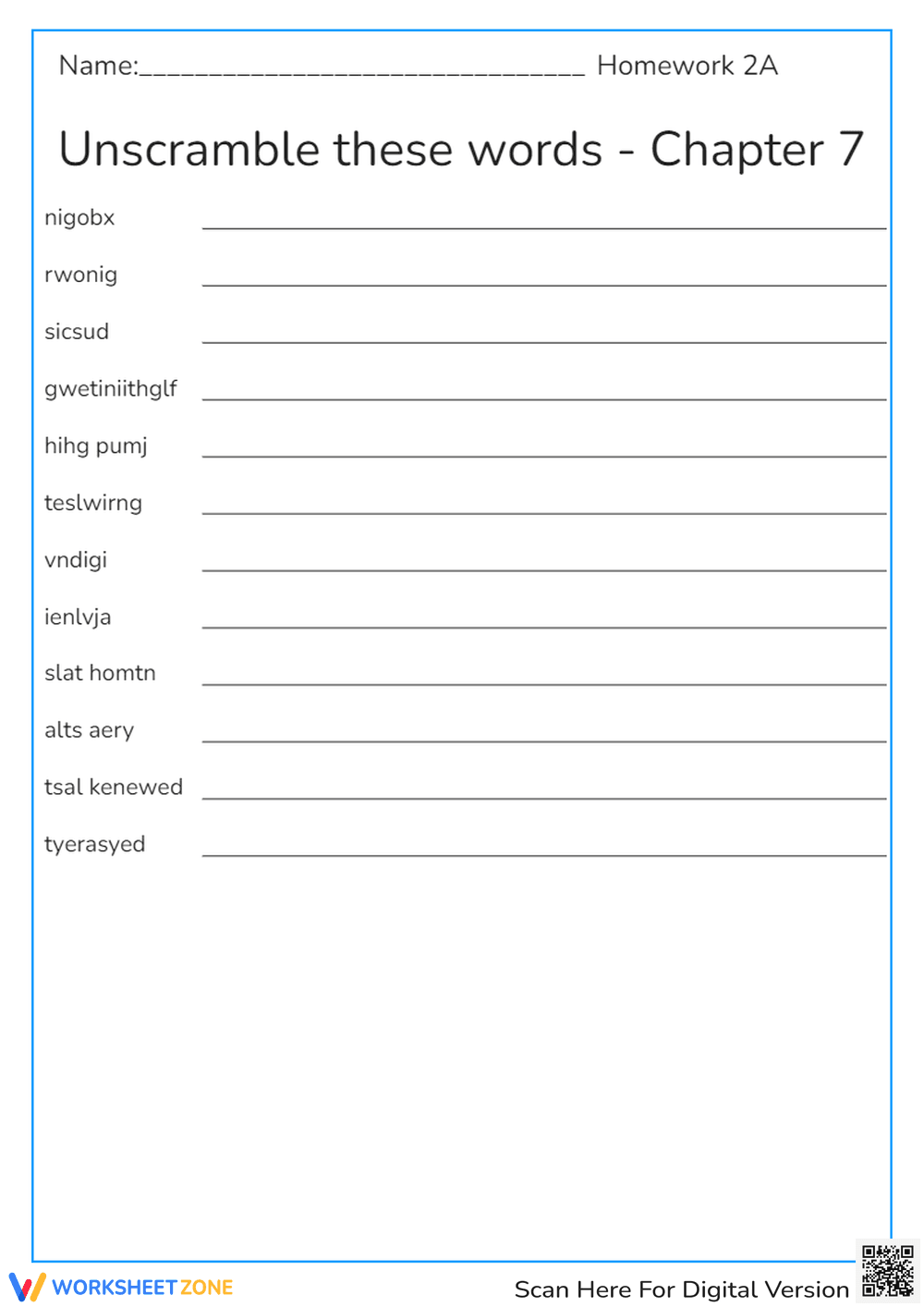

Printable Word Scramble Worksheet | Grade 3 Spelling
Paste this activity's link or code into your existing LMS (Google Classroom, Canvas, Teams, Schoology, Moodle, etc.).
Students can open and work on the activity right away, with no student login required.
You'll still be able to track student progress and results from your teacher account.
This Grade 3 vocabulary and spelling worksheet provides immediate practice with word recognition and letter patterns. Students unscramble twelve curriculum-aligned words, reinforcing their understanding of spelling conventions and vocabulary retention. The straightforward format ensures learners can focus entirely on decoding and reconstructing each term accurately.
At a Glance
- Grade: 3 · Subject: ELA
- Standard:
CCSS.ELA-LITERACY.L.3.2.E— Spell studied words and use spelling patterns correctly- Skill Focus: Spelling and Vocabulary
- Format: 1 page · 12 problems · Answer key included · PDF
- Best For: Independent practice and review
- Time: 10–15 minutes
This single-page printable features twelve scrambled words related to sports, activities, and time expressions. The layout presents the scrambled letters on the left with a clear, ruled line on the right for students to write the corrected word. An included answer key allows for rapid grading or peer review, making the entire assignment self-contained and highly structured for young learners.
Zero-Prep Workflow
- Print (1 minute): Generate the PDF and print a class set immediately. The black-and-white design is ink-friendly and requires no special formatting.
- Distribute (1 minute): Hand out the assignment as morning work, a literacy center activity, or a quick spelling check.
- Review (3 minutes): Use the provided answer key to check student responses rapidly, or display the key on a smartboard for self-correction.
Total teacher preparation time is under two minutes. The intuitive instructions make this an ideal, reliable resource for substitute teacher plans or unexpected schedule changes.
Aligned to CCSS.ELA-LITERACY.L.3.2.E, this resource requires students to use conventional spelling for high-frequency and other studied words. By unscrambling the letters, learners actively engage with phonics and word structures, reinforcing their orthographic mapping skills. Both standard codes can be copied directly into lesson plans, IEP goals, or district curriculum mapping tools.
Deploy this worksheet during the independent practice phase of a spelling or vocabulary lesson. It serves perfectly as a quiet morning work activity to settle students as they arrive. Alternatively, use it as a formative assessment at the end of a vocabulary unit to check retention of specific terms. While students work, observe their strategies—note whether they group common letter blends or struggle with vowel placement, which can inform future phonics instruction. Expected completion time ranges from 10 to 15 minutes.
This resource is designed for third-grade students developing their spelling and vocabulary proficiency. It provides excellent reinforcement for on-level learners while offering a manageable challenge for students needing extra repetition with word forms. Pair this worksheet with a visual anchor chart of common spelling patterns or a direct instruction lesson on consonant blends to maximize its effectiveness.
Mastering spelling conventions through active problem-solving tasks like word scrambles significantly enhances reading fluency and writing automaticity. According to Fisher & Frey (2014), providing students with targeted, independent practice opportunities allows them to consolidate their understanding of word structures and orthographic patterns. This worksheet directly supports CCSS.ELA-LITERACY.L.3.2.E by requiring learners to spell studied words and use spelling patterns correctly. When students manipulate letters to form recognizable words, they strengthen the neural pathways associated with vocabulary retrieval and spelling accuracy. This brief, focused activity ensures that learners interact deeply with the target vocabulary, moving beyond rote memorization to active cognitive engagement. Regular integration of such structured spelling tasks builds a stronger foundation for complex literacy skills, ultimately supporting broader academic achievement across all subject areas.


