


























Views
Downloads

Printable Sentence Types Worksheet | Grade 1 ELA
Paste this activity's link or code into your existing LMS (Google Classroom, Canvas, Teams, Schoology, Moodle, etc.).
Students can open and work on the activity right away, with no student login required.
You'll still be able to track student progress and results from your teacher account.
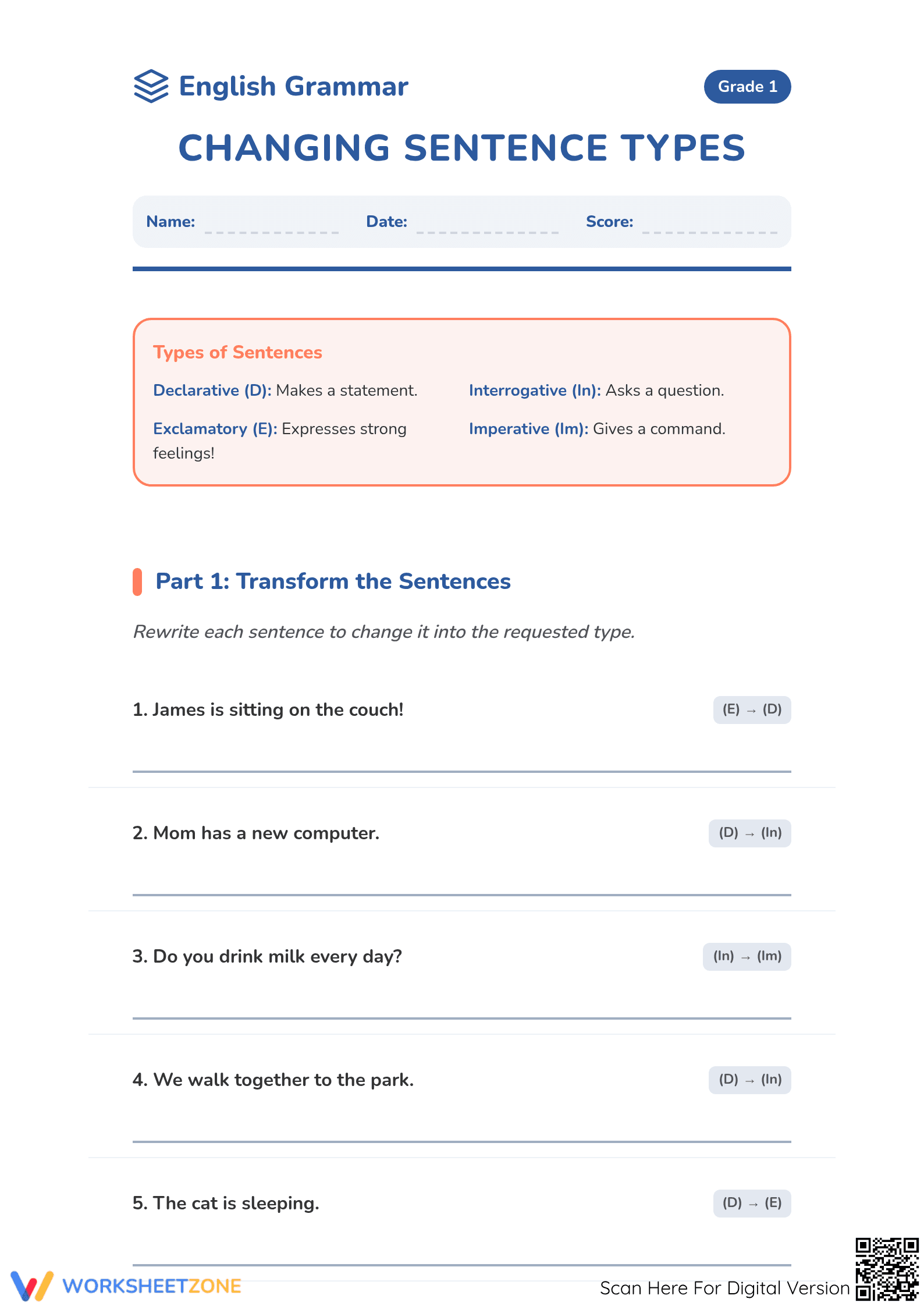
This Grade 1 English Language Arts worksheet helps students master the four primary sentence types through active transformation and identification tasks. Students will practice changing declarative statements into interrogative questions and imperative commands. By the end of these three pages, learners will demonstrate a concrete understanding of how punctuation and word order define different modes of communication.
At a Glance
- Grade: 1 · Subject: ELA
- Standard:
CCSS.ELA-LITERACY.L.1.1.J— Produce and expand complete declarative, interrogative, imperative, and exclamatory sentences- Skill Focus: Sentence type transformation and identification
- Format: 3 pages · 15 problems · Answer key included · PDF
- Best For: Independent grammar practice or sub plans
- Time: 20–30 minutes
What's Inside
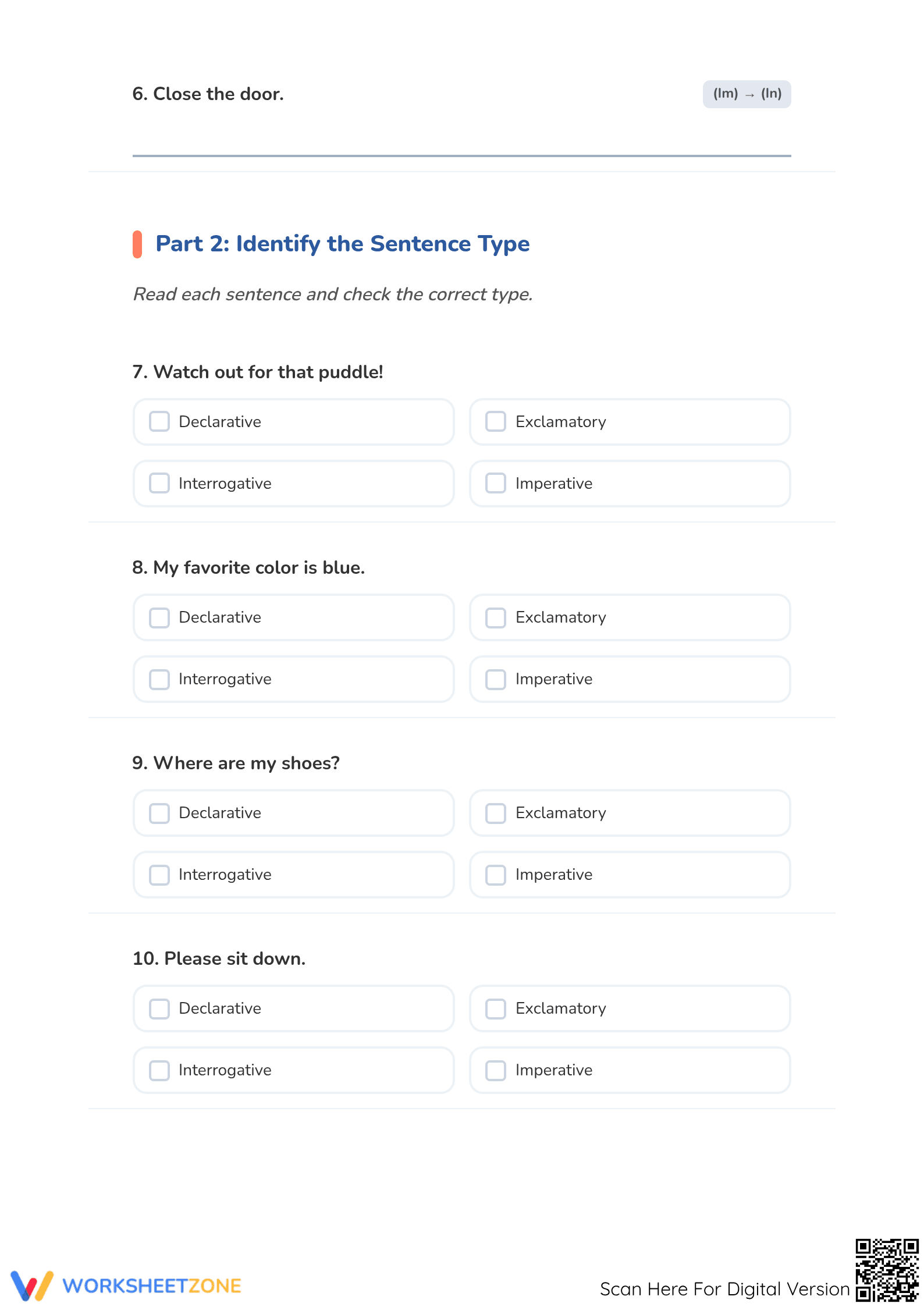
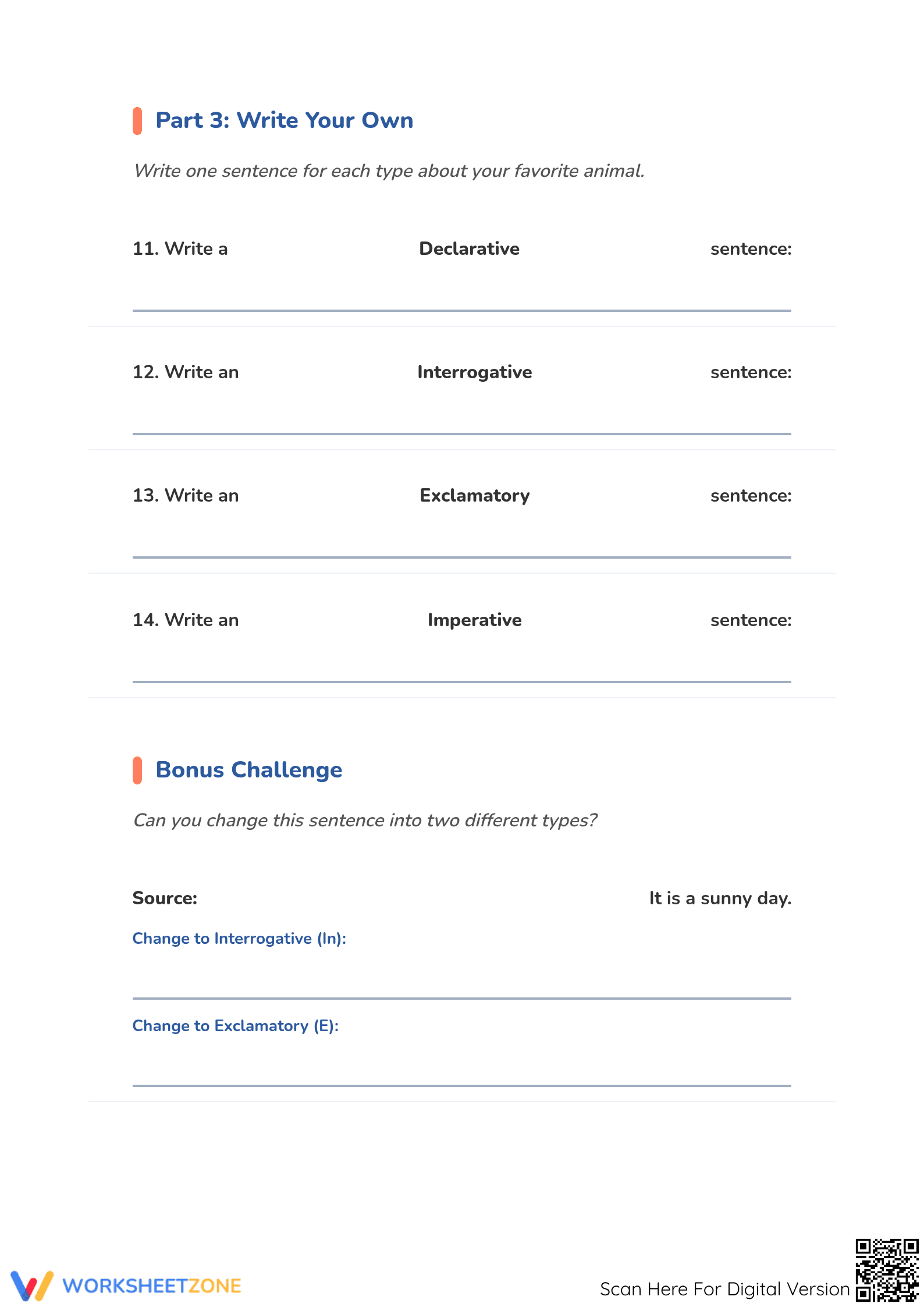
This comprehensive three-page packet includes a clear reference box defining declarative, interrogative, exclamatory, and imperative sentences. Part 1 features six transformation tasks, Part 2 provides four identification multiple-choice items, and Part 3 encourages creative writing with four original sentence prompts. A final bonus challenge tests higher-order thinking, and a complete answer key ensures effortless grading for teachers or parents.
Skill Progression
- Guided Practice: The first section uses a reference key and coded prompts (e.g., D to In) to guide students through six structured sentence transformations with clear visual cues.
- Supported Practice: Four identification tasks provide multiple-choice scaffolds, allowing students to recognize sentence types in context before moving to independent production.
- Independent Practice: The final page requires students to generate four original sentences about a favorite animal, applying their knowledge without prompts.
This sequence follows a gradual-release model (I Do, We Do, You Do) to build student confidence and accuracy.
Standards Alignment
The primary focus is CCSS.ELA-LITERACY.L.1.1.J, which requires students to produce and expand complete simple and compound declarative, interrogative, imperative, and exclamatory sentences in response to prompts. This resource directly targets the production of all four types. This standard code can be copied directly into lesson plans, IEP goals, or district curriculum mapping tools.
How to Use It
Use this worksheet during the independent practice phase of a grammar lesson on punctuation or sentence structure. It also serves as an excellent formative assessment tool; observe if students struggle more with the transformation logic or the creative production phase. The total completion time is approximately 25 minutes, making it ideal for a focused literacy center or a quiet-time activity.
Who It's For
This resource is designed for first-grade students, but it is also highly effective for second-grade review or English Language Learners (ELL) requiring structured grammar support. Pair this worksheet with a sentence type anchor chart or a mentor text that features a variety of punctuation to reinforce the concepts visually and auditory.
According to the NAEP framework for writing, early mastery of sentence variety is a critical predictor of later composition fluency. This resource aligns with Fisher & Frey (2014) principles of purposeful independent practice by providing scaffolded transformations before requiring unassisted writing. By explicitly teaching the differences between CCSS.ELA-LITERACY.L.1.1.J sentence types—declarative, interrogative, imperative, and exclamatory—teachers help students bridge the gap between spoken language and formal written structures. Research in ScienceDirect TpT Analysis suggests that grammar worksheets featuring multi-modal tasks (identification plus transformation) result in higher retention rates than identification alone. This 15-problem set provides the repetition necessary for mastery while the three-page format prevents cognitive overload for young learners.


