


























Views
Downloads


Essential Sentence Types Worksheet | Grade 1 ELA
Paste this activity's link or code into your existing LMS (Google Classroom, Canvas, Teams, Schoology, Moodle, etc.).
Students can open and work on the activity right away, with no student login required.
You'll still be able to track student progress and results from your teacher account.
Students master the art of sentence transformation with this comprehensive Grade 1 English Language Arts resource. By rearranging word order and applying correct end punctuation, learners transform declarative statements into interrogative questions. This focused practice builds essential syntactic awareness and improves reading fluency by highlighting how sentence structure signals meaning and tone. It is a fundamental step toward building writing confidence in early learners.
At a Glance
- Grade: 1 · Subject: ELA · Topic: Sentence Types
- Standard:
L.1.1.J— Produce complete declarative and interrogative sentences in response to prompts with accuracy- Skill Focus: Converting declarative statements into interrogative questions
- Format: 4 pages · 11 problems · Answer key included · Printable PDF
- Best For: Literacy centers, small group instruction, and independent grammar practice
- Time: 15–20 minutes total
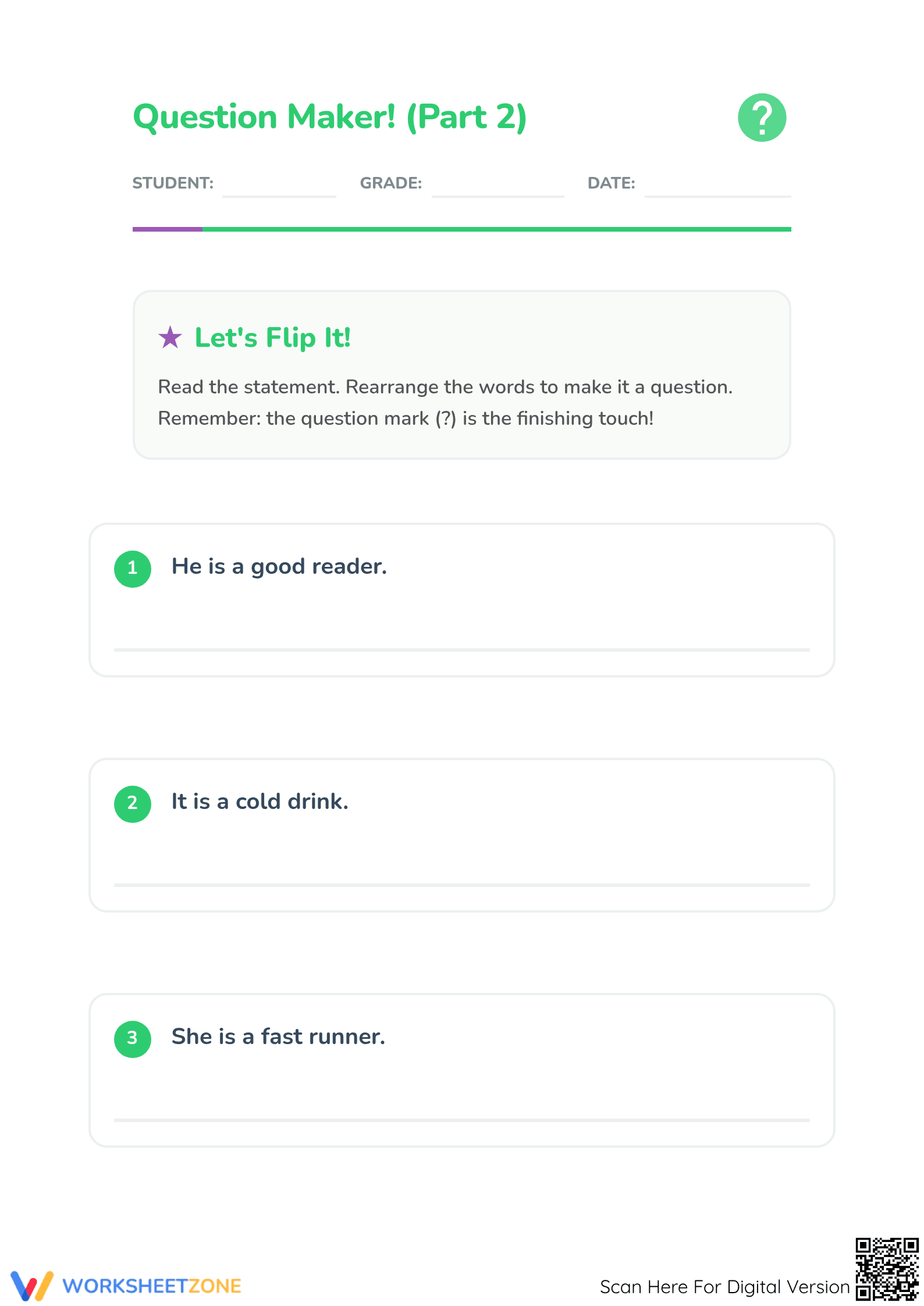
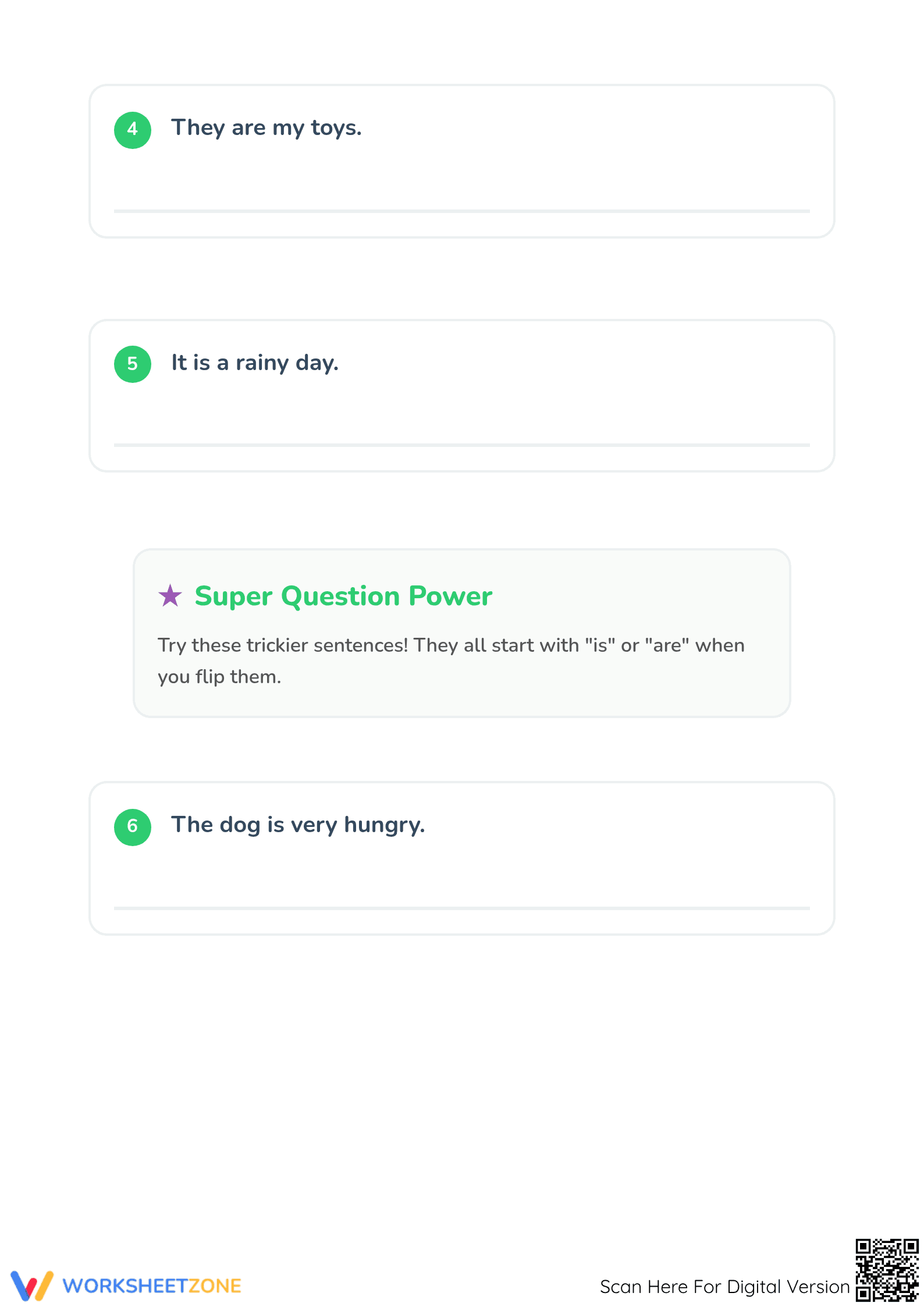
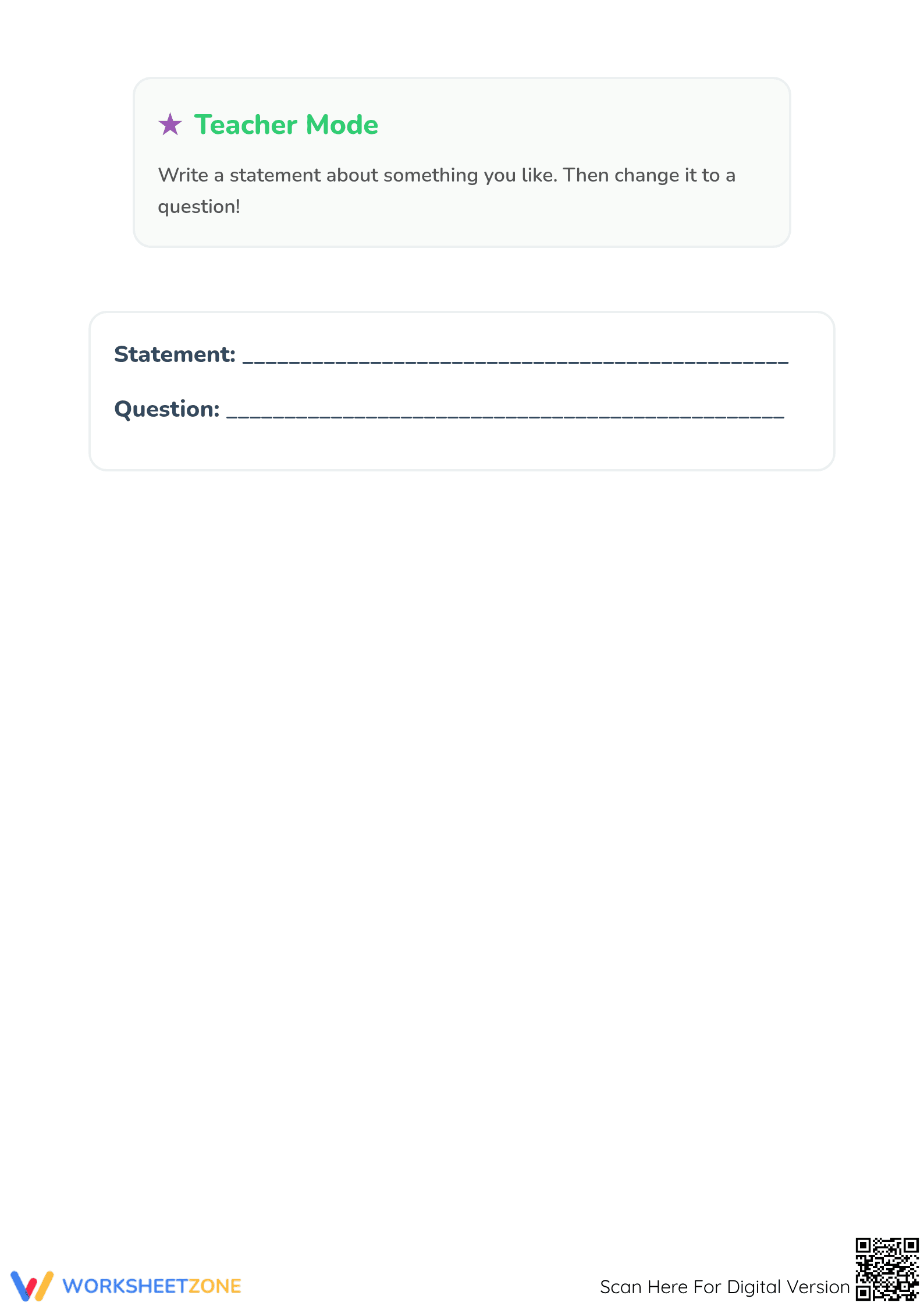
This four-page instructional packet provides a clear path to mastery through 11 carefully structured tasks. The first two pages present foundational "flip it" exercises where students rearrange simple subject-verb-complement strings. A special "Super Question Power" section introduces more complex auxiliary verb shifts, followed by four additional practice items. The final page includes a "Teacher Mode" extension, allowing students to generate their own original sentences and transformations, all supported by a comprehensive answer key.
- Guided practice: The first five items focus on high-frequency sight words and familiar structures, allowing students to focus on the mechanics of the word-order flip.
- Supported practice: The "Super Question Power" items (Problems 6–10) increase the cognitive load by requiring students to handle more complex sentence lengths and specific verb placements.
- Independent practice: The "Teacher Mode" section removes the provided prompts entirely, requiring students to demonstrate mastery by constructing their own statement-to-question pairs from scratch.
This "I Do, We Do, You Do" approach ensures that students internalize grammatical rules before applying them creatively.
The primary focus is CCSS.ELA-LITERACY.L.1.1.J, which requires students to produce and expand complete simple declarative and interrogative sentences. Additionally, this resource supports CCSS.ELA-LITERACY.L.1.2.B, focusing on the correct use of end punctuation—specifically the question mark. Both standard codes can be copied directly into lesson plans, IEP goals, or district curriculum mapping tools to ensure vertical alignment.
This resource is ideally positioned as a follow-up to direct instruction on sentence types. Teachers can use the first page for a whole-group "think-aloud," modeling the rearrangement of words on a whiteboard before students move into independent work. During the independent phase, circulate and use the "Super Question Power" section as a formative assessment check; if students struggle with auxiliary verb placement in item 6, provide immediate re-teaching. Expect a 15-to-20 minute completion time.
Designed for first-grade general education classrooms, this packet is also highly effective for ESL/ELL students learning English word order for questions. It serves as an excellent resource for Title I intervention groups or as a remedial activity for second graders needing a syntax refresher. Pair this with a shared reading passage to find examples of questions in context for an extended literacy lesson, reinforcing practical application of these grammatical rules.
Syntactic awareness in early elementary education is a critical predictor of later reading comprehension and writing proficiency. Explicit instruction in sentence-level manipulation helps students bridge the gap between decoding individual words and understanding structural relationships. By engaging in "sentence flipping" exercises, first graders develop a functional understanding of interrogative patterns that often differ from spoken vernacular. Guided practice with sentence frames and structural transformations reduces cognitive load, allowing young writers to focus on punctuation and word choice. This worksheet provides the repeated, structured exposure necessary to transition these skills from conscious effort to automaticity. Educators can use these 11 targeted tasks to gather evidence of mastery for L.1.1.J, ensuring foundational grammar skills are firmly established before advancing to complex sentence composition.


