


























Views
Downloads

Changing Nouns to Pronouns | Printable Grade 1 ELA
Paste this activity's link or code into your existing LMS (Google Classroom, Canvas, Teams, Schoology, Moodle, etc.).
Students can open and work on the activity right away, with no student login required.
You'll still be able to track student progress and results from your teacher account.
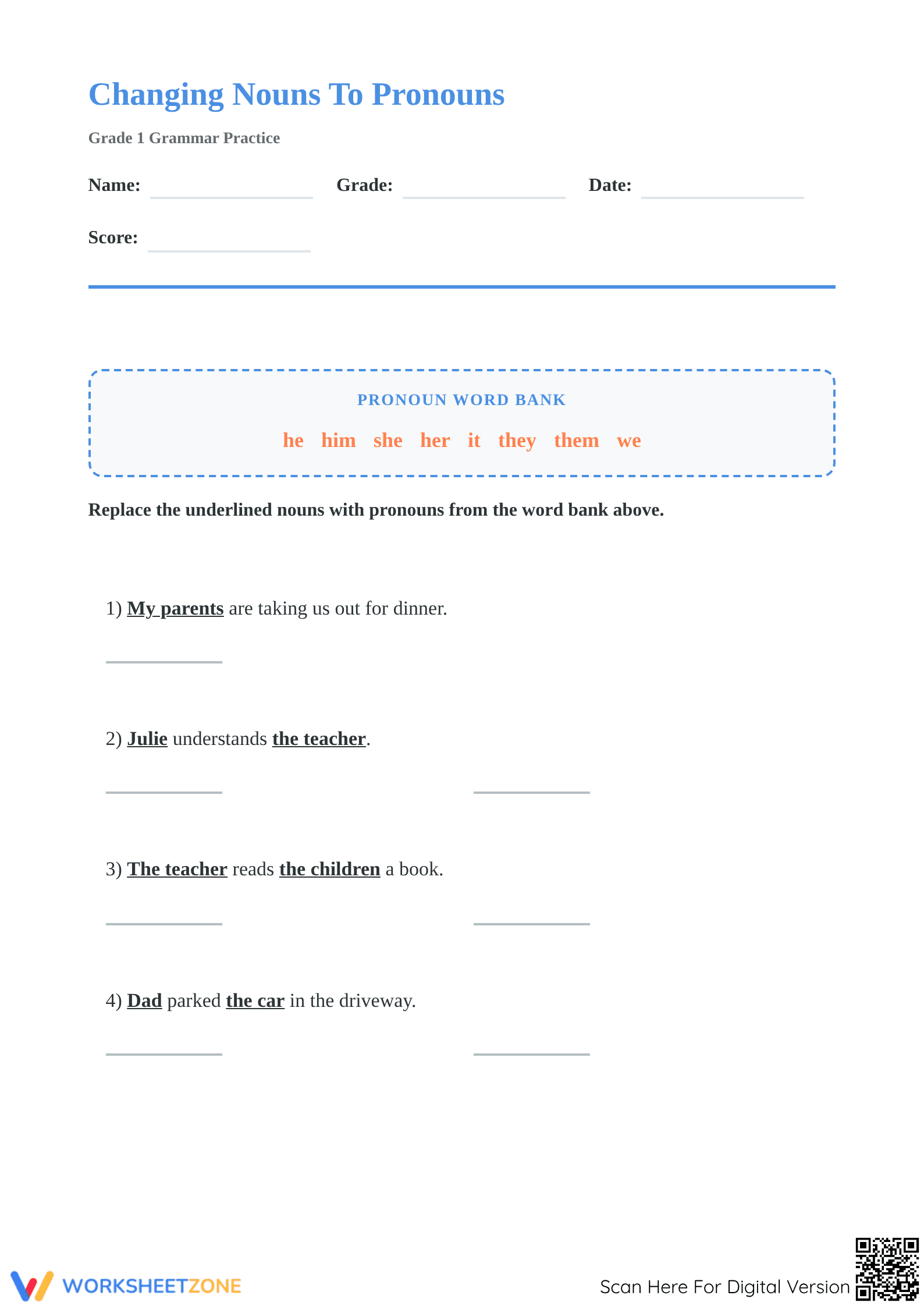
This Grade 1 grammar worksheet provides targeted practice for replacing nouns with appropriate personal pronouns. By working through structured exercises, students learn to reduce repetition in their writing and understand how words like he, she, it, and they function within complete sentences.
At a Glance
- Grade: 1 · Subject: ELA
- Standard:
CCSS.ELA-LITERACY.L.1.1.D— Use personal pronouns to replace nouns.- Skill Focus: Personal Pronouns
- Format: 3 pages · 16 problems · Answer key included · PDF
- Best For: Independent practice and grammar review
- Time: 15–20 minutes
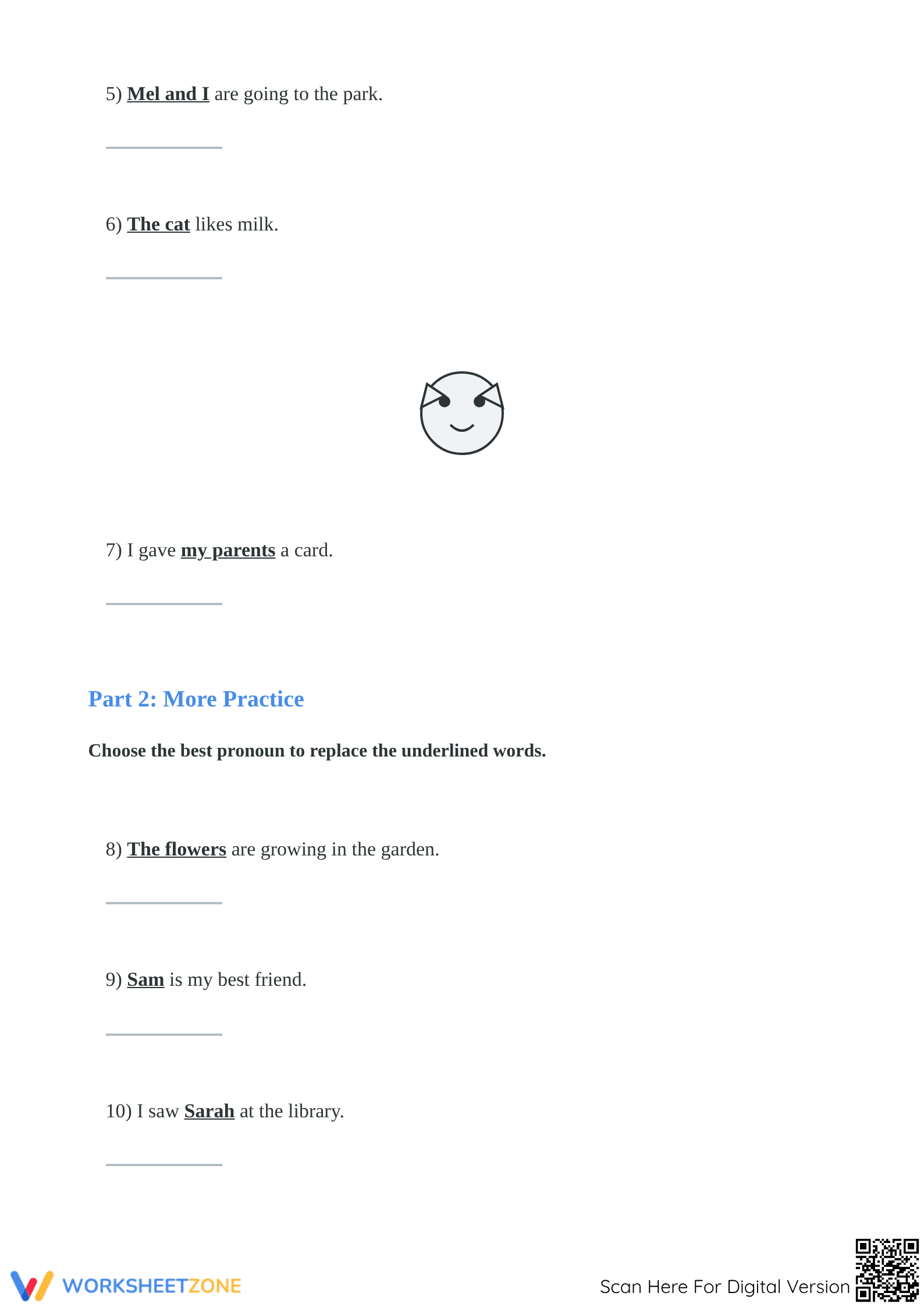
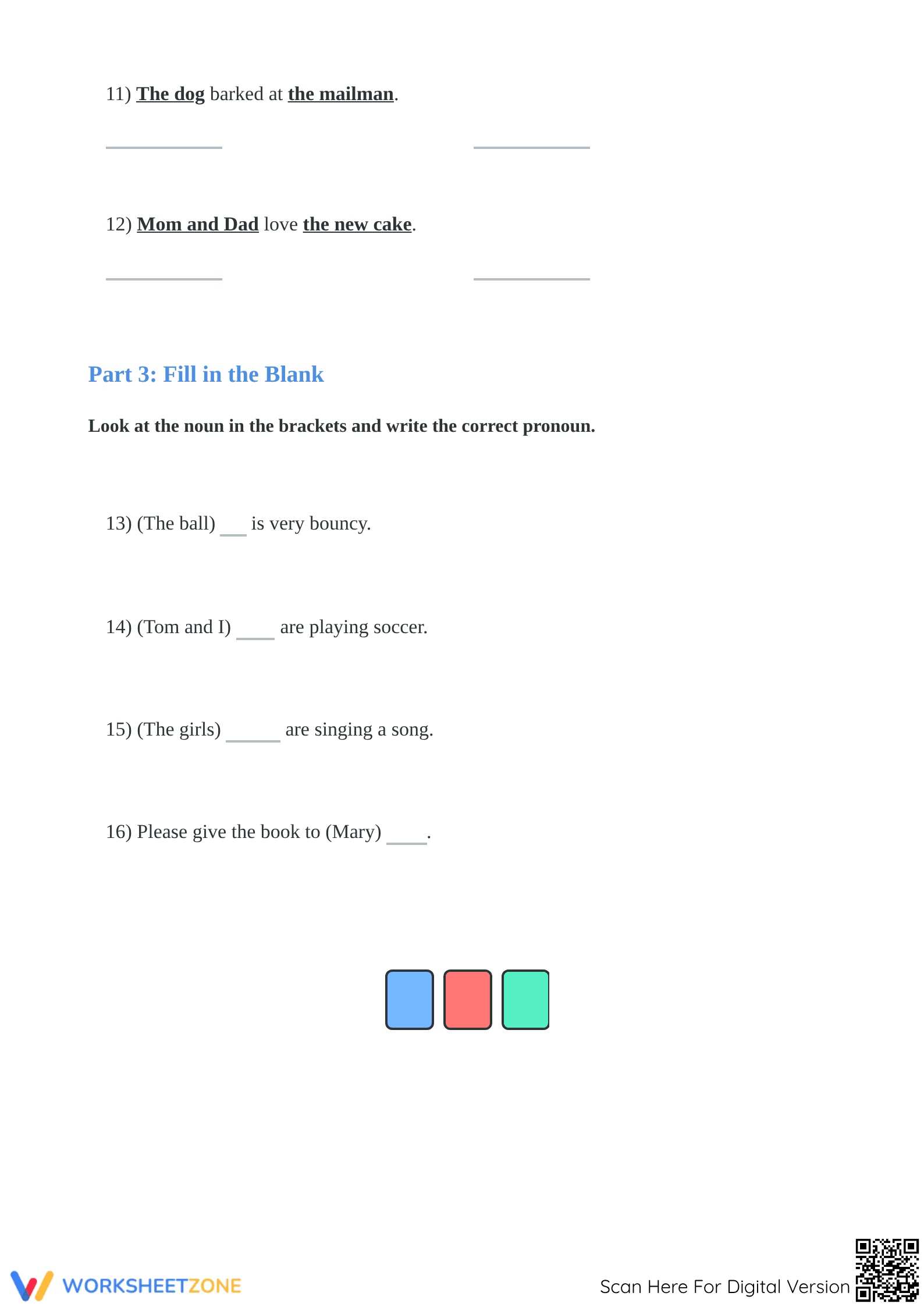
This three-page printable includes 16 varied tasks designed to build pronoun fluency. The resource features a helpful pronoun word bank at the top of the first page to support early readers. Students will encounter three distinct task types: replacing underlined nouns using the word bank, choosing the best pronoun for a given sentence, and filling in the blank based on a bracketed noun. An answer key is provided for quick grading.
Skill Progression
- Guided practice: The first seven problems provide a clear word bank (he, him, she, her, it, they, them, we) and underline the exact nouns to replace, offering maximum support.
- Supported practice: The next three questions remove the word bank but keep the target nouns underlined, prompting students to recall the correct pronoun from memory.
- Independent practice: The final six fill-in-the-blank tasks require students to read a sentence, look at a bracketed noun, and generate the correct pronoun to complete the thought.
This gradual-release approach follows an I Do, We Do, You Do model to ensure student confidence.
Standards Alignment
Aligned to CCSS.ELA-LITERACY.L.1.1.D: Use personal, possessive, and indefinite pronouns. This resource specifically targets the use of personal pronouns as direct replacements for proper and common nouns in basic sentence structures. Both standard codes can be copied directly into lesson plans, IEP goals, or district curriculum mapping tools.
How to Use It
Use this worksheet during independent work after a direct instruction lesson on parts of speech. It also functions well as a morning work activity to reinforce grammar concepts introduced earlier in the week. As a formative assessment observation tip, watch to see if students struggle with plural nouns versus singular nouns; this often indicates whether they grasp the difference between it and they. Expected completion time is 15 to 20 minutes.
Who It's For
This resource is designed for first-grade students mastering basic sentence mechanics. For differentiation, teachers can cross out the second half of the worksheet for students needing a reduced workload, or highlight the underlined nouns in a bright color for visual learners. Pair this practice sheet with a shared reading activity where students hunt for pronouns in a familiar picture book.
Mastering the ability to use personal pronouns to replace nouns is a critical stepping stone for early elementary writers. According to Fisher & Frey (2014), explicit grammar instruction combined with structured, repeated practice significantly improves students' reading comprehension and writing clarity. When first graders practice identifying and substituting nouns with pronouns, they develop a stronger intuitive grasp of sentence cohesion and syntax. This targeted practice directly supports CCSS.ELA-LITERACY.L.1.1.D by moving students from simple recognition to active application in their own writing. By reducing noun repetition, young writers learn to craft more fluid, natural-sounding sentences that hold a reader's attention. Providing immediate feedback through the included answer key further solidifies this foundational literacy skill, ensuring students are fully prepared for the more complex grammatical structures and writing demands they will face in subsequent grades.


