


























Views
Downloads

Printable Behavior Reflection Worksheet | Grade 6-7
Paste this activity's link or code into your existing LMS (Google Classroom, Canvas, Teams, Schoology, Moodle, etc.).
Students can open and work on the activity right away, with no student login required.
You'll still be able to track student progress and results from your teacher account.
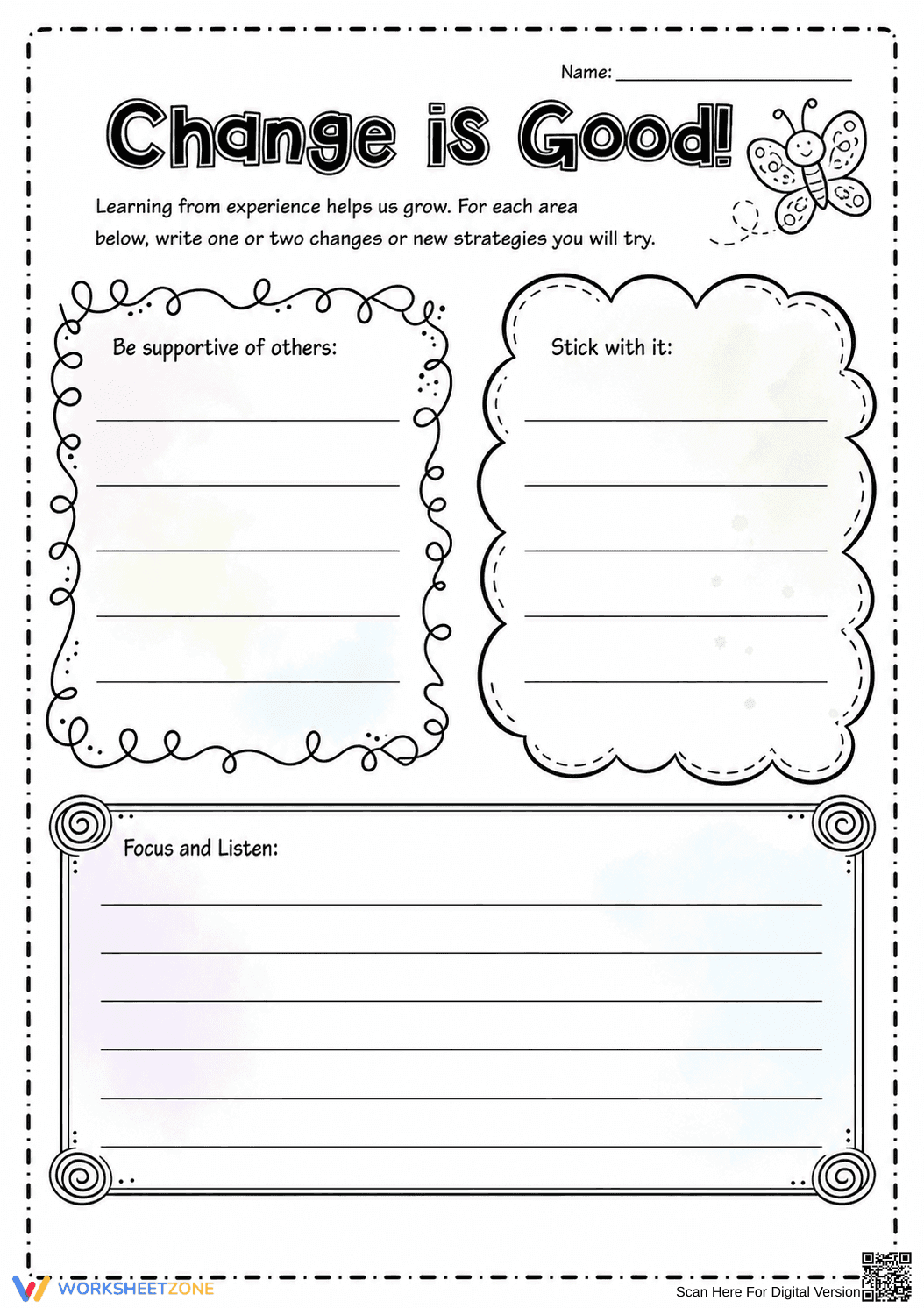
This Grade 6-7 social skills worksheet facilitates meaningful self-reflection by prompting students to identify actionable changes in their daily behavior. By focusing on supportiveness, perseverance, and active listening, students develop the metacognitive skills necessary for personal growth and improved classroom dynamics through structured goal setting.
At a Glance
- Grade: 6-7 · Subject: Social Skills
- Standard:
CCSS.ELA-LITERACY.W.6.10— Write routinely for discipline-specific tasks- Skill Focus: Self-reflection and goal setting
- Format: 1 page · 3 tasks · No answer key · PDF
- Best For: Morning meetings and behavior reflection
- Time: 15–20 minutes
The worksheet features a clean, one-page layout with three distinct open-ended writing sections: "Be supportive of others," "Stick with it," and "Focus and Listen." Each section includes ample lined space for students to list one or two specific changes or new strategies they intend to implement. Because the prompts are highly personalized, no answer key is required. The visual design is engaging without being distracting, making it suitable for middle school learners who require clear, focused tasks.
Zero-Prep Workflow
This resource is designed for a completely zero-prep workflow. Teachers can print the single-page PDF in less than 30 seconds. Distribution takes approximately 1 minute during a transition period or morning meeting. Reviewing student responses can be done individually or through a brief peer-sharing session, totaling less than 2 minutes of teacher preparation. It is an ideal grab-and-go resource for substitute folders, advisory periods, or unexpected schedule changes.
Standards Alignment
The primary alignment is CCSS.ELA-LITERACY.W.6.10, which requires students to write routinely over shorter time frames for a range of discipline-specific tasks, purposes, and audiences. In this context, the discipline is social-emotional learning, and the purpose is self-improvement. Both standard codes can be copied directly into lesson plans, IEP goals, or district curriculum mapping tools.
How to Use It
Use this worksheet as a formative assessment tool following a classroom conflict or as a proactive goal-setting exercise at the start of a new week. During instruction on growth mindset, assign this as an independent reflection task to gauge student understanding of how to apply these concepts. Expect students to spend 15 to 20 minutes thoughtfully completing the three prompts. Teachers can observe whether students are setting realistic, actionable goals or if they need further guidance.
Who It's For
This resource is tailored for middle school students in Grades 6 and 7 navigating complex social environments. It is highly effective for students with IEP goals related to social skills and self-regulation. Pair this worksheet with an anchor chart detailing active listening techniques to provide additional scaffolding for students who may struggle with brainstorming their own strategies.
Research by Fisher & Frey (2014) emphasizes that metacognitive reflection is a critical component of the gradual release of responsibility model, particularly when students are asked to internalize social-emotional behaviors. This worksheet aligns with CCSS.ELA-LITERACY.W.6.10 by requiring students to write routinely for discipline-specific tasks, such as self-regulation and goal setting. By identifying specific strategies for being supportive, persevering, and listening, students move from abstract concepts to concrete actionable steps. Studies suggest that students who engage in regular reflective writing demonstrate higher levels of self-awareness and academic engagement. This resource provides a structured framework for middle schoolers to document their growth, making it an essential tool for behavior intervention plans or general classroom management. The 3-task structure ensures that the cognitive load remains manageable while still demanding meaningful introspection and specific planning for future social interactions.


