


























Views
Downloads

Essential Dental Materials Handling Worksheet | College
Paste this activity's link or code into your existing LMS (Google Classroom, Canvas, Teams, Schoology, Moodle, etc.).
Students can open and work on the activity right away, with no student login required.
You'll still be able to track student progress and results from your teacher account.
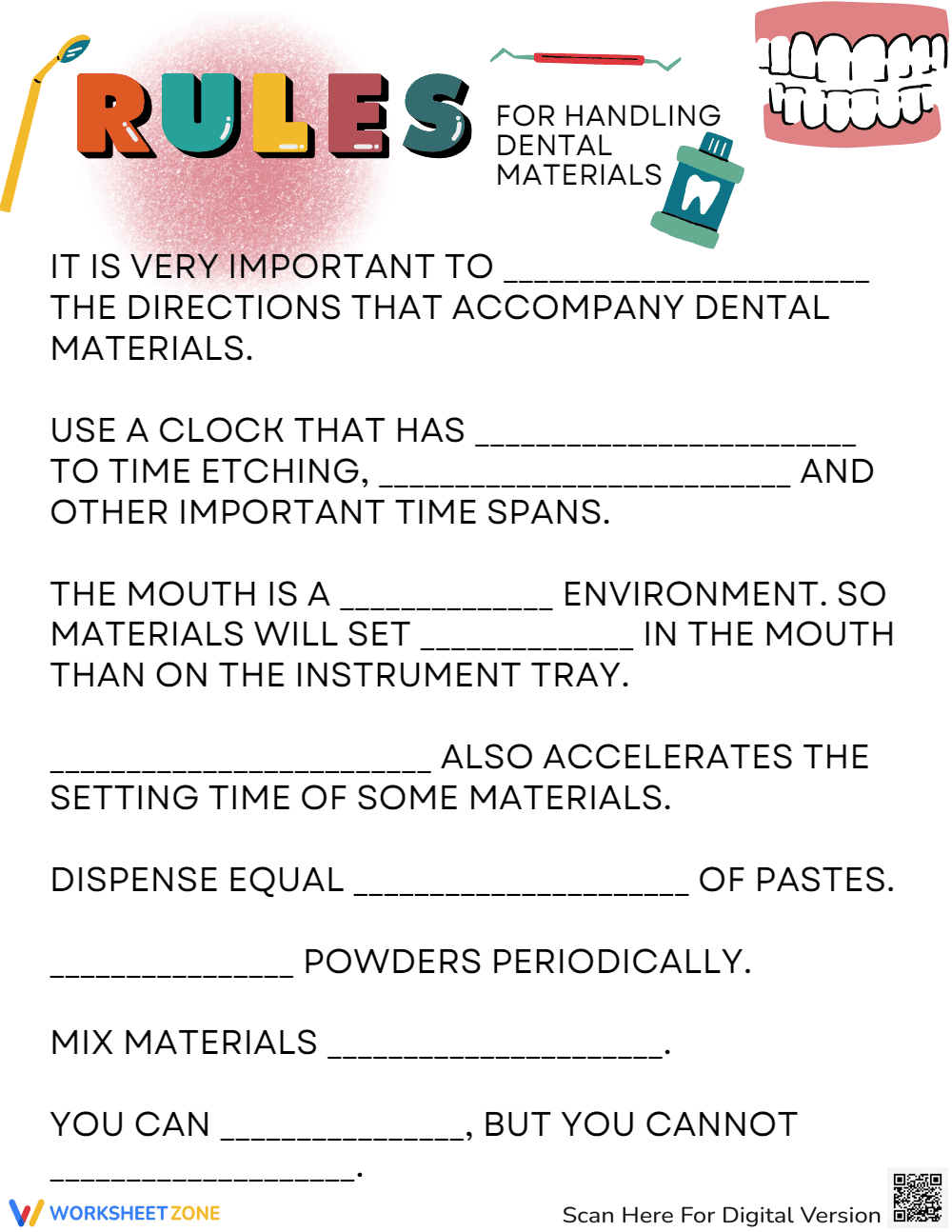
This college-level dental materials worksheet provides students with 8 targeted fill-in-the-blank prompts to reinforce clinical protocols for handling restorative and impression materials. By focusing on environmental factors and mixing techniques, students develop the foundational knowledge required for chairside efficiency and material longevity in a professional dental setting.
At a Glance
- Grade: College · Subject: Dental Assisting
- Standard:
CODA.DA.2— Demonstrate knowledge of dental materials and clinical chairside procedures- Skill Focus: Material Handling Protocols
- Format: 1 page · 8 problems · Answer key included · PDF
- Best For: Clinical review and exam preparation
- Time: 15–20 minutes
This single-page PDF features a structured review of Chapter 22 concepts, specifically focusing on the "Rules for Handling Dental Materials." It contains 8 high-impact fill-in-the-blank sentences that require students to recall specific details regarding timing, moisture control, and dispensing ratios. The layout is clean and professional, designed to be used as a quick knowledge check or a guided study tool during lecture.
The zero-prep design allows instructors to integrate this resource into a busy clinical lab schedule in under 2 minutes. Simply print the single-page document, distribute it to students as they enter the lab, and review the answers collectively at the end of the session. This workflow ensures that students are mentally primed for the physical handling of materials before they begin practical applications. It is an ideal resource for emergency sub plans in vocational programs.
The primary alignment for this resource is `CODA.DA.2`, which requires dental assisting students to demonstrate mastery of dental materials and their clinical applications. This worksheet specifically addresses the environmental variables and manufacturer instructions that dictate material success. Both standard codes can be copied directly into lesson plans, IEP goals, or district curriculum mapping tools.
Use this worksheet as a formative assessment immediately following a lecture on restorative materials to gauge student comprehension of mixing variables. It also serves as an excellent pre-lab activity to ensure students understand the rules before they begin using clinical supplies. Expected completion time is approximately 15 minutes, allowing for a 5-minute peer-review session afterward to clarify misconceptions about setting times.
This resource is tailored for students in Dental Assisting or Dental Hygiene programs. It is particularly useful for adult learners who benefit from concise, focused review materials. It pairs naturally with a standard dental materials textbook or a hands-on demonstration of alginate and composite mixing to provide a multi-modal learning experience.
According to research from Fisher & Frey (2014) regarding the gradual release of responsibility, structured review tools like this dental materials worksheet are vital for bridging the gap between theoretical lecture and clinical practice. By requiring students to articulate the rules of material handling—such as the impact of mouth temperature on setting time—the resource reinforces the cognitive pathways necessary for procedural fluency. The 8-task format aligns with evidence-based practices in vocational education that emphasize high-frequency, low-stakes retrieval practice to improve long-term retention of technical protocols. This worksheet specifically targets `CODA.DA.2` competencies, ensuring that students can accurately describe the student action of managing dental materials within a clinical environment. Such focused practice is essential in dental education where precision and timing are critical to patient outcomes and material integrity.


