




























Views
Downloads
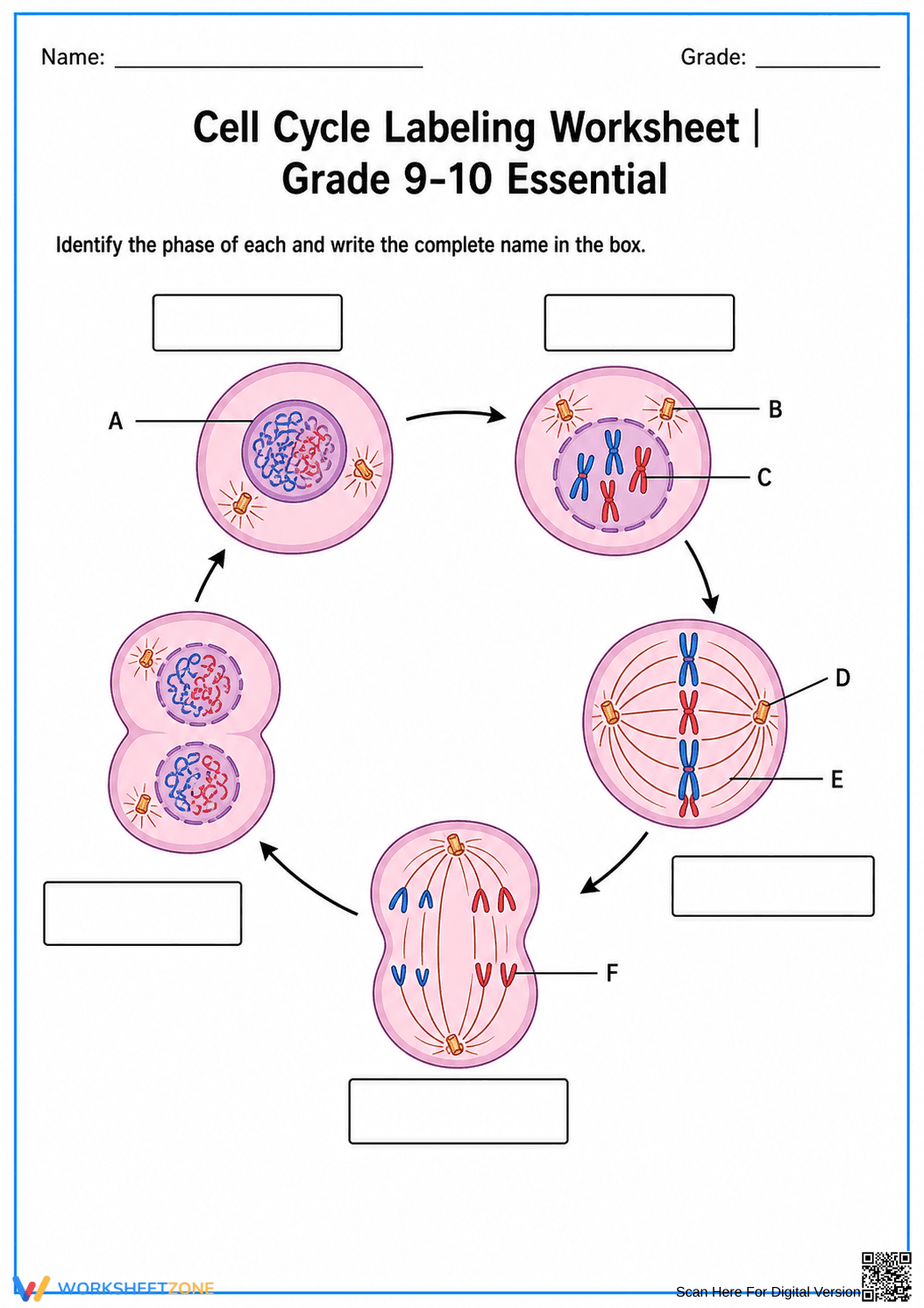

Cell Cycle Labeling Worksheet | Grade 9-10 Printable

Paste this activity's link or code into your existing LMS (Google Classroom, Canvas, Teams, Schoology, Moodle, etc.).
Students can open and work on the activity right away, with no student login required.
You'll still be able to track student progress and results from your teacher account.
This Grade 9-10 biology worksheet provides a clear visual model for students to master the stages of mitosis and interphase. By identifying specific cellular structures and naming each phase of the cell cycle, learners develop a concrete understanding of how eukaryotic cells replicate.
At a Glance
- Grade: 9-10 · Subject: Biology
- Standard:
HS-LS1-4— Use a model to illustrate cellular division- Skill Focus: Mitosis phase identification and structural labeling
- Format: 1 page · 11 problems · Answer key included · PDF
- Best For: Independent practice or quick formative assessment
- Time: 15–20 minutes
This single-page PDF features a high-quality diagram illustrating the continuous loop of the cell cycle. It includes five dedicated labeling boxes for the primary phases and six alphabetical pointers targeting specific organelles and components like chromosomes, spindle fibers, and the nuclear envelope. The layout is clean and distraction-free, accompanied by a comprehensive answer key for rapid grading.
This worksheet is designed for immediate classroom implementation with a total teacher prep time of under two minutes. First, print the single-page PDF (30 seconds). Next, distribute the sheets to students as a warm-up or exit ticket (30 seconds). Finally, review the answers using the provided key or by projecting the diagram for a whole-class check (1 minute). It is an ideal sub plan component.
This resource aligns directly with HS-LS1-4: Use a model to illustrate the role of cellular division (mitosis) and differentiation in producing and maintaining complex organisms. By labeling the physical changes in the nucleus and cytoplasm, students demonstrate an understanding of how mitosis maintains complex organisms. Both standard codes can be copied directly into lesson plans, IEP goals, or district curriculum mapping tools.
Assign this worksheet during the elaborate phase of a 5E lesson cycle after students have viewed a mitosis animation. It also serves as an excellent formative assessment to check for misconceptions regarding the difference between metaphase and anaphase. Teachers can quickly observe if students are confusing the alignment of chromosomes with their separation. Expect students to complete the labeling in 15 to 20 minutes, allowing for a quick transition to a lab or discussion.
This activity is tailored for high school biology students in Grades 9 and 10, though it is accessible for advanced Grade 8 life science learners. It provides necessary visual scaffolding for English Language Learners and students with IEPs through clear diagrammatic cues. Pair this with a cell cycle anchor chart or a microscope lab for a complete instructional unit.
The use of visual labeling tasks in biology is supported by research into dual coding and cognitive load theory. According to Fisher & Frey (2014), providing students with structured models to label helps bridge the gap between abstract biological concepts and concrete physical structures. This worksheet specifically addresses the HS-LS1-4 standard by requiring students to use a model to illustrate cellular division, which is a foundational skill for understanding more complex topics like cancer, growth, and tissue repair. By engaging with 11 distinct identification points, students reinforce their mental model of mitosis, leading to higher retention rates compared to passive reading alone. This resource provides the necessary repetition and visual reinforcement recommended for high-quality science instructional materials. It ensures that students can accurately communicate the sequence of events that allow for the continuity of life at the cellular level.


