


























Views
Downloads
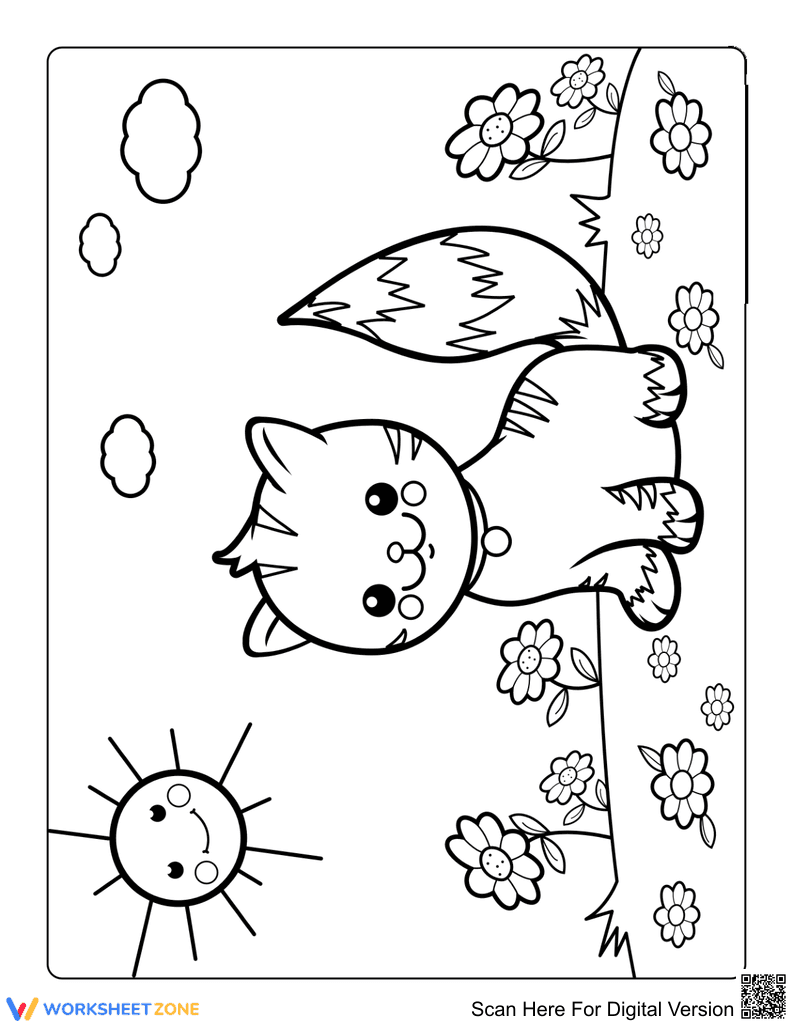

Cat in Flower Garden Coloring Page | Essential Printable
Paste this activity's link or code into your existing LMS (Google Classroom, Canvas, Teams, Schoology, Moodle, etc.).
Students can open and work on the activity right away, with no student login required.
You'll still be able to track student progress and results from your teacher account.
This Cat in Flower Garden coloring page provides young learners with a creative outlet to develop essential fine motor control and color recognition. By engaging with the detailed illustrations of a cat, sun, and flowers, students practice the precision required for early writing while expressing their artistic preferences through color choice.
At a Glance
- Grade: Kindergarten · Subject: Arts & Crafts
- Standard:
CCSS.ELA-LITERACY.SL.K.5— Add drawings or visual displays to descriptions to provide additional detail- Skill Focus: Fine Motor Skills
- Format: 1 page · 1 task · No answer key · PDF
- Best For: Early finishers and morning work
- Time: 15–20 minutes
Inside this resource, you will find a single-page, high-quality PDF featuring a charming cat sitting in a garden. The illustration includes large, clear outlines of a smiling sun, fluffy clouds, and various flowers, making it accessible for small hands. There are no complex instructions, allowing students to focus entirely on their coloring technique and creative expression.
The zero-prep workflow for this worksheet is designed for maximum efficiency in a busy classroom. First, print the single-page PDF (30 seconds). Second, distribute the sheets along with crayons or colored pencils to your students (1 minute). Finally, review the completed work by having students describe the colors they chose (1 minute). Total teacher preparation time is under 2 minutes, making it an ideal sub plan or transition activity.
This activity aligns with `CCSS.ELA-LITERACY.SL.K.5`, which encourages students to use visual displays to enhance their communication. While primarily an artistic task, it supports the foundational grip and stroke control necessary for meeting writing standards. Both standard codes can be copied directly into lesson plans, IEP goals, or district curriculum mapping tools.
Use this worksheet as a calming morning work activity to help students settle into the school day. It also serves as an excellent formative assessment tool; observe how students hold their coloring tools and their ability to stay within the lines to gauge fine motor development. Expect completion within 15 to 20 minutes depending on the student's detail level.
This resource is designed for Kindergarten and Grade 1 students, particularly those working on hand-eye coordination. It pairs naturally with a read-aloud story about pets or spring gardens, providing a tactile follow-up to auditory learning. It is also suitable for occupational therapy sessions focusing on grip strength.
Research from Fisher & Frey (2014) emphasizes the importance of visual representation in early childhood development, noting that artistic activities like coloring serve as a bridge to formal writing. This worksheet targets CCSS.ELA-LITERACY.SL.K.5 by allowing students to create visual details that can later be described orally, reinforcing the link between imagery and language. By providing a structured yet open-ended task, the worksheet supports the development of the small muscle groups in the hand, which is a critical precursor to legible handwriting. According to the NAEP, early exposure to expressive arts correlates with higher engagement in literacy tasks. This printable resource ensures that students have the opportunity to practice these skills in a low-stakes, high-interest format. The inclusion of familiar icons like the sun and flowers helps build confidence in young learners as they master spatial awareness and color application.


