


























Views
Downloads
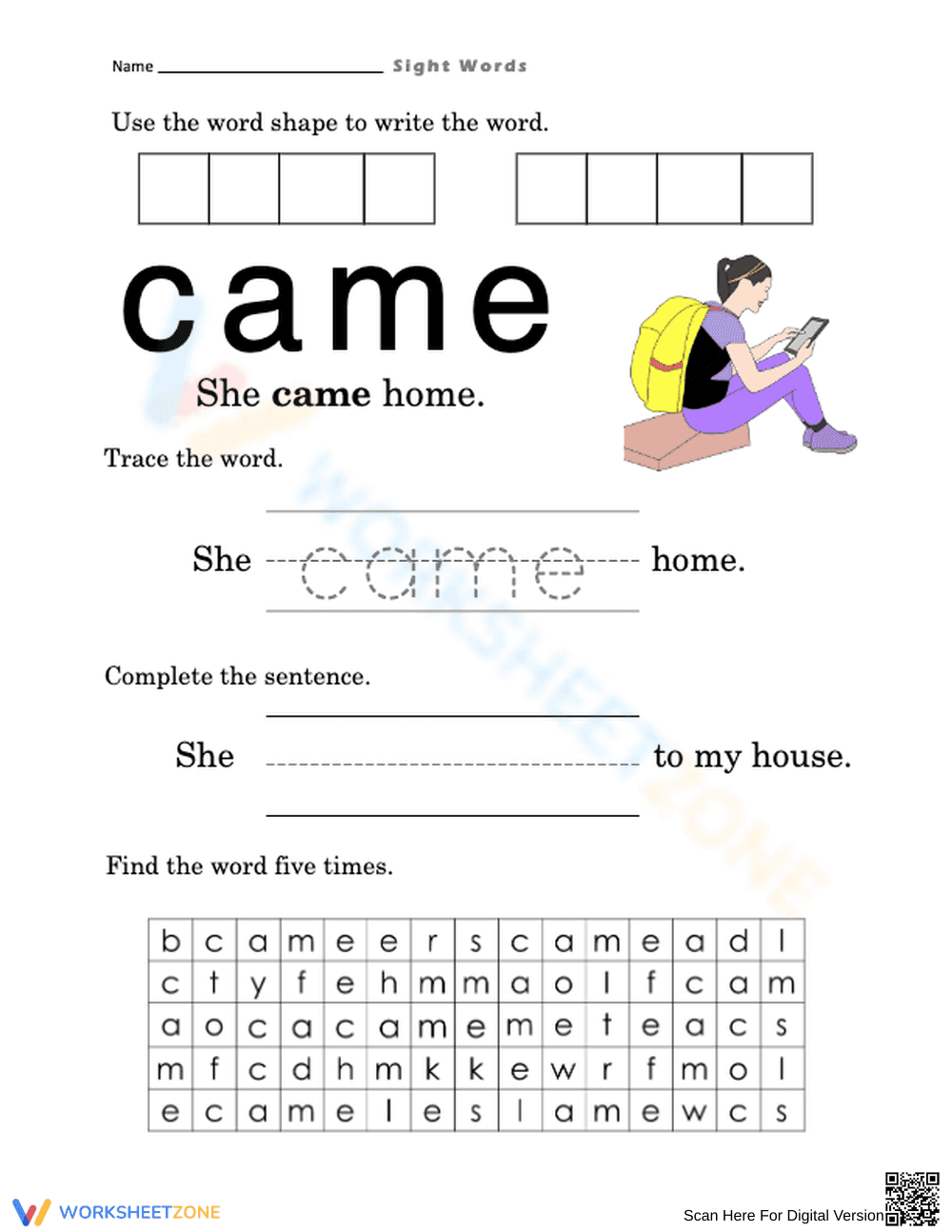

Came Sight Word Worksheet | Grade 1 Essential English
Paste this activity's link or code into your existing LMS (Google Classroom, Canvas, Teams, Schoology, Moodle, etc.).
Students can open and work on the activity right away, with no student login required.
You'll still be able to track student progress and results from your teacher account.
This essential Grade 1 ELA worksheet provides targeted practice for the high-frequency sight word "came." By engaging students in multi-sensory activities—from word shapes to tracing—this resource ensures learners internalize spelling and meaning. It is an ideal tool for building foundational reading fluency and confidence in early writers.
At a Glance
- Grade: 1 · Subject: English Language Arts
- Standard:
CCSS.ELA-LITERACY.RF.1.3.G— Recognize and read grade-appropriate irregularly spelled high-frequency words in various contexts- Skill Focus: Sight word "came" recognition
- Format: 1 page · 4 problems · Answer key included · PDF
- Best For: Daily morning work or centers
- Time: 10–15 minutes
What's Inside
This comprehensive one-page resource features four distinct instructional segments designed to reinforce word mastery. Students begin by mapping the word shape, followed by tracing the word within a structured sentence. The activity continues with a sentence completion task that tests contextual understanding, concluding with a stimulating word search where students must locate the target word five times to confirm visual retention.
Zero-Prep Workflow
Teachers can implement this worksheet with minimal effort. First, print the single-page PDF (30 seconds). Second, distribute copies to students for independent work stations (30 seconds). Third, review responses using the included answer key (30 seconds). Total preparation time remains under two minutes, making it a perfect solution for busy classrooms or substitute plans.
Standards Alignment
The primary alignment for this activity is `CCSS.ELA-LITERACY.RF.1.3.G`, which requires students to recognize and read grade-appropriate irregularly spelled words. By requiring students to identify "came" in both isolation and within simple sentences, the worksheet directly supports the acquisition of high-frequency vocabulary essential for first-grade reading success. Both standard codes can be copied directly into lesson plans, IEP goals, or district curriculum mapping tools.
How to Use It
This worksheet is best utilized during the "independent practice" phase of a literacy lesson after the word has been introduced via an anchor chart or flashcards. Teachers should observe students during the word search task to ensure they are scanning systematically, which provides a valuable formative assessment of their visual processing skills. Students typically complete the entire page within a 12-minute window.
Who It's For
This resource is specifically designed for first-grade students, but also serves as an excellent intervention tool for second graders requiring additional fluency support. It pairs naturally with leveled readers that feature high-frequency verbs, allowing students to see the word "came" in a broader narrative context immediately after completing their written practice.
Early literacy development relies heavily on the automaticity of high-frequency word recognition, a skill directly targeted by this `CCSS.ELA-LITERACY.RF.1.3.G` worksheet. According to the RAND AIRS 2024 report, structured repetition in varied formats significantly reduces the cognitive load during reading, allowing Grade 1 students to shift their focus from decoding to comprehension. This worksheet facilitates that transition by providing 4 distinct touchpoints for the word "came." By integrating word-shape analysis with contextual sentence completion, the resource aligns with the "Science of Reading" principles regarding orthographic mapping. Educators can confidently utilize this tool to meet district benchmarks, knowing that the multi-modal approach supports diverse learning needs. The inclusion of a word search specifically strengthens visual discrimination, a prerequisite for reading fluency as noted in recent NAEP instructional analyses.


