


























Views
Downloads

Printable Food Chain Worksheet for Kindergarten & Grade 1
Paste this activity's link or code into your existing LMS (Google Classroom, Canvas, Teams, Schoology, Moodle, etc.).
Students can open and work on the activity right away, with no student login required.
You'll still be able to track student progress and results from your teacher account.
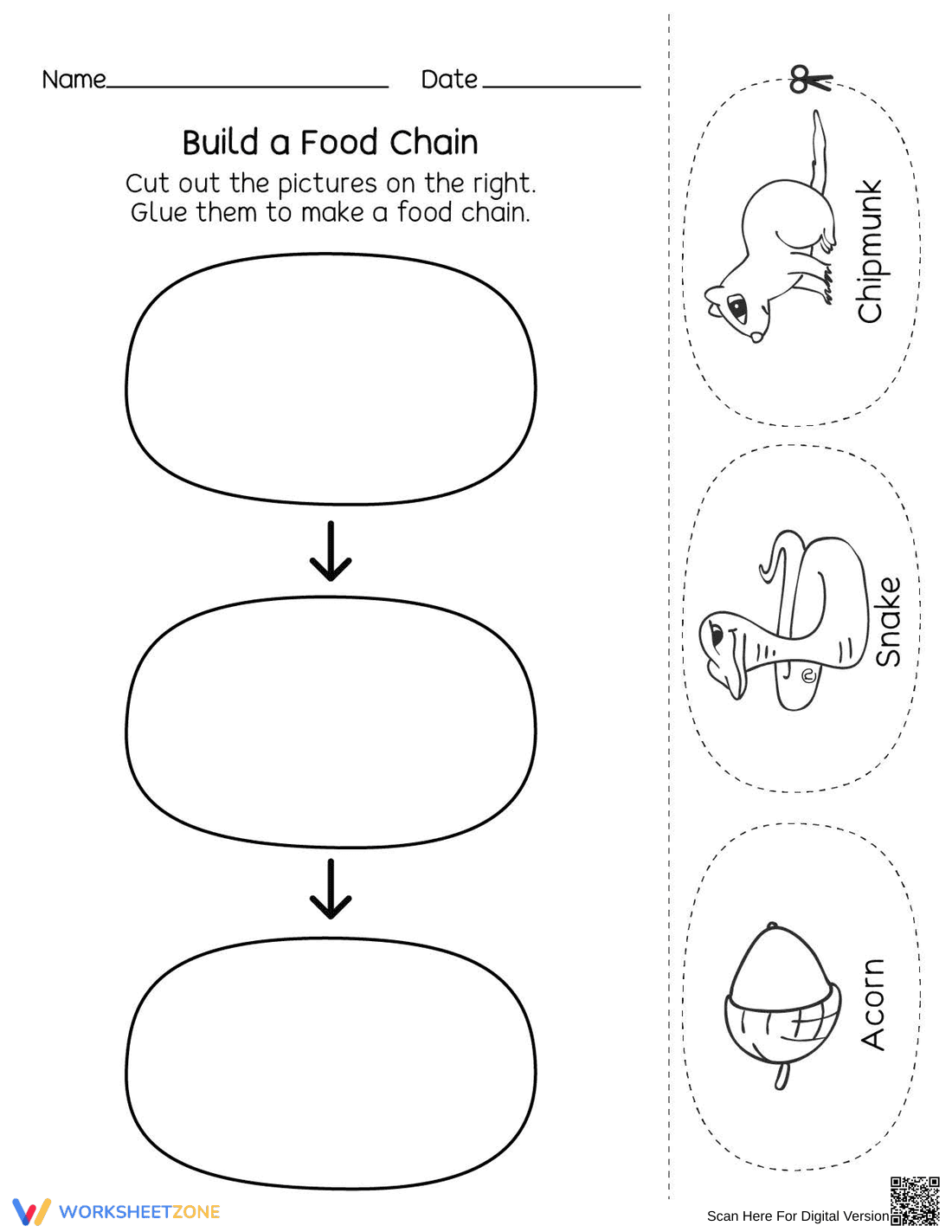
This hands-on science worksheet helps early learners understand basic energy flow by building a simple food chain. Students cut out images of an acorn, chipmunk, and snake, then sequence them correctly to show how living things depend on each other for survival.
At a Glance
- Grade: Kindergarten · Subject: Science
- Standard:
K-LS1-1— Describe what plants and animals need to survive- Skill Focus: Sequencing a food chain
- Format: 1 page · 1 task · No answer key · PDF
- Best For: Independent practice
- Time: 10–15 minutes
This single-page printable features a straightforward cut-and-paste activity designed for young students. The page includes three empty sequencing ovals connected by directional arrows to indicate the flow of energy. On the right side, a dashed cut-out strip provides three distinct illustrations: an acorn (producer), a chipmunk (primary consumer), and a snake (secondary consumer). The clear visual layout minimizes confusion and allows students to focus on the scientific concept.
Zero-Prep Workflow
- Print (1 minute): Simply print the single-page PDF. No color ink is required.
- Distribute (1 minute): Hand out the worksheet along with scissors and glue sticks. The instructions are self-explanatory for students who have basic cutting skills.
- Review (3 minutes): Quickly check student work visually. The linear three-step sequence makes it easy to assess comprehension at a glance.
With a total teacher prep time of under two minutes, this activity is an excellent addition to emergency sub plans or quick science centers.
Standards Alignment
This activity aligns with primary standard K-LS1-1, which requires students to use observations to describe patterns of what plants and animals need to survive. By sequencing the acorn, chipmunk, and snake, students visually demonstrate their understanding of these survival dependencies. The standard code can be copied directly into lesson plans, IEP goals, or district curriculum mapping tools.
How to Use It
Use this worksheet after direct instruction about forest ecosystems. It serves as an excellent independent practice activity while the teacher circulates the room. As a formative assessment observation tip, watch how students place the acorn; if they struggle to identify the producer as the starting point, pause and review how plants get their energy from the sun. Expected completion time ranges from ten to fifteen minutes, depending on the students' scissor skills.
Who It's For
This resource is primarily designed for Kindergarten and first-grade students who are just beginning to explore life science concepts. The visual nature of the cut-and-paste format provides built-in differentiation for English Language Learners and students who require fine motor skill practice alongside academic tasks. Pair this worksheet with a vibrant anchor chart showing various woodland creatures to help solidify the concept of interconnected habitats.
Understanding foundational ecological concepts like those addressed in standard K-LS1-1 is critical for early science literacy. When students describe what plants and animals need to survive through hands-on sequencing, they build cognitive frameworks for more complex biological systems later in their academic careers. According to a ScienceDirect TpT Analysis, integrating tactile activities with core science instruction significantly increases retention of abstract concepts among early elementary learners. By physically moving the acorn, chipmunk, and snake into the correct sequential order, young learners bridge the gap between theoretical knowledge and observable patterns in nature. This multimodal approach ensures that foundational life science principles are actively processed and understood through engaging, developmentally appropriate practice. Teachers can rely on this evidence-based method to foster a deeper appreciation for environmental science right from the start of a child's educational journey.


