


























Views
Downloads
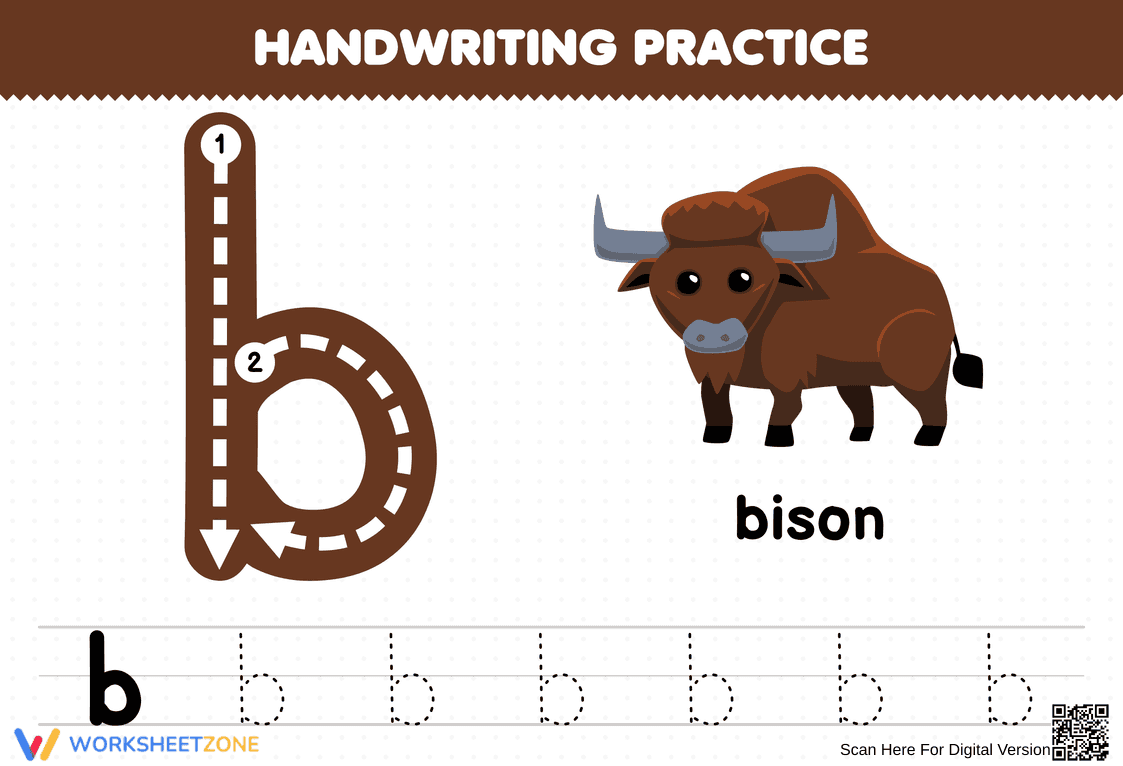

Grade K Letter B Tracing — Printable No-Prep Worksheet
Paste this activity's link or code into your existing LMS (Google Classroom, Canvas, Teams, Schoology, Moodle, etc.).
Students can open and work on the activity right away, with no student login required.
You'll still be able to track student progress and results from your teacher account.
This single-page handwriting worksheet provides targeted practice for early learners mastering the lowercase letter b. By tracing guided directional arrows and dotted lines, students develop fine motor control and correct letter formation habits. The engaging bison illustration connects the target letter to a concrete vocabulary word.
At a Glance
- Grade: Kindergarten · Subject: English
- Standard:
CCSS.ELA-LITERACY.L.K.1.A— Print many upper- and lowercase letters- Skill Focus: Lowercase letter b tracing
- Format: 1 page · 7 problems · No answer key needed · PDF
- Best For: Morning work or literacy centers
- Time: 5–10 minutes
Inside this resource, educators will find a straightforward practice page focused entirely on the lowercase letter b. The layout features one large, numbered directional model to establish the correct stroke sequence, followed by six standard-sized dotted letters on primary writing lines. A colorful bison graphic reinforces the phonetic sound. The self-explanatory format requires no separate answer key.
This resource is designed for immediate classroom implementation:
- Print (1 minute): The standard PDF format ensures crisp dotted lines on any school printer.
- Distribute (1 minute): Hand out the single page to students with pencils.
- Review (1 minute): Quickly scan student work to ensure they follow the directional arrows.
Total teacher preparation requires under two minutes, making this an ideal emergency sub plan.
This handwriting practice aligns directly with CCSS.ELA-LITERACY.L.K.1.A, which requires students to "print many upper- and lowercase letters." By providing explicit stroke order guidance and repeated practice on primary lines, the activity builds the foundational motor memory required by this standard. Both standard codes can be copied directly into lesson plans, IEP goals, or district curriculum mapping tools.
Teachers can deploy this worksheet during morning arrival as a quiet, independent task that settles the classroom. It also functions perfectly within a rotating literacy center focused on alphabet recognition and phonics. As a formative assessment tip, observe students while they trace the large model letter; watch closely to ensure they start at the top line and pull down, rather than starting from the bottom, which is a common early writing error. Expected completion time is a brief 5 to 10 minutes.
This material is primarily designed for Kindergarten students, though it serves as excellent remedial practice for first graders struggling with b/d reversals. Preschool educators can also use it for advanced learners showing an early interest in writing. For differentiation, slip the page into a heavy-duty sheet protector and provide dry-erase markers for students who need multiple attempts to build confidence. It pairs naturally with a whole-group phonics lesson introducing the /b/ sound or an anchor chart displaying animals that start with the letter b.
Developing automaticity in handwriting is a critical precursor to expressive writing and reading fluency. This resource targets CCSS.ELA-LITERACY.L.K.1.A, helping students print many upper- and lowercase letters with accuracy. According to Fisher & Frey (2014), explicit instruction in letter formation, combined with guided, repetitive practice, significantly reduces cognitive load during later composition tasks. When young learners no longer have to consciously think about how to form a lowercase b, they can allocate their working memory to spelling and sentence structure. By integrating directional arrows and primary writing lines, this worksheet provides the exact scaffolding recommended by early literacy researchers to prevent common directional errors. Consistent use of such targeted motor-skill activities builds the physical stamina necessary for long-term academic success in language arts.


