


























Views
Downloads



Months of the Year Music Worksheet | Grade 1 Essential
Paste this activity's link or code into your existing LMS (Google Classroom, Canvas, Teams, Schoology, Moodle, etc.).
Students can open and work on the activity right away, with no student login required.
You'll still be able to track student progress and results from your teacher account.
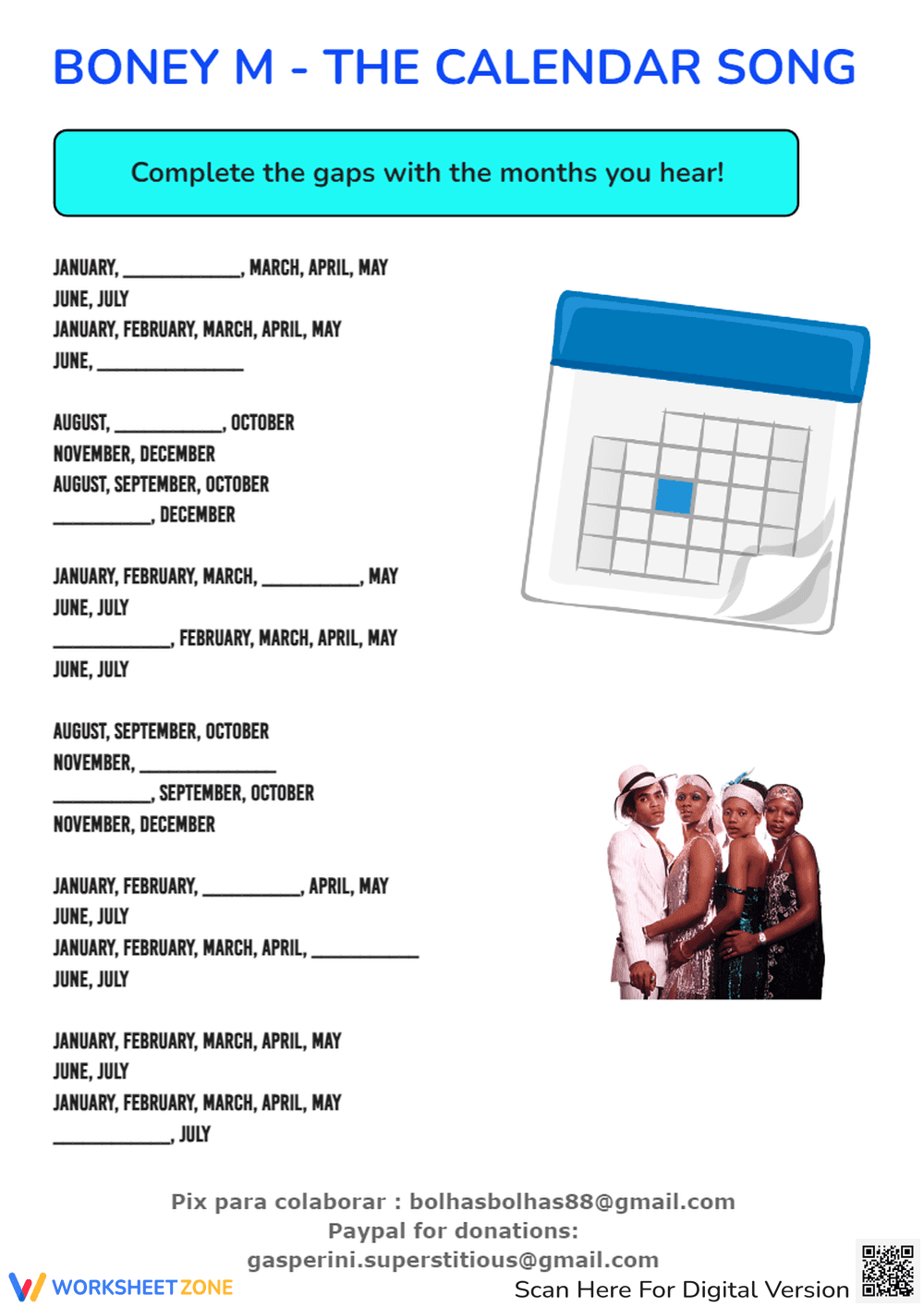
This Grade 1 music worksheet uses the classic Boney M "Calendar Song" to help students master the months of the year. By engaging with rhythmic disco patterns, learners identify and spell chronological time markers. This activity transforms a simple listening task into a foundational vocabulary exercise that builds long-term retention through auditory cues.
At a Glance
- Grade: 1 · Subject: Music
- Standard:
CCSS.ELA-LITERACY.L.1.6— Use words and phrases acquired through listening and responding to texts- Skill Focus: Months of the year sequencing
- Format: 3 pages · 10 problems · Answer key included · PDF
- Best For: Early morning work or sub plans
- Time: 15–20 minutes
The packet includes a vibrant cover page, a teacher's introduction, and a dedicated student worksheet. The primary task features 10 strategic gaps within the song's lyrics, requiring students to listen closely and write the missing months. The layout is clean and includes visual calendar icons to provide context for early readers, ensuring they stay on track while the music plays.
This resource follows a streamlined three-step workflow. First, print the single-page worksheet in under 30 seconds. Next, distribute the sheets and play the Boney M audio track for approximately 5 minutes. Finally, review the answers as a class to check for spelling and sequencing accuracy for another 5 minutes. Total teacher preparation time is under 2 minutes, making it an ideal choice for busy mornings.
This activity aligns with `CCSS.ELA-LITERACY.L.1.6`, focusing on the acquisition of temporal vocabulary. It also supports CCSS.ELA-LITERACY.L.1.1.A by encouraging correct spelling of common nouns. Both standard codes can be copied directly into lesson plans, IEP goals, or district curriculum mapping tools to ensure all instructional minutes are accounted for and standards-based.
Use this as a formative assessment during a unit on time or as a high-energy transition activity. Play the song once for pure listening, then a second time for students to fill in the blanks. Observe which students struggle with the "September" through "December" sequence to identify those needing additional calendar practice. This provides immediate data on student listening comprehension and spelling readiness.
This is designed for Grade 1 general education students and English Language Learners at the Pre-A1 Starter level. It pairs naturally with a classroom anchor chart showing the four seasons or a daily calendar routine. The disco genre provides a multi-sensory experience that benefits kinesthetic and auditory learners who may struggle with traditional rote memorization of the months.
According to Fisher & Frey (2014), the use of music and rhythmic repetition in the classroom significantly enhances the retrieval of Tier 1 and Tier 2 vocabulary for early elementary students. This worksheet leverages the "Calendar Song" to meet `CCSS.ELA-LITERACY.L.1.6` requirements, providing a structured environment for students to practice the spelling and chronological order of the months. Research from the NAEP indicates that integrating arts-based instruction into core literacy subjects improves student engagement and helps solidify abstract concepts like the passage of time. By combining auditory input with a written gap-fill task, this resource ensures that learners process information through multiple cognitive channels. This approach is particularly effective for Grade 1 students who are transitioning from oral language proficiency to written literacy, as it provides a familiar melodic scaffold for new academic vocabulary.


