




























Views
Downloads

Body Systems Worksheet | Grade 6 Science Printable

Paste this activity's link or code into your existing LMS (Google Classroom, Canvas, Teams, Schoology, Moodle, etc.).
Students can open and work on the activity right away, with no student login required.
You'll still be able to track student progress and results from your teacher account.
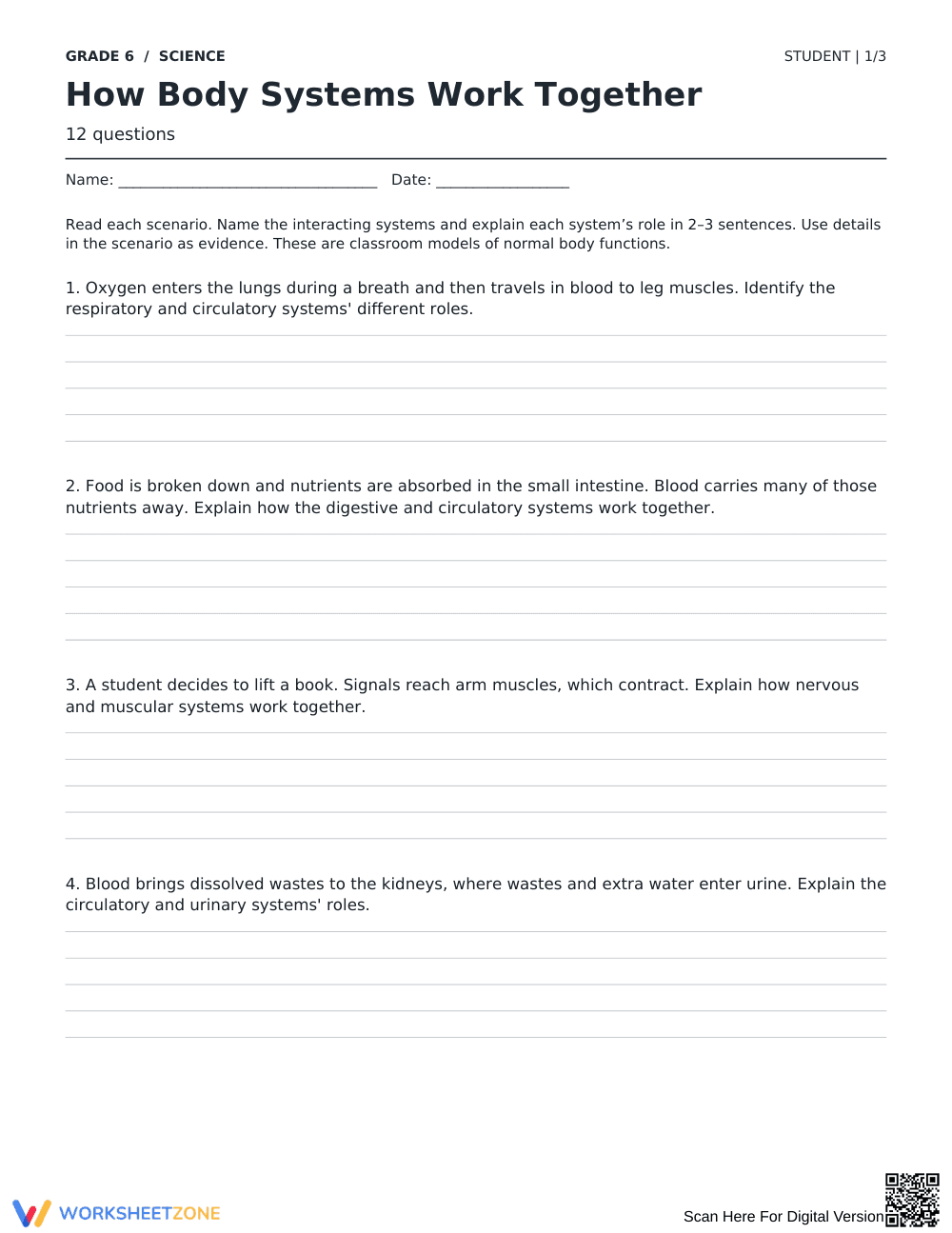
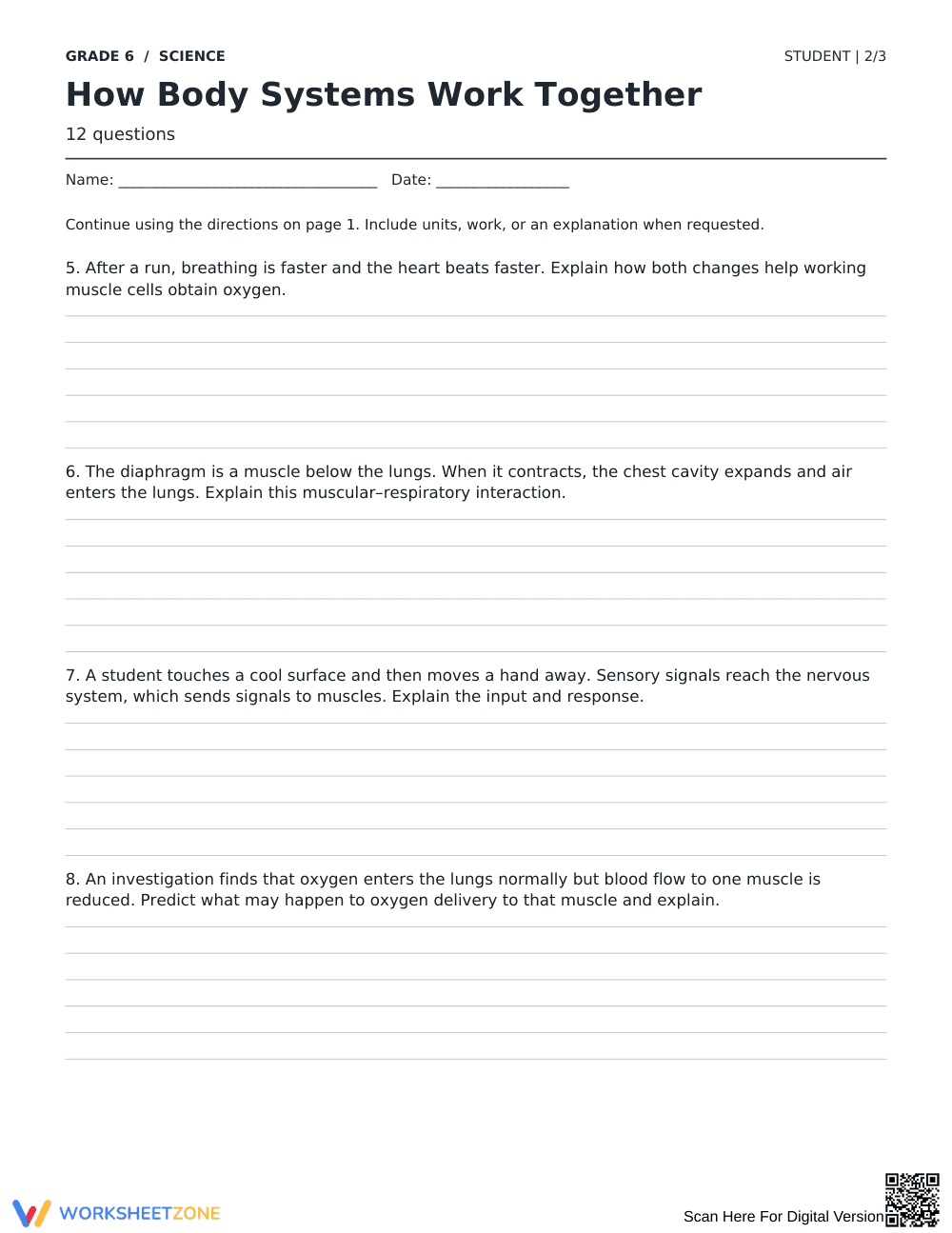
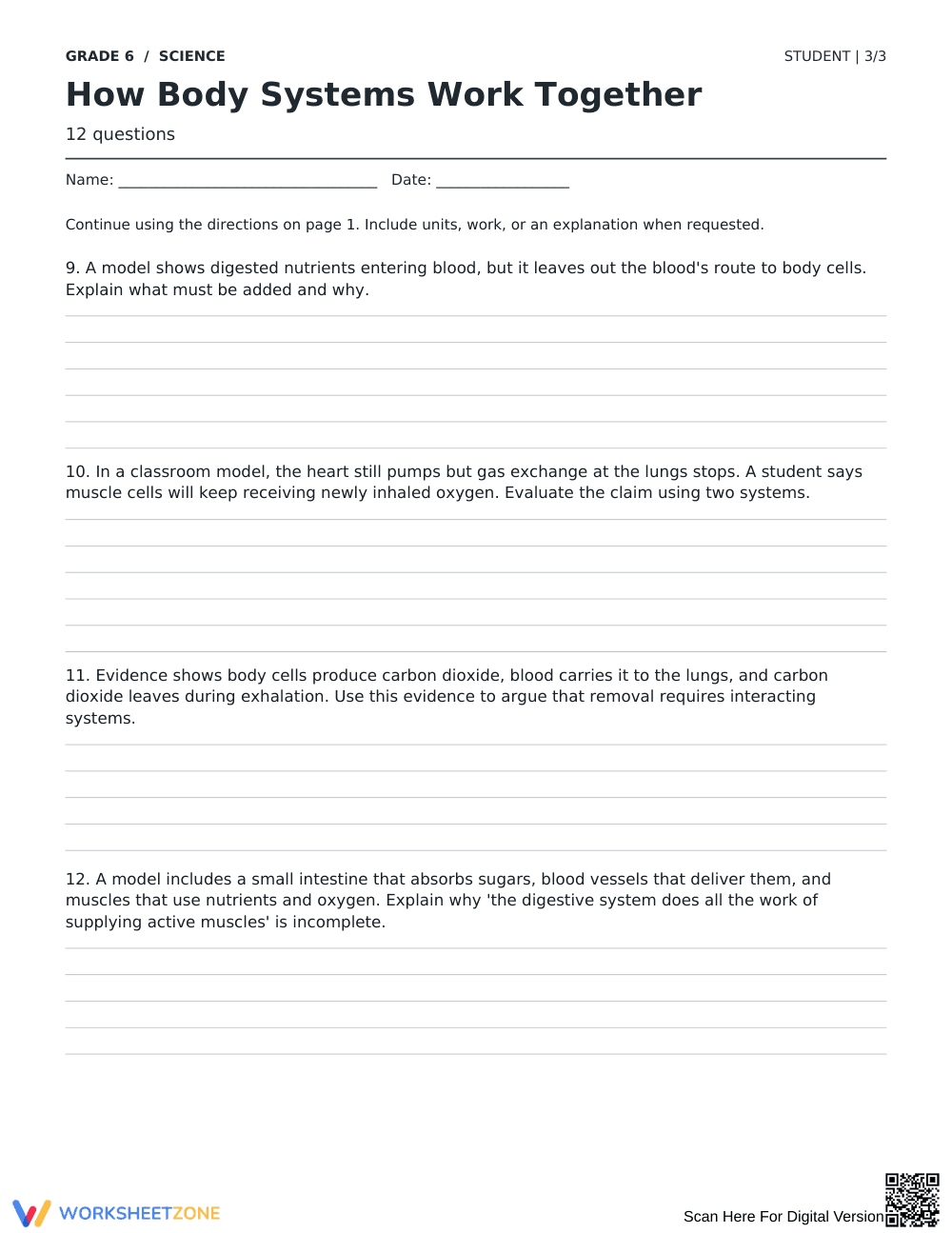
This Grade 6 science worksheet builds students' ability to explain how the body's major organ systems work together to maintain life functions. Across 18 structured tasks, students identify system interactions, analyze cause-and-effect relationships between organs, and apply evidence-based reasoning to real-world body scenarios — all aligned to NGSS standard MS-LS1-3.
At a Glance
- Grade: 6 · Subject: Life Science
- Standard:
MS-LS1-3— Use argument from evidence to support how body systems interact- Skill Focus: Interactions among major organ systems
- Format: 3 pages · 18 problems · Answer key included · PDF
- Best For: Guided practice after direct instruction
- Time: 25–35 minutes
The worksheet spans three student pages and covers the digestive, circulatory, respiratory, muscular, and skeletal systems. Task types include labeled diagram completion, short-answer explanation prompts, matching system functions to organs, and scenario-based questions that ask students to trace how a disruption in one system affects others. The two-page answer key provides complete model responses for every item, making grading straightforward.
- Guided practice (problems 1–6): Students match organ systems to their primary functions using a reference word bank, reducing cognitive load while building foundational vocabulary.
- Supported practice (problems 7–13): Students complete diagram labels and fill-in-the-blank sentences that require them to connect two systems at a time, with sentence-frame scaffolds provided for written responses.
- Independent practice (problems 14–18): Students write short constructed responses explaining multi-system interactions without scaffolds, demonstrating readiness for assessment-level tasks.
This gradual-release structure mirrors the I Do, We Do, You Do model, allowing teachers to assign the full worksheet sequentially or select sections to match the current phase of instruction.
Standards Alignment
The primary standard is MS-LS1-3: Use argument supported by evidence for how the body is a system of interacting subsystems composed of groups of cells. Supporting connections include MS-LS1-8, which addresses how body systems respond to internal and external stimuli — reinforced by the scenario-based items in the independent section. Both standard codes can be copied directly into lesson plans, IEP goals, or district curriculum mapping tools.
How to Use It
Assign problems 1–6 as a warm-up check immediately after introducing organ system vocabulary, then use problems 7–13 during guided practice while circulating to observe whether students can articulate connections between two systems in writing. Problems 14–18 work well as an exit ticket or post-lesson formative assessment; watch for students who describe only one-directional relationships — this signals a need for reteaching system interdependence. Expected completion time is 25–35 minutes for the full worksheet or 10–12 minutes per section when used in stages.
Who It's For
Designed for Grade 6 life science students beginning their study of human body systems, this worksheet suits both on-grade learners and students who benefit from the built-in scaffold progression. It pairs naturally with a body-systems anchor chart or a close-reading passage on homeostasis to give students the content background needed before tackling the independent response items.
Aligned to MS-LS1-3, this worksheet targets the NGSS disciplinary core idea that the body functions as a system of interacting subsystems. Research supports structured, evidence-based practice for middle school life science: according to the RAND AIRS 2024 report, students who engage in repeated cause-and-effect reasoning tasks within a single content domain show measurably stronger transfer to novel science scenarios than peers who receive lecture-only instruction. With 18 problems sequenced from vocabulary recognition through independent argumentation, this resource gives Grade 6 students the repeated, low-stakes practice needed to internalize how organ systems depend on one another — and prepares them to construct evidence-based explanations on unit assessments and state science tests.


