


























Views
Downloads
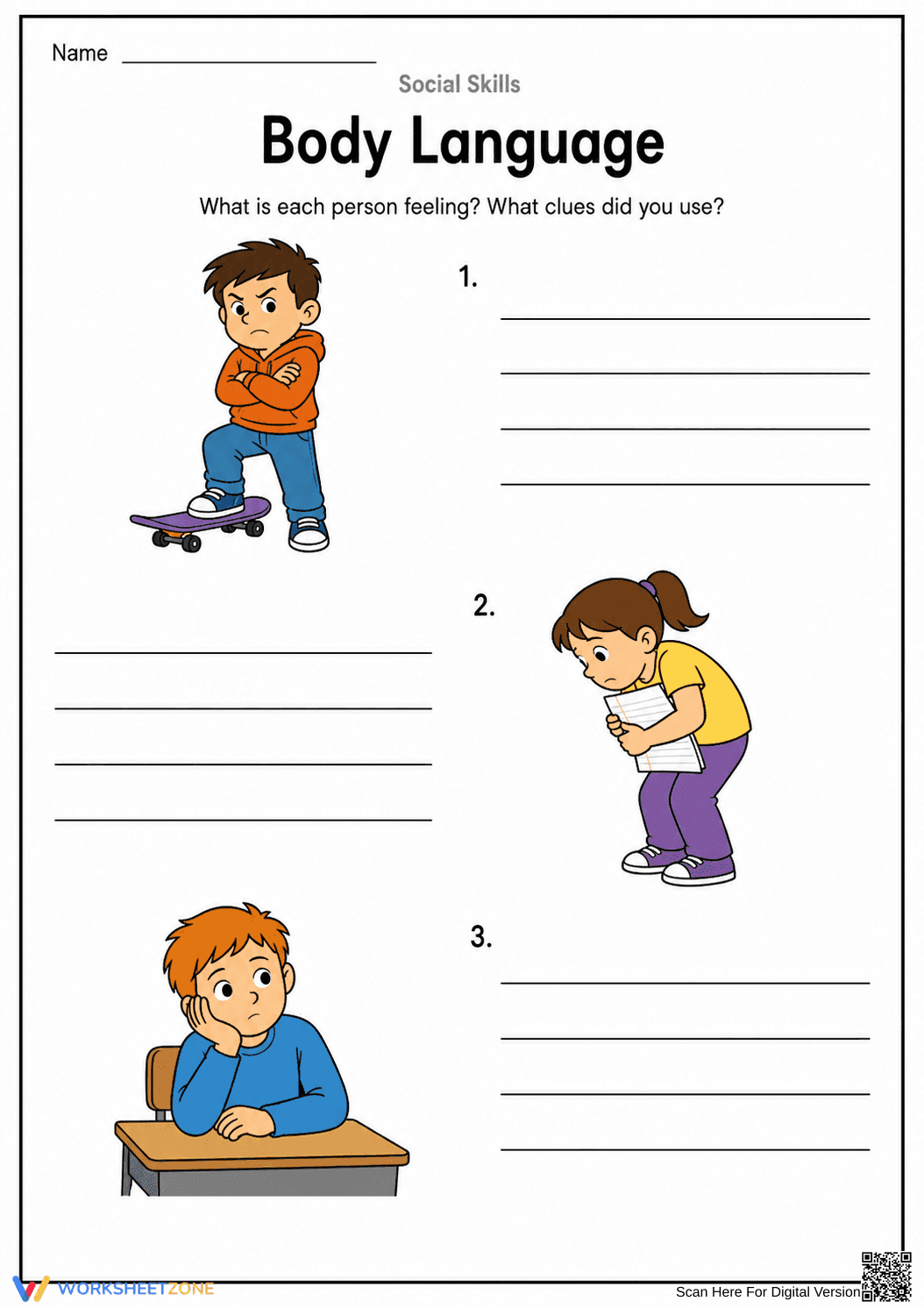

Grade 6-8 Body Language — Printable No-Prep Worksheet
Paste this activity's link or code into your existing LMS (Google Classroom, Canvas, Teams, Schoology, Moodle, etc.).
Students can open and work on the activity right away, with no student login required.
You'll still be able to track student progress and results from your teacher account.
This middle school social skills resource focuses on the critical ability to decode non-verbal communication. Students analyze specific illustrations to determine emotional states and provide evidence based on physical cues. By connecting visual evidence to social inferences, learners strengthen their interpersonal awareness and emotional intelligence in real-world scenarios.
At a Glance
- Grade: 6-8 Middle School · Subject: Social Skills
- Standard:
CCSS.ELA-LITERACY.SL.6.1— Interpret information presented in diverse media and formats to build social understanding- Skill Focus: Non-verbal cue interpretation
- Format: 1 page · 3 tasks · Open-ended response · PDF · Printable
- Best For: Middle school social-emotional learning and behavior intervention
- Time: 15–20 minutes
What's Inside
The worksheet features three high-quality illustrations of characters exhibiting distinct physical postures and facial expressions. Each prompt includes four lines for detailed written responses, allowing students to explain both the emotion and the specific body language clues. This one-page PDF is designed for clarity and immediate student engagement without distracting clutter.
Zero-Prep Workflow
The zero-prep design allows for immediate implementation in any classroom or counseling setting. Follow these three simple steps:
- Print: Select the single-page PDF and print enough copies for your group (30 seconds).
- Distribute: Hand out the worksheets as a bell-ringer or transition activity (1 minute).
- Review: Facilitate a 5-minute group discussion where students compare the clues they identified (5 minutes).
Standards Alignment
This resource aligns with `CCSS.ELA-LITERACY.SL.6.1`, which requires students to engage effectively in collaborative discussions. Specifically, it targets the ability to interpret visual information and use it to support claims about a character's internal state. This standard code can be copied directly into lesson plans, IEP goals, or district curriculum mapping tools.
How to Use It
Use this worksheet during the guided practice phase of a lesson on communication. After a brief lecture on non-verbal cues, have students work in pairs to identify the clues in the three images. As a formative assessment, observe whether students can name specific body parts rather than just general feelings. Completion typically takes 15 to 20 minutes.
Who It's For
This activity is tailored for Grade 6, 7, and 8 students who are navigating the complexities of middle school social dynamics. It is particularly effective for students receiving social skills instruction, those with IEP goals related to social pragmatics, or general education students during advisory periods.
Effective social-emotional instruction relies on the ability to translate visual stimuli into social knowledge. According to Fisher & Frey (2014), the gradual release of responsibility model is most effective when students are given clear, scaffolded opportunities to practice inferencing skills. This worksheet provides that scaffold by isolating three distinct emotional states for analysis. By focusing on CCSS.ELA-LITERACY.SL.6.1, the resource ensures that students are not just guessing feelings but are grounding their social observations in observable evidence. Research from the RAND AIRS 2024 report suggests that explicit instruction in non-verbal communication significantly improves peer-to-peer conflict resolution in middle school settings. This printable tool bridges the gap between abstract emotional concepts and concrete physical evidence, providing a reliable framework for social skill development that can be easily integrated into existing ELA or counseling curricula.


