


























Views
Downloads
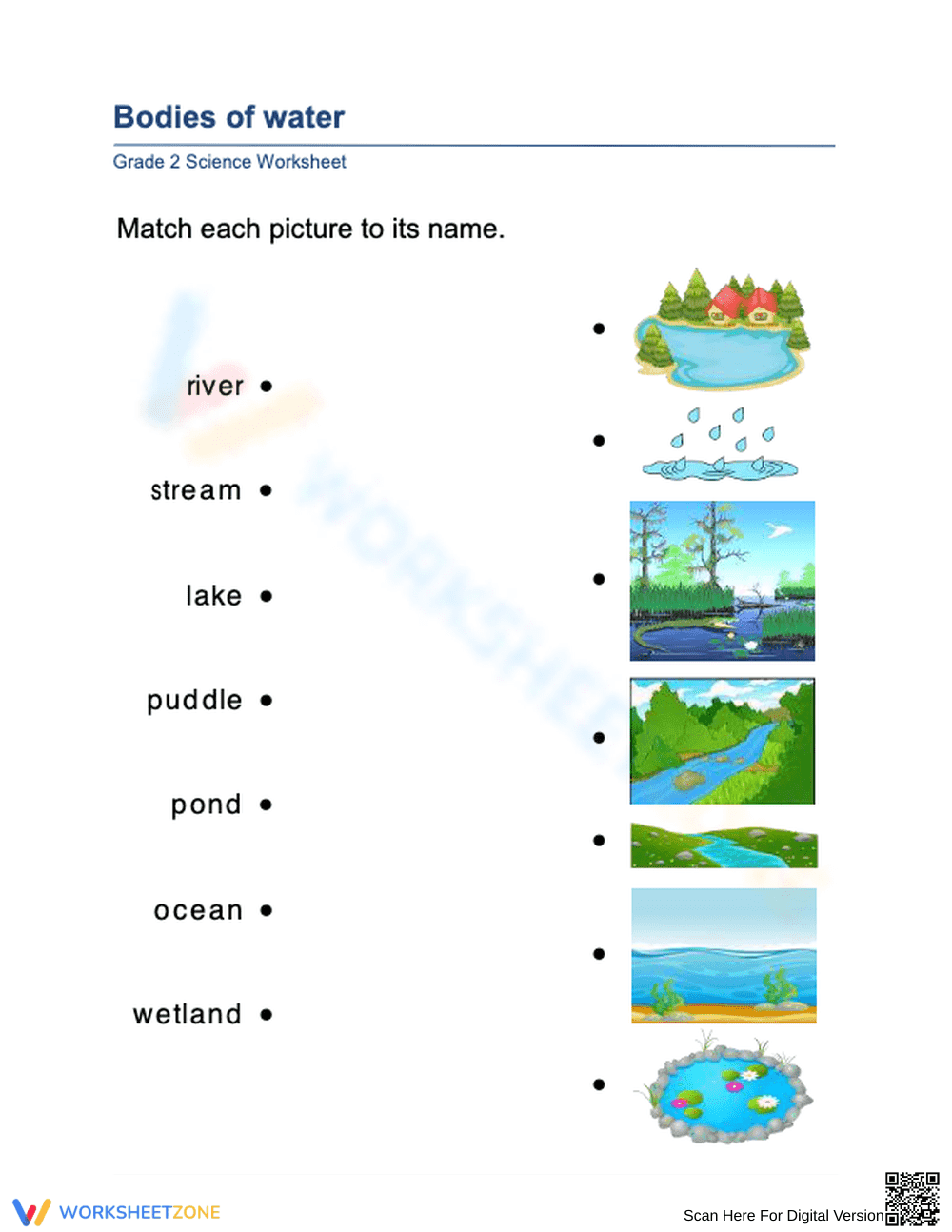

Grade 2 Bodies of Water — Essential No-Prep Worksheet
Paste this activity's link or code into your existing LMS (Google Classroom, Canvas, Teams, Schoology, Moodle, etc.).
Students can open and work on the activity right away, with no student login required.
You'll still be able to track student progress and results from your teacher account.
This Grade 2 Science worksheet helps students identify and name common bodies of water through a visual matching activity. Students examine realistic illustrations of rivers, oceans, and wetlands to build foundational Earth science vocabulary. By connecting visual cues to scientific terminology, learners develop a clearer understanding of where water is found on our planet.
At a Glance
- Grade: 2 · Subject: Science
- Standard:
2-ESS2-3— Identify where water is found on Earth and its various forms- Skill Focus: Water body identification
- Format: 2 pages · 7 problems · Answer key included · PDF
- Best For: Quick review or independent practice
- Time: 10–15 minutes
Inside this resource, you will find a primary worksheet page featuring seven distinct illustrations paired with a list of scientific terms. The layout is clean and focused, ensuring that second-grade students can navigate the task without distraction. A comprehensive answer key is provided on the second page, making it easy to review work or for students to self-correct during independent centers.
This resource follows a streamlined three-step workflow designed for the busy classroom. First, print the single-page worksheet for your entire class in under a minute. Next, distribute the papers for a quick 10-minute independent activity or warm-up. Finally, use the included answer key to review the concepts together. Total teacher prep time is under two minutes, making it ideal for sub plans.
This activity is aligned with NGSS 2-ESS2-3, which requires students to obtain information to identify where water is found on Earth. By matching specific terms like "wetland" and "stream" to their visual characteristics, students satisfy the core requirements of identifying Earth's water distribution. The code can be copied into lesson plans to ensure alignment across your science unit.
Use this worksheet as a formative assessment after a direct instruction lesson on Earth's features. As students work, observe if they can distinguish between flowing water (rivers and streams) and standing water (ponds and lakes). This provides immediate insight into their conceptual mastery. It works perfectly as an exit ticket or transition activity between science and literacy blocks.
This resource is intended for Grade 2 students but is highly effective for Grade 1 enrichment or Grade 3 review. It supports English Language Learners by providing clear visual scaffolds for academic vocabulary. Pair this activity with a short reading passage about the water cycle or a classroom anchor chart displaying different types of landforms to deepen the connection between visual and textual information.
According to RAND AIRS 2024, visual scaffolding in primary science is critical for moving students from concrete observation to abstract categorization. This Grade 2 worksheet implements this research by using high-quality illustrations to help students identify where water is found on Earth, specifically meeting the requirements of the 2-ESS2-3 standard. By matching visual representations of rivers, wetlands, and oceans to their scientific names, students build the foundational Earth Science vocabulary necessary for more complex ecological studies in later grades. ScienceDirect TpT Analysis suggests that simple, zero-prep matching tasks are among the most effective tools for reinforcing vocabulary in early elementary settings because they reduce cognitive load and allow students to focus on word-to-image association. This 7-task activity provides exactly the type of targeted, evidence-based practice recommended by Fisher & Frey (2014) for the gradual release of responsibility during the acquisition of new academic domains in science.


