


























Views
Downloads

Essential Bodies of Water Worksheet | Grade 2 Science
Paste this activity's link or code into your existing LMS (Google Classroom, Canvas, Teams, Schoology, Moodle, etc.).
Students can open and work on the activity right away, with no student login required.
You'll still be able to track student progress and results from your teacher account.
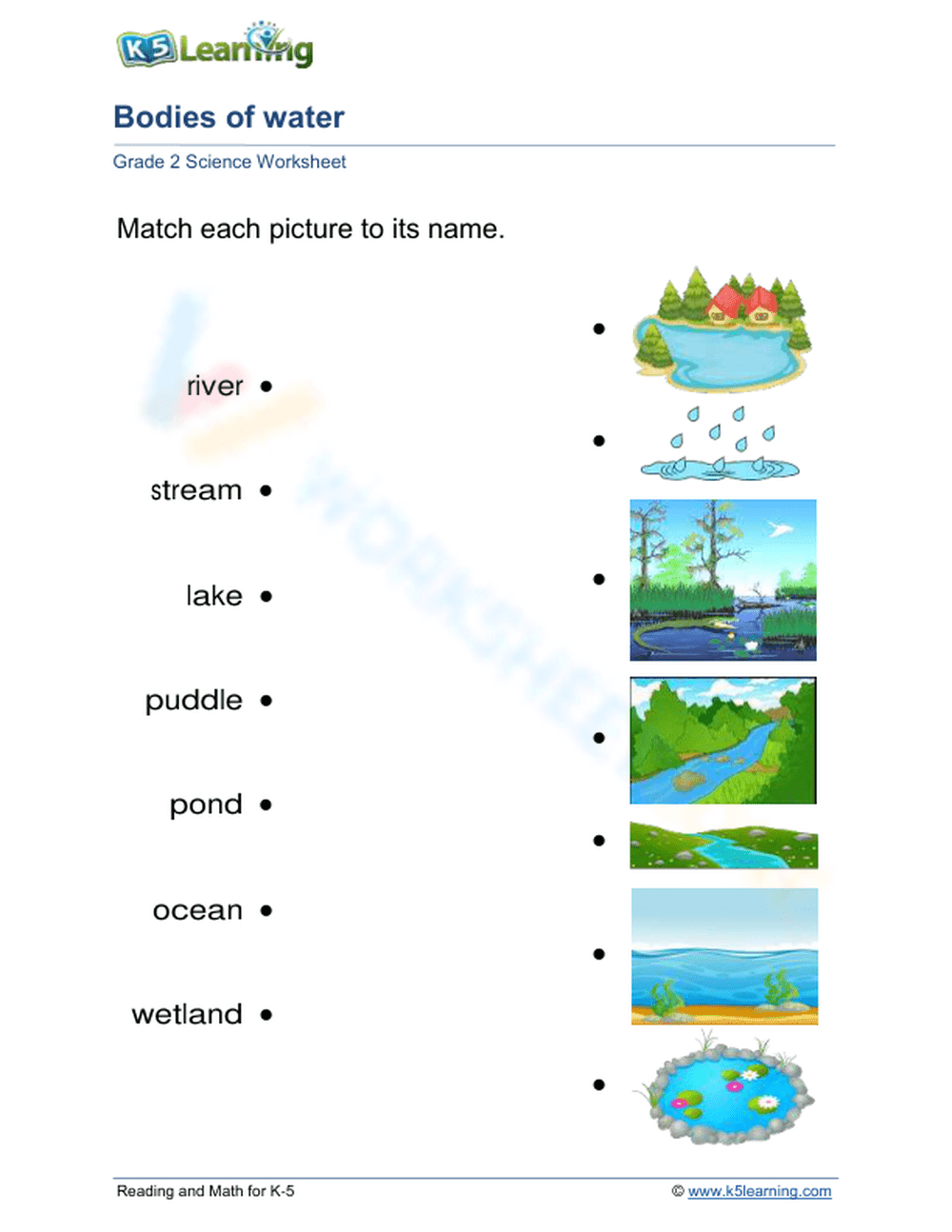
This Grade 2 Earth science worksheet helps students identify and describe different bodies of water through visual matching exercises. By connecting names like "wetland" and "ocean" to realistic illustrations, learners build the foundational vocabulary needed to discuss Earth's hydrosphere. This activity ensures students recognize the physical features that distinguish a river from a lake or a pond.
At a Glance
- Grade: 2 · Subject: Science
- Standard:
2-ESS2-3— Identify where water is found on Earth as solid or liquid- Skill Focus: Identifying bodies of water
- Format: 2 pages · 7 problems · Answer key included · PDF
- Best For: Independent practice or quick formative assessment
- Time: 10–15 minutes
What's Inside
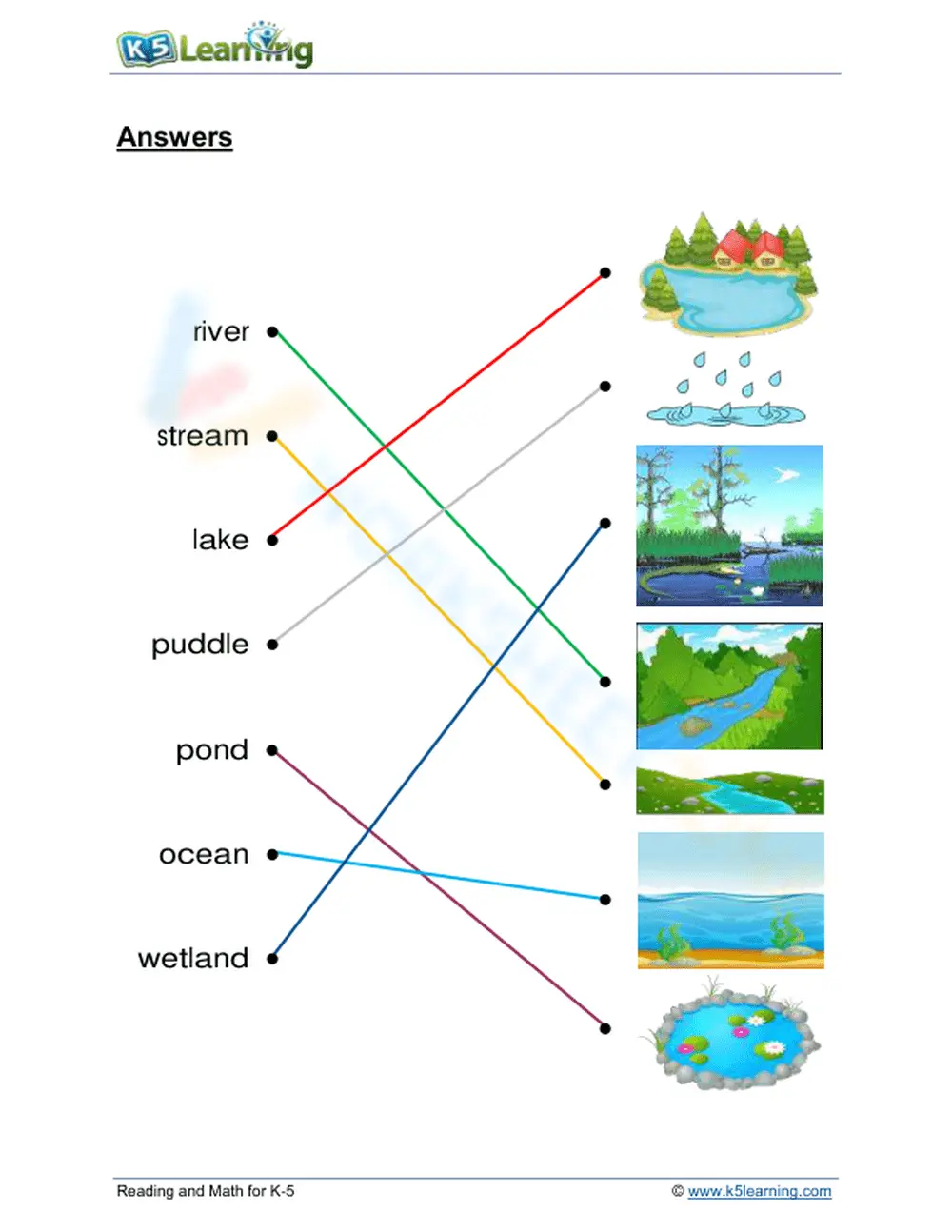
The download includes a two-page PDF featuring a clean, student-friendly layout. The first page presents seven distinct illustrations of water features paired with a column of vocabulary terms including river, stream, lake, puddle, pond, ocean, and wetland. The second page provides a complete answer key with clear lines connecting the correct pairs, making it easy for students to self-correct or for teachers to grade at a glance.
Zero-Prep Workflow
This resource is designed for a seamless, zero-prep classroom workflow that saves valuable instructional time. Simply print the worksheet (30 seconds), distribute it to your students (1 minute), and review the answers using the provided key (5 minutes). Teacher preparation takes under two minutes, making this an ideal selection for emergency sub plans, morning work, or a focused transition activity between science lessons.
Standards Alignment
This activity aligns with Next Generation Science Standard 2-ESS2-3, which requires students to obtain information to identify where water is found on Earth and that it can be solid or liquid. It specifically addresses the identification of liquid water features. This standard code can be copied directly into lesson plans, IEP goals, or district curriculum mapping tools.
How to Use It
Use this worksheet as a concluding activity during a unit on Earth's systems to verify vocabulary acquisition. Alternatively, assign it as a pre-assessment to gauge prior knowledge before beginning direct instruction. During the activity, observe if students can distinguish between moving water (rivers/streams) and still water (ponds/lakes). Completion usually takes 10 to 15 minutes depending on the student's reading level.
Who It's For
This worksheet is perfect for second-grade students or third-graders needing a review of Earth science concepts. It provides excellent support for English Language Learners (ELLs) through its use of clear visual cues paired with tier-three vocabulary. It pairs naturally with a landscape-based anchor chart or a reading passage about the water cycle to deepen conceptual understanding.
The 2-ESS2-3 standard emphasizes the importance of students being able to visually and conceptually identify various bodies of water across Earth's surface. According to the RAND AIRS 2024 report on elementary science literacy, using visual matching tasks helps bridge the gap between abstract geographical terms and their concrete physical representations. This worksheet focuses on the plain-English skill of identifying seven unique water features, providing the necessary repetition for long-term retention. Research from Fisher & Frey (2014) suggests that such scaffolded vocabulary activities are essential for developing the background knowledge required for more complex scientific inquiry. By engaging with these specific task counts and clear illustrations, students demonstrate their ability to categorize natural resources effectively. This resource serves as a reliable tool for classroom teachers to document student mastery of foundational Earth science standards while maintaining a high level of engagement and accessibility.


