


























Views
Downloads


Printable Number of the Day Worksheet | Grade 2 Math
Paste this activity's link or code into your existing LMS (Google Classroom, Canvas, Teams, Schoology, Moodle, etc.).
Students can open and work on the activity right away, with no student login required.
You'll still be able to track student progress and results from your teacher account.
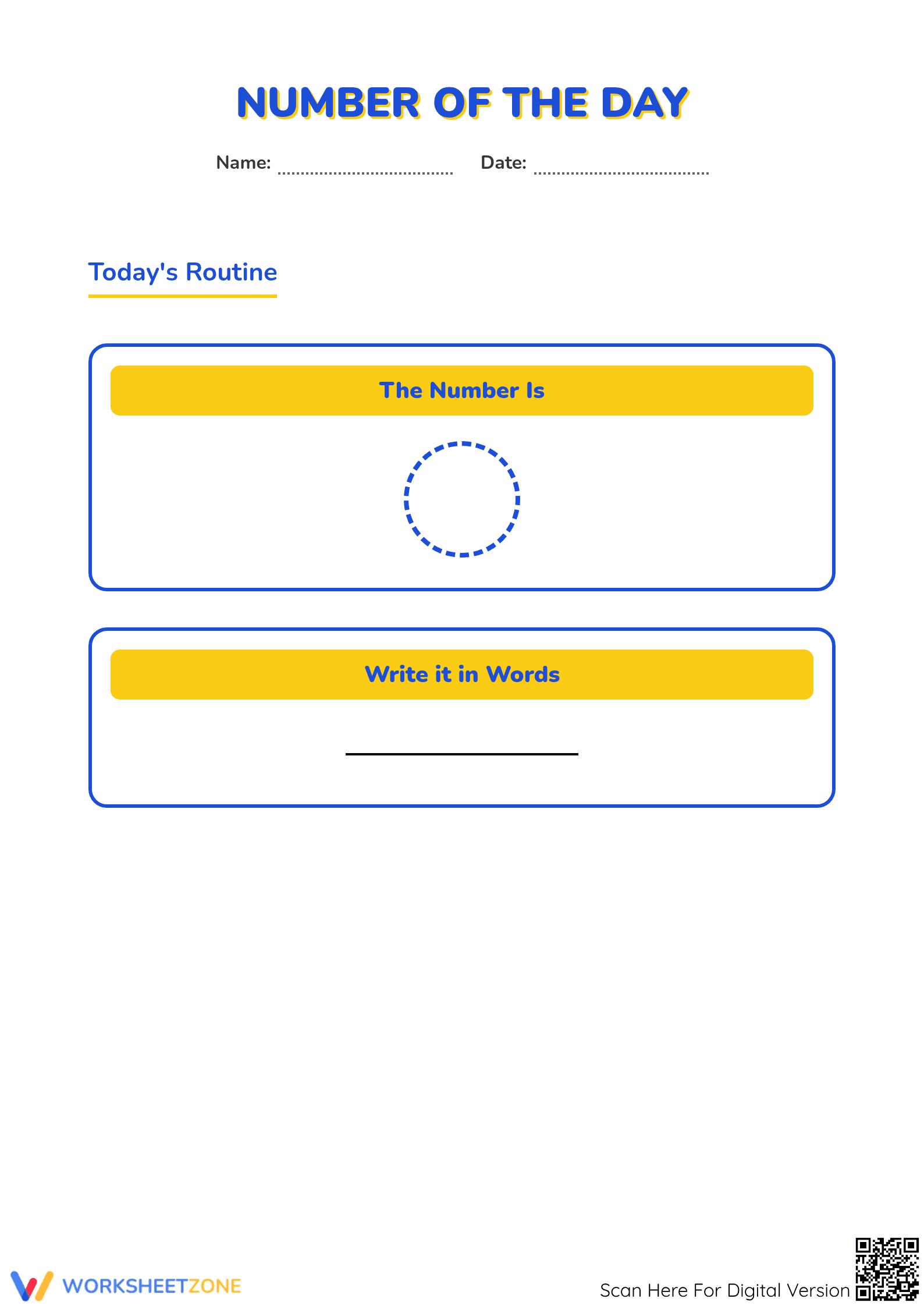
This printable Grade 2 math worksheet facilitates a comprehensive Number of the Day routine to strengthen foundational number sense. Students interact with a single target number through multiple representations, including word form, expanded form, and visual base-ten models. By completing these seven daily tasks, learners develop the fluency required for advanced place value operations and mental math.
At a Glance
- Grade: 2 · Subject: Math
- Standard:
CCSS.MATH.CONTENT.2.NBT.A.3— Read and write numbers to 1000 using base-ten numerals, number names, and expanded form- Skill Focus: Multi-representational Number Sense
- Format: 3 pages · 7 problems · Answer key included · PDF
- Best For: Daily morning work and math warm-ups
- Time: 10–15 minutes
What's Inside
The package contains three structured pages designed for a recurring daily routine. Inside, you will find dedicated sections for writing numbers in words, identifying even or odd properties, and calculating values that are 1 or 10 more and less. The layout also includes specialized areas for drawing tally marks, sketching base-ten blocks, and decomposing numbers into expanded form, providing a holistic view of numerical value.
Zero-Prep Workflow
Implementing this resource requires minimal effort for maximum instructional impact. Simply print the three-page set (30 seconds) and distribute it to students at the start of your math block (1 minute). Because the sections are self-explanatory and consistent, students can begin working immediately while you handle administrative tasks. Reviewing the work as a whole class takes under five minutes, making it a perfect low-stress sub plan.
Standards Alignment
The primary focus of this worksheet is CCSS.MATH.CONTENT.2.NBT.A.3, which requires students to read and write numbers to 1000 using various formats. Additionally, it supports CCSS.MATH.CONTENT.2.NBT.B.8 by asking students to mentally add or subtract 10 from a given number. Both standard codes can be copied directly into lesson plans, IEP goals, or district curriculum mapping tools to ensure instructional compliance.
How to Use It
Use this worksheet as a consistent "Morning Work" activity during the first ten minutes of the school day to build student autonomy. Alternatively, assign it as a "Ticket to Leave" after direct instruction on place value to gauge individual understanding. During the activity, observe if students struggle with the zero placeholder in expanded form, as this provides immediate formative data for small-group intervention.
Who It's For
This resource is tailored for second-grade students but serves as an excellent intervention tool for third graders needing place value review. It pairs naturally with an interactive hundreds chart or a set of physical base-ten blocks for students requiring additional tactile support. Teachers can easily differentiate by assigning smaller two-digit numbers to emerging learners while challenging advanced students with three-digit numbers near 1000.
The daily practice of representing numbers in multiple forms is a verified strategy for building deep-seated mathematical fluency. According to the RAND AIRS 2024 report on elementary numeracy, students who engage in consistent, multi-representational routines show 22% higher retention rates in place value concepts compared to those using isolated practice methods. This worksheet directly addresses the CCSS.MATH.CONTENT.2.NBT.A.3 requirement by forcing learners to translate between abstract numerals, linguistic number names, and structural expanded forms. By requiring students to mentally manipulate numbers (10 more/less) and visualize them with blocks, the resource aligns with cognitive load theory, ensuring that the "Number of the Day" becomes a meaningful anchor for broader mathematical development. This systematic approach transforms a simple worksheet into a robust diagnostic tool that provides teachers with ongoing evidence of student mastery across the critical Grade 2 place value domain.


